

2.4 Spin Accumulation
43
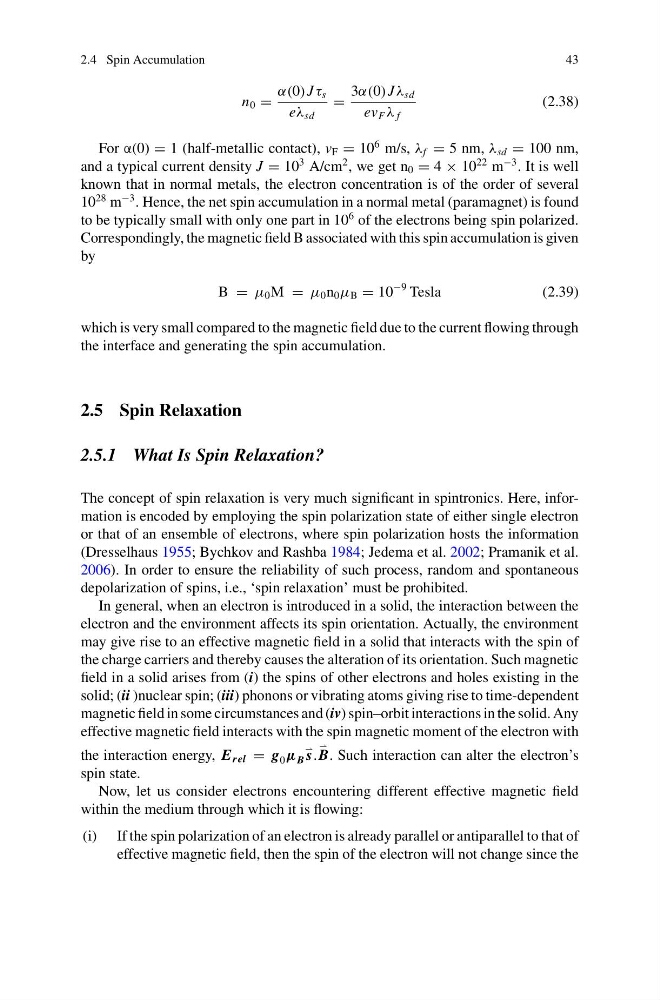
n 0 =
α(0)J τ s
eλ sd
=
3α(0)J λ sd
ev F λ f
(2.38)
For α(0) = 1 (half-metallic contact), v F = 10
6 m/s, λ f = 5 nm, λ sd = 100 nm,
and a typical current density J = 10
3 A/cm
2 , we get n 0 = 4 × 10
22 m
−3 . It is well
known that in normal metals, the electron concentration is of the order of several
10
28 m
−3 . Hence, the net spin accumulation in a normal metal (paramagnet) is found
to be typically small with only one part in 10
6 of the electrons being spin polarized.
Correspondingly, the magnetic field B associated with this spin accumulation is given
by
B = μ 0 M = μ 0 n 0 μ B = 10
−9 Tesla
(2.39)
which is very small compared to the magnetic field due to the current flowing through
the interface and generating the spin accumulation.
2.5 Spin Relaxation
2.5.1 What Is Spin Relaxation?
The concept of spin relaxation is very much significant in spintronics. Here, information is encoded by employing the spin polarization state of either single electron
or that of an ensemble of electrons, where spin polarization hosts the information
(Dresselhaus 1955; Bychkov and Rashba 1984; Jedema et al. 2002; Pramanik et al.
2006). In order to ensure the reliability of such process, random and spontaneous
depolarization of spins, i.e., ‘spin relaxation’ must be prohibited.
In general, when an electron is introduced in a solid, the interaction between the
electron and the environment affects its spin orientation. Actually, the environment
may give rise to an effective magnetic field in a solid that interacts with the spin of
the charge carriers and thereby causes the alteration of its orientation. Such magnetic
field in a solid arises from (i) the spins of other electrons and holes existing in the
solid; (ii )nuclear spin; (iii) phonons or vibrating atoms giving rise to time-dependent
magnetic field in some circumstances and (iv) spin–orbit interactions in the solid. Any
effective magnetic field interacts with the spin magnetic moment of the electron with
the interaction energy, E rel = g 0 μ B
s.
B. Such interaction can alter the electron’s
spin state.
Now, let us consider electrons encountering different effective magnetic field
within the medium through which it is flowing:
(i) If the spin polarization of an electron is already parallel or antiparallel to that of
effective magnetic field, then the spin of the electron will not change since the
43
n 0 =
α(0)J τ s
eλ sd
=
3α(0)J λ sd
ev F λ f
(2.38)
For α(0) = 1 (half-metallic contact), v F = 10
6 m/s, λ f = 5 nm, λ sd = 100 nm,
and a typical current density J = 10
3 A/cm
2 , we get n 0 = 4 × 10
22 m
−3 . It is well
known that in normal metals, the electron concentration is of the order of several
10
28 m
−3 . Hence, the net spin accumulation in a normal metal (paramagnet) is found
to be typically small with only one part in 10
6 of the electrons being spin polarized.
Correspondingly, the magnetic field B associated with this spin accumulation is given
by
B = μ 0 M = μ 0 n 0 μ B = 10
−9 Tesla
(2.39)
which is very small compared to the magnetic field due to the current flowing through
the interface and generating the spin accumulation.
2.5 Spin Relaxation
2.5.1 What Is Spin Relaxation?
The concept of spin relaxation is very much significant in spintronics. Here, information is encoded by employing the spin polarization state of either single electron
or that of an ensemble of electrons, where spin polarization hosts the information
(Dresselhaus 1955; Bychkov and Rashba 1984; Jedema et al. 2002; Pramanik et al.
2006). In order to ensure the reliability of such process, random and spontaneous
depolarization of spins, i.e., ‘spin relaxation’ must be prohibited.
In general, when an electron is introduced in a solid, the interaction between the
electron and the environment affects its spin orientation. Actually, the environment
may give rise to an effective magnetic field in a solid that interacts with the spin of
the charge carriers and thereby causes the alteration of its orientation. Such magnetic
field in a solid arises from (i) the spins of other electrons and holes existing in the
solid; (ii )nuclear spin; (iii) phonons or vibrating atoms giving rise to time-dependent
magnetic field in some circumstances and (iv) spin–orbit interactions in the solid. Any
effective magnetic field interacts with the spin magnetic moment of the electron with
the interaction energy, E rel = g 0 μ B
s.
B. Such interaction can alter the electron’s
spin state.
Now, let us consider electrons encountering different effective magnetic field
within the medium through which it is flowing:
(i) If the spin polarization of an electron is already parallel or antiparallel to that of
effective magnetic field, then the spin of the electron will not change since the