

40
2 Basic Elements of Spintronics
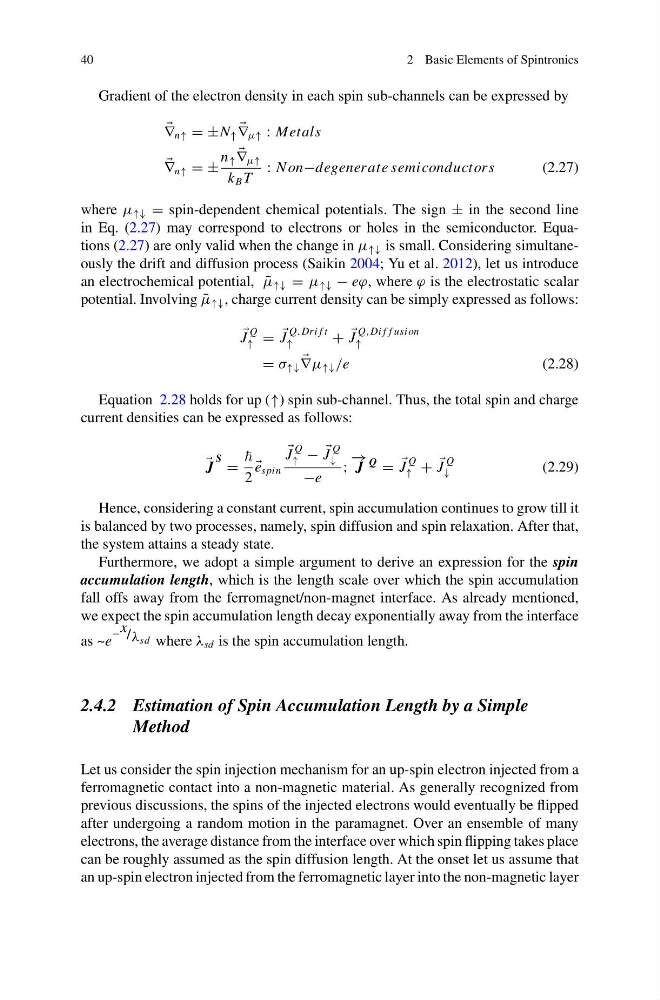
Gradient of the electron density in each spin sub-channels can be expressed by
∇ n↑ = ±N ↑
∇ μ↑ : Metals
∇ n↑ = ±
n ↑
∇ μ↑
k B T
: N on−degenerate semiconductors
(2.27)
where μ ↑↓ = spin-dependent chemical potentials. The sign ± in the second line
in Eq. (2.27) may correspond to electrons or holes in the semiconductor. Equations (2.27) are only valid when the change in μ ↑↓ is small. Considering simultaneously the drift and diffusion process (Saikin 2004; Yu et al. 2012), let us introduce
an electrochemical potential, ¯
μ ↑↓ = μ ↑↓ − eϕ, where ϕ is the electrostatic scalar
potential. Involving ¯
μ ↑↓ , charge current density can be simply expressed as follows:
J
Q
↑ =
J
Q,Dri f t
↑
+
J
Q,Di f f usion
↑
= σ ↑↓
∇μ ↑↓ /e
(2.28)
Equation 2.28 holds for up (↑) spin sub-channel. Thus, the total spin and charge
current densities can be expressed as follows:
J
S =
2
e spin
J
Q
↑ −
J
Q
↓
−e
;
− →
J
Q
=
J
Q
↑ +
J
Q
↓
(2.29)
Hence, considering a constant current, spin accumulation continues to grow till it
is balanced by two processes, namely, spin diffusion and spin relaxation. After that,
the system attains a steady state.
Furthermore, we adopt a simple argument to derive an expression for the spin
accumulation length, which is the length scale over which the spin accumulation
fall offs away from the ferromagnet/non-magnet interface. As already mentioned,
we expect the spin accumulation length decay exponentially away from the interface
as ~e
− x / λ sd where λ sd is the spin accumulation length.
2.4.2 Estimation of Spin Accumulation Length by a Simple
Method
Let us consider the spin injection mechanism for an up-spin electron injected from a
ferromagnetic contact into a non-magnetic material. As generally recognized from
previous discussions, the spins of the injected electrons would eventually be flipped
after undergoing a random motion in the paramagnet. Over an ensemble of many
electrons, the average distance from the interface over which spin flipping takes place
can be roughly assumed as the spin diffusion length. At the onset let us assume that
an up-spin electron injected from the ferromagnetic layer into the non-magnetic layer
2 Basic Elements of Spintronics
Gradient of the electron density in each spin sub-channels can be expressed by
∇ n↑ = ±N ↑
∇ μ↑ : Metals
∇ n↑ = ±
n ↑
∇ μ↑
k B T
: N on−degenerate semiconductors
(2.27)
where μ ↑↓ = spin-dependent chemical potentials. The sign ± in the second line
in Eq. (2.27) may correspond to electrons or holes in the semiconductor. Equations (2.27) are only valid when the change in μ ↑↓ is small. Considering simultaneously the drift and diffusion process (Saikin 2004; Yu et al. 2012), let us introduce
an electrochemical potential, ¯
μ ↑↓ = μ ↑↓ − eϕ, where ϕ is the electrostatic scalar
potential. Involving ¯
μ ↑↓ , charge current density can be simply expressed as follows:
J
Q
↑ =
J
Q,Dri f t
↑
+
J
Q,Di f f usion
↑
= σ ↑↓
∇μ ↑↓ /e
(2.28)
Equation 2.28 holds for up (↑) spin sub-channel. Thus, the total spin and charge
current densities can be expressed as follows:
J
S =
2
e spin
J
Q
↑ −
J
Q
↓
−e
;
− →
J
Q
=
J
Q
↑ +
J
Q
↓
(2.29)
Hence, considering a constant current, spin accumulation continues to grow till it
is balanced by two processes, namely, spin diffusion and spin relaxation. After that,
the system attains a steady state.
Furthermore, we adopt a simple argument to derive an expression for the spin
accumulation length, which is the length scale over which the spin accumulation
fall offs away from the ferromagnet/non-magnet interface. As already mentioned,
we expect the spin accumulation length decay exponentially away from the interface
as ~e
− x / λ sd where λ sd is the spin accumulation length.
2.4.2 Estimation of Spin Accumulation Length by a Simple
Method
Let us consider the spin injection mechanism for an up-spin electron injected from a
ferromagnetic contact into a non-magnetic material. As generally recognized from
previous discussions, the spins of the injected electrons would eventually be flipped
after undergoing a random motion in the paramagnet. Over an ensemble of many
electrons, the average distance from the interface over which spin flipping takes place
can be roughly assumed as the spin diffusion length. At the onset let us assume that
an up-spin electron injected from the ferromagnetic layer into the non-magnetic layer