

38
2 Basic Elements of Spintronics
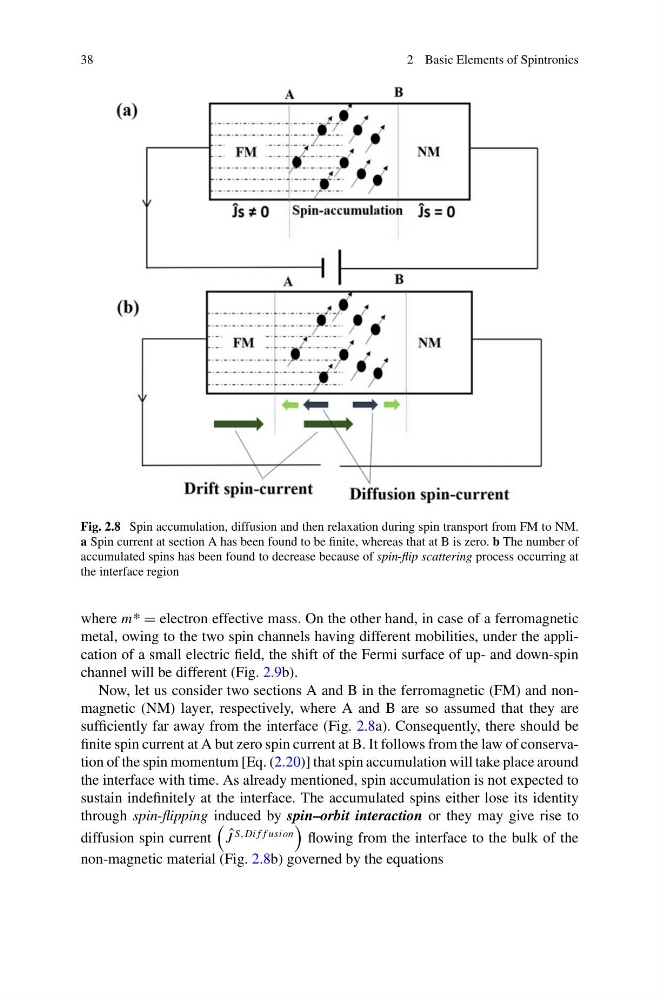
Fig. 2.8 Spin accumulation, diffusion and then relaxation during spin transport from FM to NM.
a Spin current at section A has been found to be finite, whereas that at B is zero. b The number of
accumulated spins has been found to decrease because of spin-flip scattering process occurring at
the interface region
where m* = electron effective mass. On the other hand, in case of a ferromagnetic
metal, owing to the two spin channels having different mobilities, under the application of a small electric field, the shift of the Fermi surface of up- and down-spin
channel will be different (Fig. 2.9b).
Now, let us consider two sections A and B in the ferromagnetic (FM) and nonmagnetic (NM) layer, respectively, where A and B are so assumed that they are
sufficiently far away from the interface (Fig. 2.8a). Consequently, there should be
finite spin current at A but zero spin current at B. It follows from the law of conservation of the spin momentum [Eq. (2.20)] that spin accumulation will take place around
the interface with time. As already mentioned, spin accumulation is not expected to
sustain indefinitely at the interface. The accumulated spins either lose its identity
through spin-flipping induced by spin–orbit interaction or they may give rise to
diffusion spin current
ˆ
J
S,Di f f usion
flowing from the interface to the bulk of the
non-magnetic material (Fig. 2.8b) governed by the equations
2 Basic Elements of Spintronics
Fig. 2.8 Spin accumulation, diffusion and then relaxation during spin transport from FM to NM.
a Spin current at section A has been found to be finite, whereas that at B is zero. b The number of
accumulated spins has been found to decrease because of spin-flip scattering process occurring at
the interface region
where m* = electron effective mass. On the other hand, in case of a ferromagnetic
metal, owing to the two spin channels having different mobilities, under the application of a small electric field, the shift of the Fermi surface of up- and down-spin
channel will be different (Fig. 2.9b).
Now, let us consider two sections A and B in the ferromagnetic (FM) and nonmagnetic (NM) layer, respectively, where A and B are so assumed that they are
sufficiently far away from the interface (Fig. 2.8a). Consequently, there should be
finite spin current at A but zero spin current at B. It follows from the law of conservation of the spin momentum [Eq. (2.20)] that spin accumulation will take place around
the interface with time. As already mentioned, spin accumulation is not expected to
sustain indefinitely at the interface. The accumulated spins either lose its identity
through spin-flipping induced by spin–orbit interaction or they may give rise to
diffusion spin current
ˆ
J
S,Di f f usion
flowing from the interface to the bulk of the
non-magnetic material (Fig. 2.8b) governed by the equations