

2.3 Spin Generation and Injection
35
Electron
FM 1
FM 2
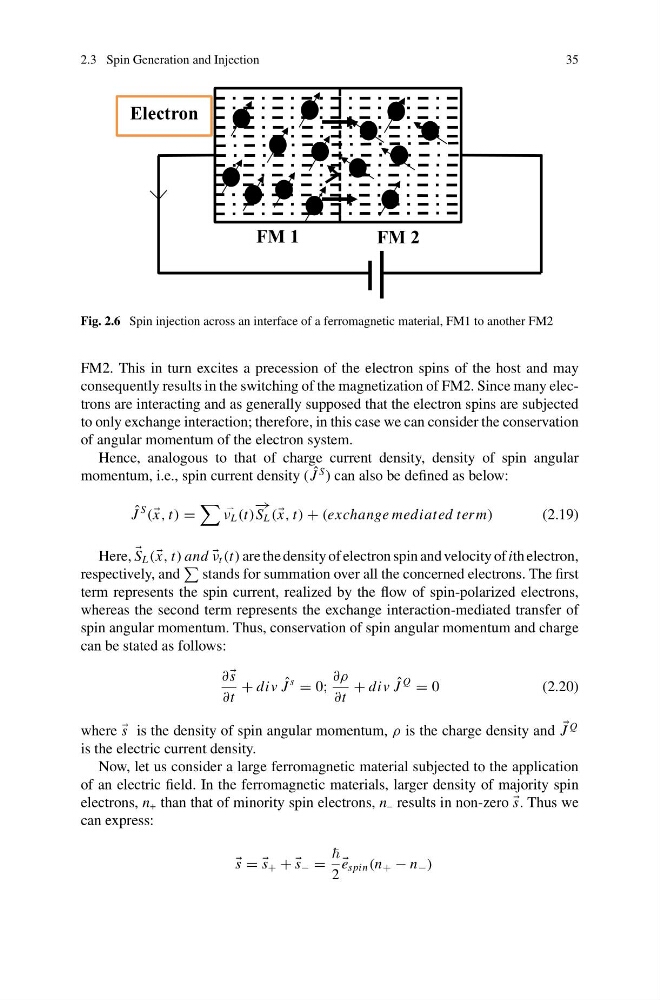
Fig. 2.6 Spin injection across an interface of a ferromagnetic material, FM1 to another FM2
FM2. This in turn excites a precession of the electron spins of the host and may
consequently results in the switching of the magnetization of FM2. Since many electrons are interacting and as generally supposed that the electron spins are subjected
to only exchange interaction; therefore, in this case we can consider the conservation
of angular momentum of the electron system.
Hence, analogous to that of charge current density, density of spin angular
momentum, i.e., spin current density ( ˆ
J
S ) can also be defined as below:
ˆ
J
S
( x, t) =
ν L (t)
− →
S L ( x, t) + (exchange mediated term)
(2.19)
Here,
S L ( x, t) and
ν t (t) are the density of electron spin and velocity of ith electron,
respectively, and
stands for summation over all the concerned electrons. The first
term represents the spin current, realized by the flow of spin-polarized electrons,
whereas the second term represents the exchange interaction-mediated transfer of
spin angular momentum. Thus, conservation of spin angular momentum and charge
can be stated as follows:
∂ s
∂t
+ div ˆ
J
s
= 0;
∂ρ
∂t
+ div ˆ
J
Q
= 0
(2.20)
where
s is the density of spin angular momentum, ρ is the charge density and
J
Q
is the electric current density.
Now, let us consider a large ferromagnetic material subjected to the application
of an electric field. In the ferromagnetic materials, larger density of majority spin
electrons, n + than that of minority spin electrons, n – results in non-zero
s. Thus we
can express:
s = =
s + + +
s − =
2
e spin (n + − n − )
35
Electron
FM 1
FM 2
Fig. 2.6 Spin injection across an interface of a ferromagnetic material, FM1 to another FM2
FM2. This in turn excites a precession of the electron spins of the host and may
consequently results in the switching of the magnetization of FM2. Since many electrons are interacting and as generally supposed that the electron spins are subjected
to only exchange interaction; therefore, in this case we can consider the conservation
of angular momentum of the electron system.
Hence, analogous to that of charge current density, density of spin angular
momentum, i.e., spin current density ( ˆ
J
S ) can also be defined as below:
ˆ
J
S
( x, t) =
ν L (t)
− →
S L ( x, t) + (exchange mediated term)
(2.19)
Here,
S L ( x, t) and
ν t (t) are the density of electron spin and velocity of ith electron,
respectively, and
stands for summation over all the concerned electrons. The first
term represents the spin current, realized by the flow of spin-polarized electrons,
whereas the second term represents the exchange interaction-mediated transfer of
spin angular momentum. Thus, conservation of spin angular momentum and charge
can be stated as follows:
∂ s
∂t
+ div ˆ
J
s
= 0;
∂ρ
∂t
+ div ˆ
J
Q
= 0
(2.20)
where
s is the density of spin angular momentum, ρ is the charge density and
J
Q
is the electric current density.
Now, let us consider a large ferromagnetic material subjected to the application
of an electric field. In the ferromagnetic materials, larger density of majority spin
electrons, n + than that of minority spin electrons, n – results in non-zero
s. Thus we
can express:
s = =
s + + +
s − =
2
e spin (n + − n − )