

2.3 Spin Generation and Injection
33
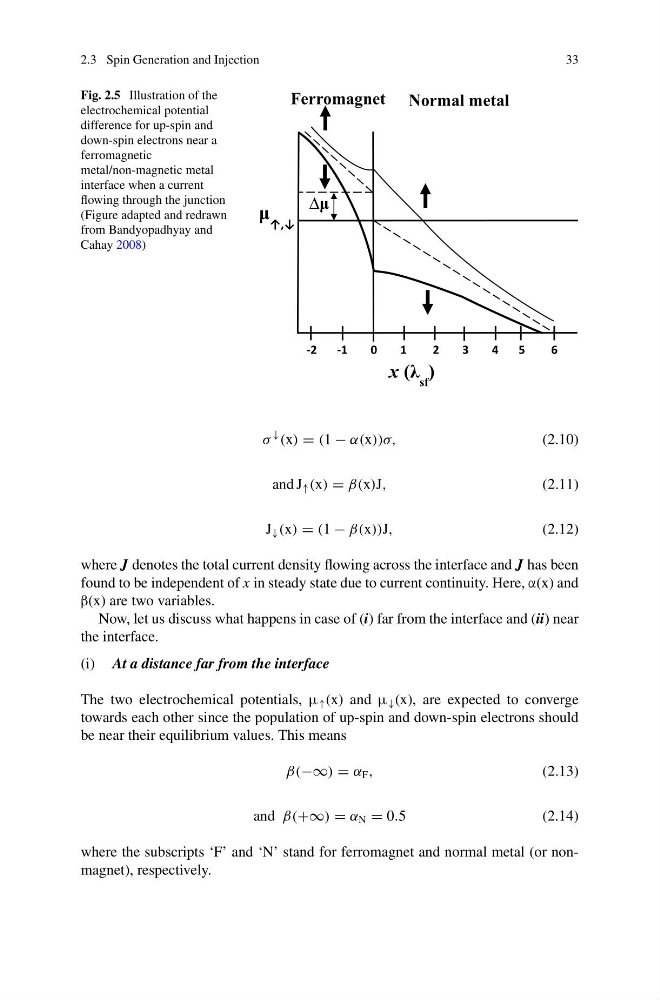
Fig. 2.5 Illustration of the
electrochemical potential
difference for up-spin and
down-spin electrons near a
ferromagnetic
metal/non-magnetic metal
interface when a current
flowing through the junction
(Figure adapted and redrawn
from Bandyopadhyay and
Cahay 2008)
-2
-1
0
1
2
3
4
5
6
Ferromagnet Normal metal
x (λ
sf
)
μ ↑,↓
∆μ
σ
↓
(x) = (1 − α(x))σ,
(2.10)
and J ↑ (x) = β(x)J,
(2.11)
J ↓ (x) = (1 − β(x))J,
(2.12)
where J denotes the total current density flowing across the interface and J has been
found to be independent of x in steady state due to current continuity. Here, α(x) and
β(x) are two variables.
Now, let us discuss what happens in case of (i) far from the interface and (ii) near
the interface.
(i) At a distance far from the interface
The two electrochemical potentials, μ ↑ (x) and μ ↓ (x), are expected to converge
towards each other since the population of up-spin and down-spin electrons should
be near their equilibrium values. This means
β(−∞) = α F ,
(2.13)
and β(+∞) = α N = 0.5
(2.14)
where the subscripts ‘F’ and ‘N’ stand for ferromagnet and normal metal (or nonmagnet), respectively.
33
Fig. 2.5 Illustration of the
electrochemical potential
difference for up-spin and
down-spin electrons near a
ferromagnetic
metal/non-magnetic metal
interface when a current
flowing through the junction
(Figure adapted and redrawn
from Bandyopadhyay and
Cahay 2008)
-2
-1
0
1
2
3
4
5
6
Ferromagnet Normal metal
x (λ
sf
)
μ ↑,↓
∆μ
σ
↓
(x) = (1 − α(x))σ,
(2.10)
and J ↑ (x) = β(x)J,
(2.11)
J ↓ (x) = (1 − β(x))J,
(2.12)
where J denotes the total current density flowing across the interface and J has been
found to be independent of x in steady state due to current continuity. Here, α(x) and
β(x) are two variables.
Now, let us discuss what happens in case of (i) far from the interface and (ii) near
the interface.
(i) At a distance far from the interface
The two electrochemical potentials, μ ↑ (x) and μ ↓ (x), are expected to converge
towards each other since the population of up-spin and down-spin electrons should
be near their equilibrium values. This means
β(−∞) = α F ,
(2.13)
and β(+∞) = α N = 0.5
(2.14)
where the subscripts ‘F’ and ‘N’ stand for ferromagnet and normal metal (or nonmagnet), respectively.