

1.9 Different Branches of Spintronics
19
1.9.2 Branching Based on Magnetic Manipulation
Efficient manipulation of magnetic state of a material is most important for the development of spintronics devices. In this regard, four main methods (magnetic, strain,
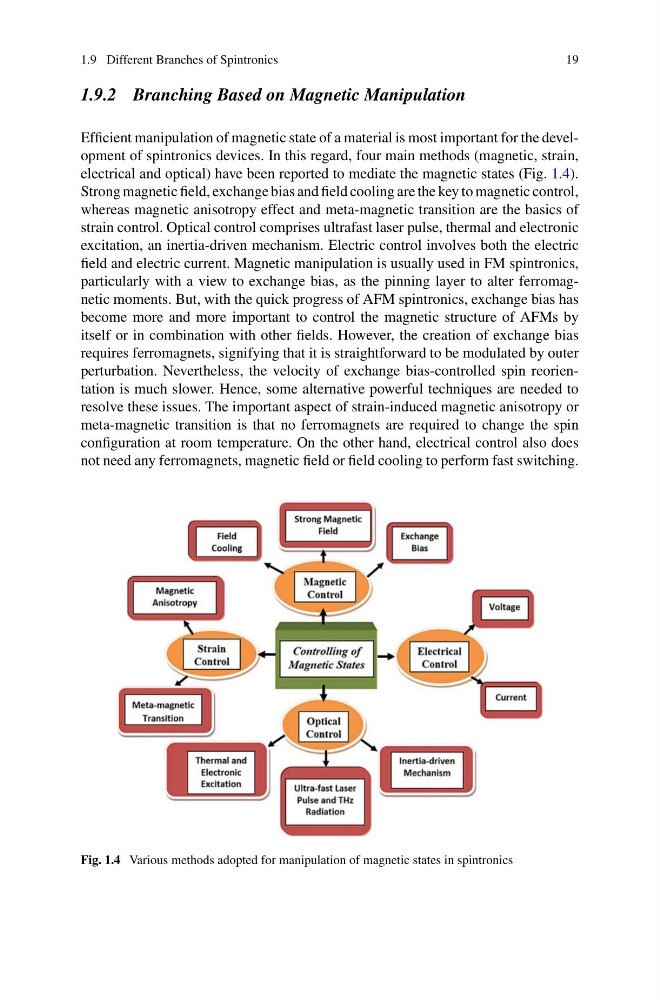
electrical and optical) have been reported to mediate the magnetic states (Fig. 1.4).
Strong magnetic field, exchange bias and field cooling are the key to magnetic control,
whereas magnetic anisotropy effect and meta-magnetic transition are the basics of
strain control. Optical control comprises ultrafast laser pulse, thermal and electronic
excitation, an inertia-driven mechanism. Electric control involves both the electric
field and electric current. Magnetic manipulation is usually used in FM spintronics,
particularly with a view to exchange bias, as the pinning layer to alter ferromagnetic moments. But, with the quick progress of AFM spintronics, exchange bias has
become more and more important to control the magnetic structure of AFMs by
itself or in combination with other fields. However, the creation of exchange bias
requires ferromagnets, signifying that it is straightforward to be modulated by outer
perturbation. Nevertheless, the velocity of exchange bias-controlled spin reorientation is much slower. Hence, some alternative powerful techniques are needed to
resolve these issues. The important aspect of strain-induced magnetic anisotropy or
meta-magnetic transition is that no ferromagnets are required to change the spin
configuration at room temperature. On the other hand, electrical control also does
not need any ferromagnets, magnetic field or field cooling to perform fast switching.
Fig. 1.4 Various methods adopted for manipulation of magnetic states in spintronics
19
1.9.2 Branching Based on Magnetic Manipulation
Efficient manipulation of magnetic state of a material is most important for the development of spintronics devices. In this regard, four main methods (magnetic, strain,
electrical and optical) have been reported to mediate the magnetic states (Fig. 1.4).
Strong magnetic field, exchange bias and field cooling are the key to magnetic control,
whereas magnetic anisotropy effect and meta-magnetic transition are the basics of
strain control. Optical control comprises ultrafast laser pulse, thermal and electronic
excitation, an inertia-driven mechanism. Electric control involves both the electric
field and electric current. Magnetic manipulation is usually used in FM spintronics,
particularly with a view to exchange bias, as the pinning layer to alter ferromagnetic moments. But, with the quick progress of AFM spintronics, exchange bias has
become more and more important to control the magnetic structure of AFMs by
itself or in combination with other fields. However, the creation of exchange bias
requires ferromagnets, signifying that it is straightforward to be modulated by outer
perturbation. Nevertheless, the velocity of exchange bias-controlled spin reorientation is much slower. Hence, some alternative powerful techniques are needed to
resolve these issues. The important aspect of strain-induced magnetic anisotropy or
meta-magnetic transition is that no ferromagnets are required to change the spin
configuration at room temperature. On the other hand, electrical control also does
not need any ferromagnets, magnetic field or field cooling to perform fast switching.
Fig. 1.4 Various methods adopted for manipulation of magnetic states in spintronics