

262
10 Spintronics Applications
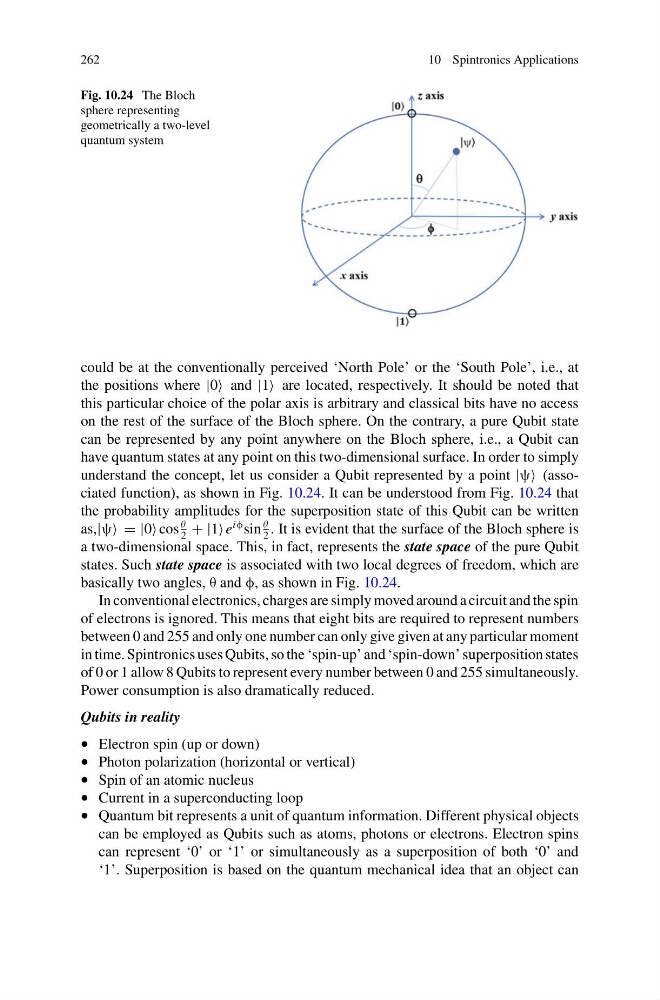
Fig. 10.24 The Bloch
sphere representing
geometrically a two-level
quantum system
could be at the conventionally perceived ‘North Pole’ or the ‘South Pole’, i.e., at
the positions where |0 and |1 are located, respectively. It should be noted that
this particular choice of the polar axis is arbitrary and classical bits have no access
on the rest of the surface of the Bloch sphere. On the contrary, a pure Qubit state
can be represented by any point anywhere on the Bloch sphere, i.e., a Qubit can
have quantum states at any point on this two-dimensional surface. In order to simply
understand the concept, let us consider a Qubit represented by a point |ψ (associated function), as shown in Fig. 10.24. It can be understood from Fig. 10.24 that
the probability amplitudes for the superposition state of this Qubit can be written
as,|ψ = |0 cos
θ
2
+ |1 e
iφ sin
θ
2
. It is evident that the surface of the Bloch sphere is
a two-dimensional space. This, in fact, represents the state space of the pure Qubit
states. Such state space is associated with two local degrees of freedom, which are
basically two angles, θ and φ, as shown in Fig. 10.24.
In conventional electronics, charges are simply moved around a circuit and the spin
of electrons is ignored. This means that eight bits are required to represent numbers
between 0 and 255 and only one number can only give given at any particular moment
in time. Spintronics uses Qubits, so the ‘spin-up’ and ‘spin-down’ superposition states
of 0 or 1 allow 8 Qubits to represent every number between 0 and 255 simultaneously.
Power consumption is also dramatically reduced.
Qubits in reality
• Electron spin (up or down)
• Photon polarization (horizontal or vertical)
• Spin of an atomic nucleus
• Current in a superconducting loop
• Quantum bit represents a unit of quantum information. Different physical objects
can be employed as Qubits such as atoms, photons or electrons. Electron spins
can represent ‘0’ or ‘1’ or simultaneously as a superposition of both ‘0’ and
‘1’. Superposition is based on the quantum mechanical idea that an object can
10 Spintronics Applications
Fig. 10.24 The Bloch
sphere representing
geometrically a two-level
quantum system
could be at the conventionally perceived ‘North Pole’ or the ‘South Pole’, i.e., at
the positions where |0 and |1 are located, respectively. It should be noted that
this particular choice of the polar axis is arbitrary and classical bits have no access
on the rest of the surface of the Bloch sphere. On the contrary, a pure Qubit state
can be represented by any point anywhere on the Bloch sphere, i.e., a Qubit can
have quantum states at any point on this two-dimensional surface. In order to simply
understand the concept, let us consider a Qubit represented by a point |ψ (associated function), as shown in Fig. 10.24. It can be understood from Fig. 10.24 that
the probability amplitudes for the superposition state of this Qubit can be written
as,|ψ = |0 cos
θ
2
+ |1 e
iφ sin
θ
2
. It is evident that the surface of the Bloch sphere is
a two-dimensional space. This, in fact, represents the state space of the pure Qubit
states. Such state space is associated with two local degrees of freedom, which are
basically two angles, θ and φ, as shown in Fig. 10.24.
In conventional electronics, charges are simply moved around a circuit and the spin
of electrons is ignored. This means that eight bits are required to represent numbers
between 0 and 255 and only one number can only give given at any particular moment
in time. Spintronics uses Qubits, so the ‘spin-up’ and ‘spin-down’ superposition states
of 0 or 1 allow 8 Qubits to represent every number between 0 and 255 simultaneously.
Power consumption is also dramatically reduced.
Qubits in reality
• Electron spin (up or down)
• Photon polarization (horizontal or vertical)
• Spin of an atomic nucleus
• Current in a superconducting loop
• Quantum bit represents a unit of quantum information. Different physical objects
can be employed as Qubits such as atoms, photons or electrons. Electron spins
can represent ‘0’ or ‘1’ or simultaneously as a superposition of both ‘0’ and
‘1’. Superposition is based on the quantum mechanical idea that an object can