

10.1 Overview
225
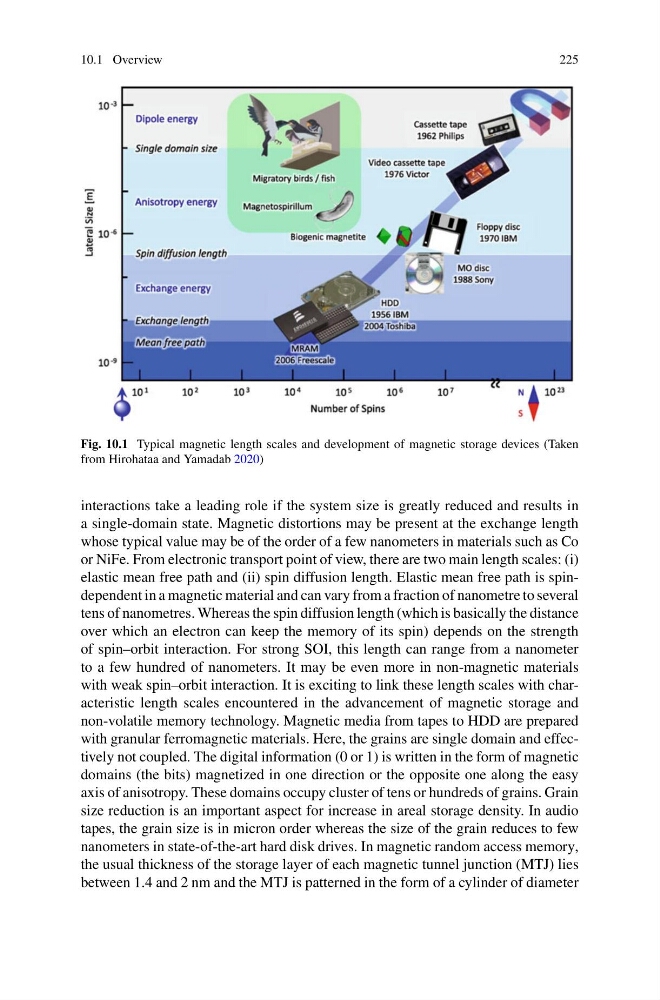
Fig. 10.1 Typical magnetic length scales and development of magnetic storage devices (Taken
from Hirohataa and Yamadab 2020)
interactions take a leading role if the system size is greatly reduced and results in
a single-domain state. Magnetic distortions may be present at the exchange length
whose typical value may be of the order of a few nanometers in materials such as Co
or NiFe. From electronic transport point of view, there are two main length scales: (i)
elastic mean free path and (ii) spin diffusion length. Elastic mean free path is spindependent in a magnetic material and can vary from a fraction of nanometre to several
tens of nanometres. Whereas the spin diffusion length (which is basically the distance
over which an electron can keep the memory of its spin) depends on the strength
of spin–orbit interaction. For strong SOI, this length can range from a nanometer
to a few hundred of nanometers. It may be even more in non-magnetic materials
with weak spin–orbit interaction. It is exciting to link these length scales with characteristic length scales encountered in the advancement of magnetic storage and
non-volatile memory technology. Magnetic media from tapes to HDD are prepared
with granular ferromagnetic materials. Here, the grains are single domain and effectively not coupled. The digital information (0 or 1) is written in the form of magnetic
domains (the bits) magnetized in one direction or the opposite one along the easy
axis of anisotropy. These domains occupy cluster of tens or hundreds of grains. Grain
size reduction is an important aspect for increase in areal storage density. In audio
tapes, the grain size is in micron order whereas the size of the grain reduces to few
nanometers in state-of-the-art hard disk drives. In magnetic random access memory,
the usual thickness of the storage layer of each magnetic tunnel junction (MTJ) lies
between 1.4 and 2 nm and the MTJ is patterned in the form of a cylinder of diameter
225
Fig. 10.1 Typical magnetic length scales and development of magnetic storage devices (Taken
from Hirohataa and Yamadab 2020)
interactions take a leading role if the system size is greatly reduced and results in
a single-domain state. Magnetic distortions may be present at the exchange length
whose typical value may be of the order of a few nanometers in materials such as Co
or NiFe. From electronic transport point of view, there are two main length scales: (i)
elastic mean free path and (ii) spin diffusion length. Elastic mean free path is spindependent in a magnetic material and can vary from a fraction of nanometre to several
tens of nanometres. Whereas the spin diffusion length (which is basically the distance
over which an electron can keep the memory of its spin) depends on the strength
of spin–orbit interaction. For strong SOI, this length can range from a nanometer
to a few hundred of nanometers. It may be even more in non-magnetic materials
with weak spin–orbit interaction. It is exciting to link these length scales with characteristic length scales encountered in the advancement of magnetic storage and
non-volatile memory technology. Magnetic media from tapes to HDD are prepared
with granular ferromagnetic materials. Here, the grains are single domain and effectively not coupled. The digital information (0 or 1) is written in the form of magnetic
domains (the bits) magnetized in one direction or the opposite one along the easy
axis of anisotropy. These domains occupy cluster of tens or hundreds of grains. Grain
size reduction is an important aspect for increase in areal storage density. In audio
tapes, the grain size is in micron order whereas the size of the grain reduces to few
nanometers in state-of-the-art hard disk drives. In magnetic random access memory,
the usual thickness of the storage layer of each magnetic tunnel junction (MTJ) lies
between 1.4 and 2 nm and the MTJ is patterned in the form of a cylinder of diameter