

2
1 An Overview of Spintronics
Alternatively, those two states were also realized by keeping two distinct voltage
levels at some circuit. Such charge-based logic bits could be processed by incorporating switching devices, like metal oxide semiconductor field effect transistors
(MOSFETs) in a circuit. In contrast, spintronics intends to exploit the spin property of charge carriers rather than charge to generate the desired outcome, namely,
core information processing and storage functionalities. Both the approaches, i.e., (i)
addition of spin degree of freedom to conventional charge-based electronic devices
and (ii) sole incorporation of the spin property, have certain potential advantages like
non-volatility, enhanced data processing speed, reduced consumption of electrical
power and much improved integration densities, compared to conventional semiconductor devices. From the late twentieth century, such inclusion of spin, alone or in
conjunction with charge, has been extensively exploited to process and store digital
information encoded by the binary bits 0 and 1. The branch of spintronics in which
there is no direct role of charge and encoding of information is done completely in the
spin polarization, i.e., spin-up and spin-down states of electrons, is called as monolithic spintronics. In effect, spintronics, also known as ‘magnetoelectronics’, has
become an emergent technology for various applications such as storing, encoding,
accessing, processing and transmitting of information in some manner.
1.1.1 What Is Spintronics?
• Spintronics is an emerging technology that exploits both the intrinsic spin of the
electron and its associated magnetic moment.
• Spin is the intrinsic angular momentum of the negatively charge electron.
• Depending on the direction of spinning of electron, either in clockwise and
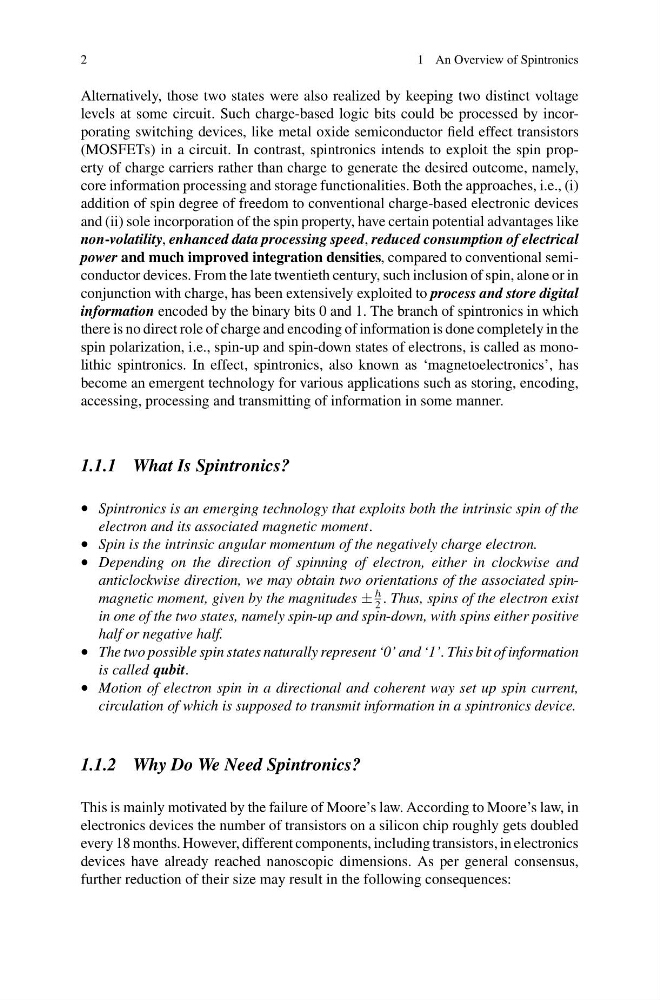
anticlockwise direction, we may obtain two orientations of the associated spinmagnetic moment, given by the magnitudes ±
2
. Thus, spins of the electron exist
in one of the two states, namely spin-up and spin-down, with spins either positive
half or negative half.
• The two possible spin states naturally represent ‘0’ and ‘1’. This bit of information
is called qubit.
• Motion of electron spin in a directional and coherent way set up spin current,
circulation of which is supposed to transmit information in a spintronics device.
1.1.2 Why Do We Need Spintronics?
This is mainly motivated by the failure of Moore’s law. According to Moore’s law, in
electronics devices the number of transistors on a silicon chip roughly gets doubled
every 18 months. However, different components, including transistors, in electronics
devices have already reached nanoscopic dimensions. As per general consensus,
further reduction of their size may result in the following consequences:
1 An Overview of Spintronics
Alternatively, those two states were also realized by keeping two distinct voltage
levels at some circuit. Such charge-based logic bits could be processed by incorporating switching devices, like metal oxide semiconductor field effect transistors
(MOSFETs) in a circuit. In contrast, spintronics intends to exploit the spin property of charge carriers rather than charge to generate the desired outcome, namely,
core information processing and storage functionalities. Both the approaches, i.e., (i)
addition of spin degree of freedom to conventional charge-based electronic devices
and (ii) sole incorporation of the spin property, have certain potential advantages like
non-volatility, enhanced data processing speed, reduced consumption of electrical
power and much improved integration densities, compared to conventional semiconductor devices. From the late twentieth century, such inclusion of spin, alone or in
conjunction with charge, has been extensively exploited to process and store digital
information encoded by the binary bits 0 and 1. The branch of spintronics in which
there is no direct role of charge and encoding of information is done completely in the
spin polarization, i.e., spin-up and spin-down states of electrons, is called as monolithic spintronics. In effect, spintronics, also known as ‘magnetoelectronics’, has
become an emergent technology for various applications such as storing, encoding,
accessing, processing and transmitting of information in some manner.
1.1.1 What Is Spintronics?
• Spintronics is an emerging technology that exploits both the intrinsic spin of the
electron and its associated magnetic moment.
• Spin is the intrinsic angular momentum of the negatively charge electron.
• Depending on the direction of spinning of electron, either in clockwise and
anticlockwise direction, we may obtain two orientations of the associated spinmagnetic moment, given by the magnitudes ±
2
. Thus, spins of the electron exist
in one of the two states, namely spin-up and spin-down, with spins either positive
half or negative half.
• The two possible spin states naturally represent ‘0’ and ‘1’. This bit of information
is called qubit.
• Motion of electron spin in a directional and coherent way set up spin current,
circulation of which is supposed to transmit information in a spintronics device.
1.1.2 Why Do We Need Spintronics?
This is mainly motivated by the failure of Moore’s law. According to Moore’s law, in
electronics devices the number of transistors on a silicon chip roughly gets doubled
every 18 months. However, different components, including transistors, in electronics
devices have already reached nanoscopic dimensions. As per general consensus,
further reduction of their size may result in the following consequences: