

8.4 Why Do We Need Terahertz Spintronics?
189
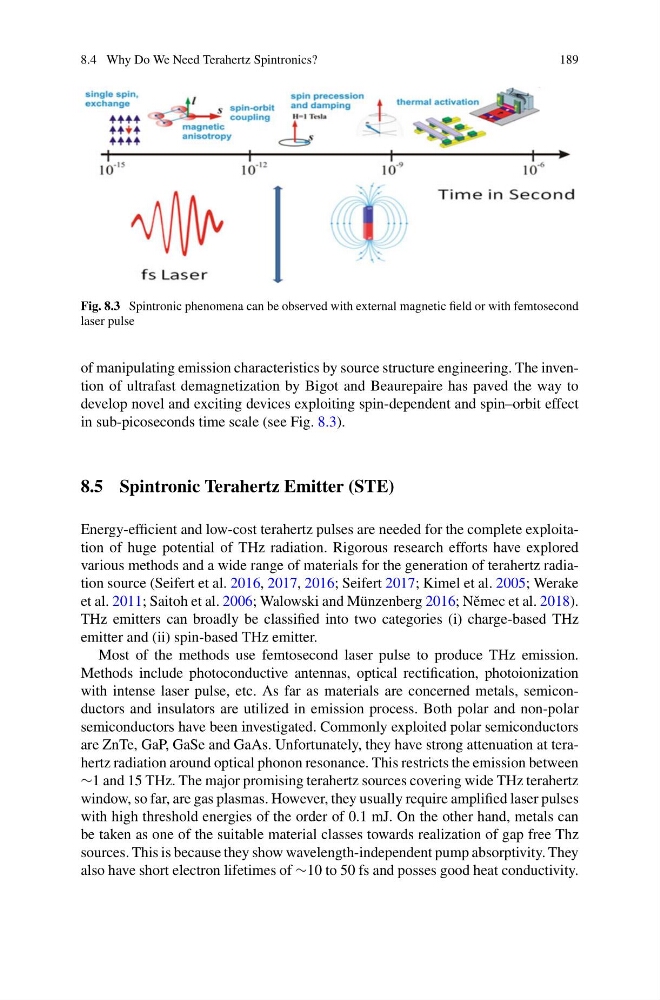
Fig. 8.3 Spintronic phenomena can be observed with external magnetic field or with femtosecond
laser pulse
of manipulating emission characteristics by source structure engineering. The invention of ultrafast demagnetization by Bigot and Beaurepaire has paved the way to
develop novel and exciting devices exploiting spin-dependent and spin–orbit effect
in sub-picoseconds time scale (see Fig. 8.3).
8.5 Spintronic Terahertz Emitter (STE)
Energy-efficient and low-cost terahertz pulses are needed for the complete exploitation of huge potential of THz radiation. Rigorous research efforts have explored
various methods and a wide range of materials for the generation of terahertz radiation source (Seifert et al. 2016, 2017, 2016; Seifert 2017; Kimel et al. 2005; Werake
et al. 2011; Saitoh et al. 2006; Walowski and Münzenberg 2016; Nˇ emec et al. 2018).
THz emitters can broadly be classified into two categories (i) charge-based THz
emitter and (ii) spin-based THz emitter.
Most of the methods use femtosecond laser pulse to produce THz emission.
Methods include photoconductive antennas, optical rectification, photoionization
with intense laser pulse, etc. As far as materials are concerned metals, semiconductors and insulators are utilized in emission process. Both polar and non-polar
semiconductors have been investigated. Commonly exploited polar semiconductors
are ZnTe, GaP, GaSe and GaAs. Unfortunately, they have strong attenuation at terahertz radiation around optical phonon resonance. This restricts the emission between
∼1 and 15 THz. The major promising terahertz sources covering wide THz terahertz
window, so far, are gas plasmas. However, they usually require amplified laser pulses
with high threshold energies of the order of 0.1 mJ. On the other hand, metals can
be taken as one of the suitable material classes towards realization of gap free Thz
sources. This is because they show wavelength-independent pump absorptivity. They
also have short electron lifetimes of ∼10 to 50 fs and posses good heat conductivity.
189
Fig. 8.3 Spintronic phenomena can be observed with external magnetic field or with femtosecond
laser pulse
of manipulating emission characteristics by source structure engineering. The invention of ultrafast demagnetization by Bigot and Beaurepaire has paved the way to
develop novel and exciting devices exploiting spin-dependent and spin–orbit effect
in sub-picoseconds time scale (see Fig. 8.3).
8.5 Spintronic Terahertz Emitter (STE)
Energy-efficient and low-cost terahertz pulses are needed for the complete exploitation of huge potential of THz radiation. Rigorous research efforts have explored
various methods and a wide range of materials for the generation of terahertz radiation source (Seifert et al. 2016, 2017, 2016; Seifert 2017; Kimel et al. 2005; Werake
et al. 2011; Saitoh et al. 2006; Walowski and Münzenberg 2016; Nˇ emec et al. 2018).
THz emitters can broadly be classified into two categories (i) charge-based THz
emitter and (ii) spin-based THz emitter.
Most of the methods use femtosecond laser pulse to produce THz emission.
Methods include photoconductive antennas, optical rectification, photoionization
with intense laser pulse, etc. As far as materials are concerned metals, semiconductors and insulators are utilized in emission process. Both polar and non-polar
semiconductors have been investigated. Commonly exploited polar semiconductors
are ZnTe, GaP, GaSe and GaAs. Unfortunately, they have strong attenuation at terahertz radiation around optical phonon resonance. This restricts the emission between
∼1 and 15 THz. The major promising terahertz sources covering wide THz terahertz
window, so far, are gas plasmas. However, they usually require amplified laser pulses
with high threshold energies of the order of 0.1 mJ. On the other hand, metals can
be taken as one of the suitable material classes towards realization of gap free Thz
sources. This is because they show wavelength-independent pump absorptivity. They
also have short electron lifetimes of ∼10 to 50 fs and posses good heat conductivity.