

7.10 All-Optical Spintronic Switching
181
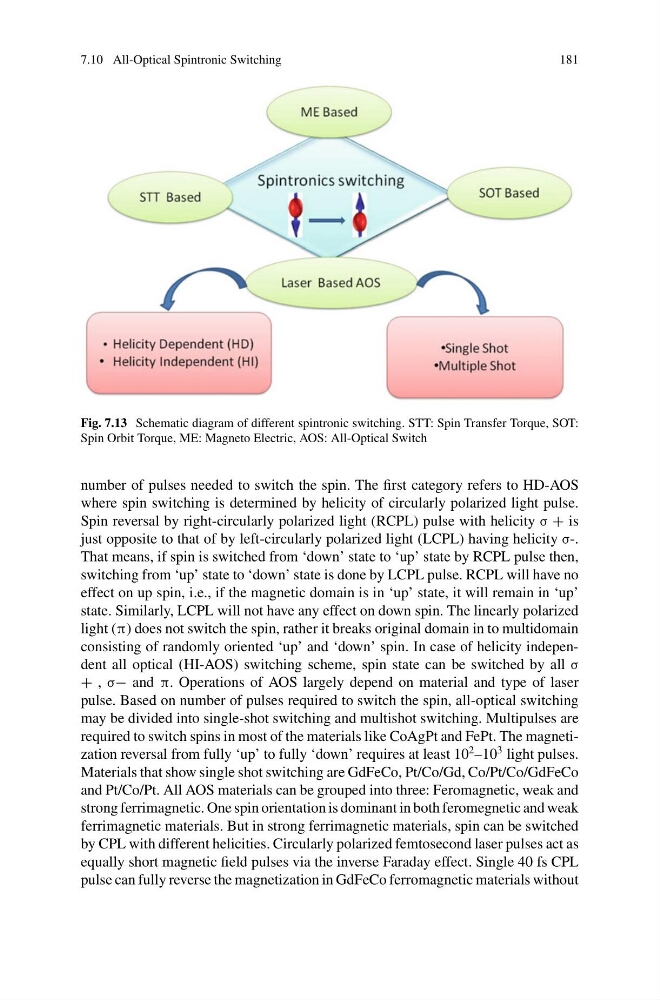
Fig. 7.13 Schematic diagram of different spintronic switching. STT: Spin Transfer Torque, SOT:
Spin Orbit Torque, ME: Magneto Electric, AOS: All-Optical Switch
number of pulses needed to switch the spin. The first category refers to HD-AOS
where spin switching is determined by helicity of circularly polarized light pulse.
Spin reversal by right-circularly polarized light (RCPL) pulse with helicity σ + is
just opposite to that of by left-circularly polarized light (LCPL) having helicity σ-.
That means, if spin is switched from ‘down’ state to ‘up’ state by RCPL pulse then,
switching from ‘up’ state to ‘down’ state is done by LCPL pulse. RCPL will have no
effect on up spin, i.e., if the magnetic domain is in ‘up’ state, it will remain in ‘up’
state. Similarly, LCPL will not have any effect on down spin. The linearly polarized
light (π) does not switch the spin, rather it breaks original domain in to multidomain
consisting of randomly oriented ‘up’ and ‘down’ spin. In case of helicity independent all optical (HI-AOS) switching scheme, spin state can be switched by all σ
+ , σ− and π. Operations of AOS largely depend on material and type of laser
pulse. Based on number of pulses required to switch the spin, all-optical switching
may be divided into single-shot switching and multishot switching. Multipulses are
required to switch spins in most of the materials like CoAgPt and FePt. The magnetization reversal from fully ‘up’ to fully ‘down’ requires at least 10
2 –10
3 light pulses.
Materials that show single shot switching are GdFeCo, Pt/Co/Gd, Co/Pt/Co/GdFeCo
and Pt/Co/Pt. All AOS materials can be grouped into three: Feromagnetic, weak and
strong ferrimagnetic. One spin orientation is dominant in both feromegnetic and weak
ferrimagnetic materials. But in strong ferrimagnetic materials, spin can be switched
by CPL with different helicities. Circularly polarized femtosecond laser pulses act as
equally short magnetic field pulses via the inverse Faraday effect. Single 40 fs CPL
pulse can fully reverse the magnetization in GdFeCo ferromagnetic materials without
181
Fig. 7.13 Schematic diagram of different spintronic switching. STT: Spin Transfer Torque, SOT:
Spin Orbit Torque, ME: Magneto Electric, AOS: All-Optical Switch
number of pulses needed to switch the spin. The first category refers to HD-AOS
where spin switching is determined by helicity of circularly polarized light pulse.
Spin reversal by right-circularly polarized light (RCPL) pulse with helicity σ + is
just opposite to that of by left-circularly polarized light (LCPL) having helicity σ-.
That means, if spin is switched from ‘down’ state to ‘up’ state by RCPL pulse then,
switching from ‘up’ state to ‘down’ state is done by LCPL pulse. RCPL will have no
effect on up spin, i.e., if the magnetic domain is in ‘up’ state, it will remain in ‘up’
state. Similarly, LCPL will not have any effect on down spin. The linearly polarized
light (π) does not switch the spin, rather it breaks original domain in to multidomain
consisting of randomly oriented ‘up’ and ‘down’ spin. In case of helicity independent all optical (HI-AOS) switching scheme, spin state can be switched by all σ
+ , σ− and π. Operations of AOS largely depend on material and type of laser
pulse. Based on number of pulses required to switch the spin, all-optical switching
may be divided into single-shot switching and multishot switching. Multipulses are
required to switch spins in most of the materials like CoAgPt and FePt. The magnetization reversal from fully ‘up’ to fully ‘down’ requires at least 10
2 –10
3 light pulses.
Materials that show single shot switching are GdFeCo, Pt/Co/Gd, Co/Pt/Co/GdFeCo
and Pt/Co/Pt. All AOS materials can be grouped into three: Feromagnetic, weak and
strong ferrimagnetic. One spin orientation is dominant in both feromegnetic and weak
ferrimagnetic materials. But in strong ferrimagnetic materials, spin can be switched
by CPL with different helicities. Circularly polarized femtosecond laser pulses act as
equally short magnetic field pulses via the inverse Faraday effect. Single 40 fs CPL
pulse can fully reverse the magnetization in GdFeCo ferromagnetic materials without