

6.2 Magnetic Domain Wall Motion in Spintronics
151
magnetic fields, correspond to the magnetization reversal of the thick bottom ferromagnetic layer. A schematic representation of the magnetization reversal behaviour
of this kind of trilayer GMR nanowire structure is also given in Fig. 6.6b.
6.3 Ratchet Effect in Magnetic Domain Wall Motion
6.3.1 What Is Rachet Effect?
Ratchet effect implies the restricted feature of reversal of any sort of human processes
once it has already been executed. A realistic example is the mechanical ratchet that
holds a spring tightly as a clock is wound up. In a simpler way, we may define
Ratchet as an effect that can limit the motion to one particular direction. In a
macroscopic scale, such an effect can be realized by employing a pawl and a wheel
with asymmetric-shaped teeth. In effect, the pawl constrains the wheel to rotate in
one particular direction.
6.3.2 Rachet Effect in Magnetic Domain Wall Motion
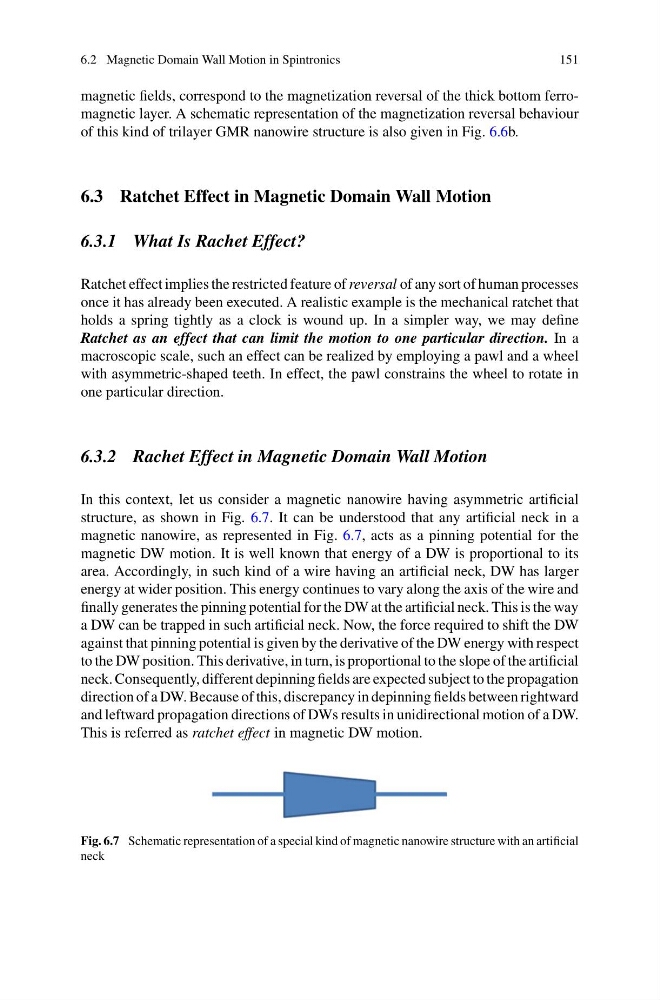
In this context, let us consider a magnetic nanowire having asymmetric artificial
structure, as shown in Fig. 6.7. It can be understood that any artificial neck in a
magnetic nanowire, as represented in Fig. 6.7, acts as a pinning potential for the
magnetic DW motion. It is well known that energy of a DW is proportional to its
area. Accordingly, in such kind of a wire having an artificial neck, DW has larger
energy at wider position. This energy continues to vary along the axis of the wire and
finally generates the pinning potential for the DW at the artificial neck. This is the way
a DW can be trapped in such artificial neck. Now, the force required to shift the DW
against that pinning potential is given by the derivative of the DW energy with respect
to the DW position. This derivative, in turn, is proportional to the slope of the artificial
neck. Consequently, different depinning fields are expected subject to the propagation
direction of a DW. Because of this, discrepancy in depinning fields between rightward
and leftward propagation directions of DWs results in unidirectional motion of a DW.
This is referred as ratchet effect in magnetic DW motion.
Fig. 6.7 Schematic representation of a special kind of magnetic nanowire structure with an artificial
neck
151
magnetic fields, correspond to the magnetization reversal of the thick bottom ferromagnetic layer. A schematic representation of the magnetization reversal behaviour
of this kind of trilayer GMR nanowire structure is also given in Fig. 6.6b.
6.3 Ratchet Effect in Magnetic Domain Wall Motion
6.3.1 What Is Rachet Effect?
Ratchet effect implies the restricted feature of reversal of any sort of human processes
once it has already been executed. A realistic example is the mechanical ratchet that
holds a spring tightly as a clock is wound up. In a simpler way, we may define
Ratchet as an effect that can limit the motion to one particular direction. In a
macroscopic scale, such an effect can be realized by employing a pawl and a wheel
with asymmetric-shaped teeth. In effect, the pawl constrains the wheel to rotate in
one particular direction.
6.3.2 Rachet Effect in Magnetic Domain Wall Motion
In this context, let us consider a magnetic nanowire having asymmetric artificial
structure, as shown in Fig. 6.7. It can be understood that any artificial neck in a
magnetic nanowire, as represented in Fig. 6.7, acts as a pinning potential for the
magnetic DW motion. It is well known that energy of a DW is proportional to its
area. Accordingly, in such kind of a wire having an artificial neck, DW has larger
energy at wider position. This energy continues to vary along the axis of the wire and
finally generates the pinning potential for the DW at the artificial neck. This is the way
a DW can be trapped in such artificial neck. Now, the force required to shift the DW
against that pinning potential is given by the derivative of the DW energy with respect
to the DW position. This derivative, in turn, is proportional to the slope of the artificial
neck. Consequently, different depinning fields are expected subject to the propagation
direction of a DW. Because of this, discrepancy in depinning fields between rightward
and leftward propagation directions of DWs results in unidirectional motion of a DW.
This is referred as ratchet effect in magnetic DW motion.
Fig. 6.7 Schematic representation of a special kind of magnetic nanowire structure with an artificial
neck