

132
5 Spin-Transfer Torque
5.3 Spin-Transfer Torque (STT)-Driven Magnetization
Dynamics
Different kinds of magnetization dynamics have been observed for the free layer
magnetic moment induced by spin-transfer torque (STT) effect. In order to describe
such dynamics, along with spin-transfer torque, it is essential to consider some additional torques acting on the free layer moment including, (i) torque due to the applied
magnetic field; (ii) torque due to magnetic anisotropies; (iii) damping torque, which
bring the moment at its lowest energy configuration, and (iv) torque due to possible
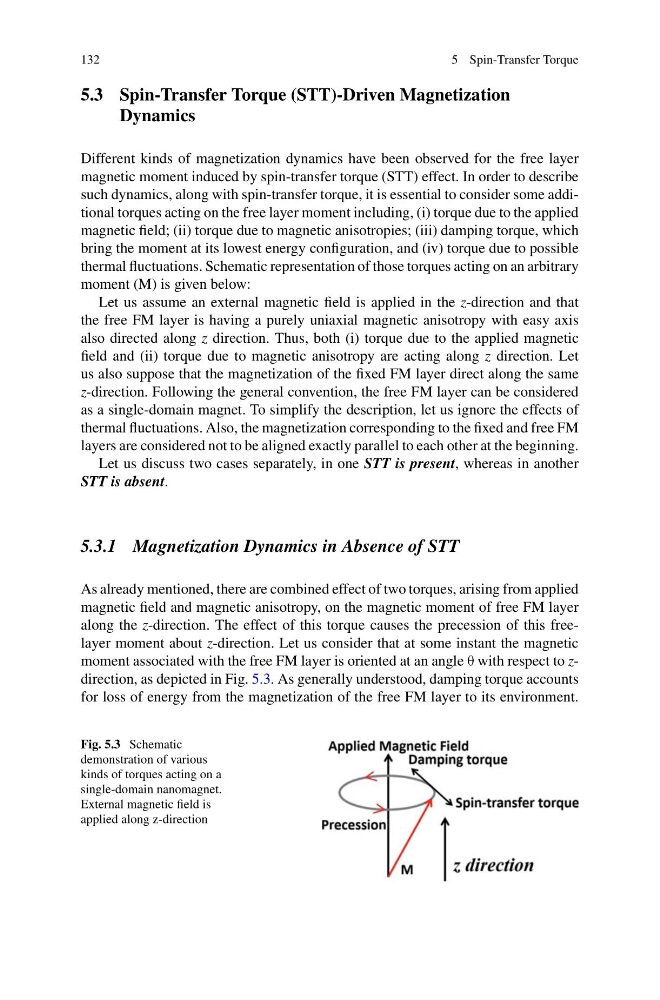
thermal fluctuations. Schematic representation of those torques acting on an arbitrary
moment (M) is given below:
Let us assume an external magnetic field is applied in the z-direction and that
the free FM layer is having a purely uniaxial magnetic anisotropy with easy axis
also directed along z direction. Thus, both (i) torque due to the applied magnetic
field and (ii) torque due to magnetic anisotropy are acting along z direction. Let
us also suppose that the magnetization of the fixed FM layer direct along the same
z-direction. Following the general convention, the free FM layer can be considered
as a single-domain magnet. To simplify the description, let us ignore the effects of
thermal fluctuations. Also, the magnetization corresponding to the fixed and free FM
layers are considered not to be aligned exactly parallel to each other at the beginning.
Let us discuss two cases separately, in one STT is present, whereas in another
STT is absent.
5.3.1 Magnetization Dynamics in Absence of STT
As already mentioned, there are combined effect of two torques, arising from applied
magnetic field and magnetic anisotropy, on the magnetic moment of free FM layer
along the z-direction. The effect of this torque causes the precession of this freelayer moment about z-direction. Let us consider that at some instant the magnetic
moment associated with the free FM layer is oriented at an angle θ with respect to zdirection, as depicted in Fig. 5.3. As generally understood, damping torque accounts
for loss of energy from the magnetization of the free FM layer to its environment.
Fig. 5.3 Schematic
demonstration of various
kinds of torques acting on a
single-domain nanomagnet.
External magnetic field is
applied along z-direction
5 Spin-Transfer Torque
5.3 Spin-Transfer Torque (STT)-Driven Magnetization
Dynamics
Different kinds of magnetization dynamics have been observed for the free layer
magnetic moment induced by spin-transfer torque (STT) effect. In order to describe
such dynamics, along with spin-transfer torque, it is essential to consider some additional torques acting on the free layer moment including, (i) torque due to the applied
magnetic field; (ii) torque due to magnetic anisotropies; (iii) damping torque, which
bring the moment at its lowest energy configuration, and (iv) torque due to possible
thermal fluctuations. Schematic representation of those torques acting on an arbitrary
moment (M) is given below:
Let us assume an external magnetic field is applied in the z-direction and that
the free FM layer is having a purely uniaxial magnetic anisotropy with easy axis
also directed along z direction. Thus, both (i) torque due to the applied magnetic
field and (ii) torque due to magnetic anisotropy are acting along z direction. Let
us also suppose that the magnetization of the fixed FM layer direct along the same
z-direction. Following the general convention, the free FM layer can be considered
as a single-domain magnet. To simplify the description, let us ignore the effects of
thermal fluctuations. Also, the magnetization corresponding to the fixed and free FM
layers are considered not to be aligned exactly parallel to each other at the beginning.
Let us discuss two cases separately, in one STT is present, whereas in another
STT is absent.
5.3.1 Magnetization Dynamics in Absence of STT
As already mentioned, there are combined effect of two torques, arising from applied
magnetic field and magnetic anisotropy, on the magnetic moment of free FM layer
along the z-direction. The effect of this torque causes the precession of this freelayer moment about z-direction. Let us consider that at some instant the magnetic
moment associated with the free FM layer is oriented at an angle θ with respect to zdirection, as depicted in Fig. 5.3. As generally understood, damping torque accounts
for loss of energy from the magnetization of the free FM layer to its environment.
Fig. 5.3 Schematic
demonstration of various
kinds of torques acting on a
single-domain nanomagnet.
External magnetic field is
applied along z-direction