

128
5 Spin-Transfer Torque
first proposed by Slonczewskil and Berger (Slonczewski 1989, 1996, 2005) independently in 1996. Important point is that this STT is possibly more effective to modulate
the orientation of the magnetization of nanoscale memory devices compared to that
of external magnetic fields. In effect, such feasibility of magnetization modulation
of ferromagnetic materials employing STT makes it possible to design integrated
spintronic devices with reduced dimension and energy consumption than conventional magnetic field actuation. Therefore, STT has attracted great deal of interest for
possible implementation in future magneto-electronic devices (Slonczewski 1989,
1996, 2005; Huang et al. 2007; Myers et al. 1999).
5.2 Spin-Transfer Torque in Ferromagnetic Layer
Structures
5.2.1 Single Ferromagnetic (FM) Layer
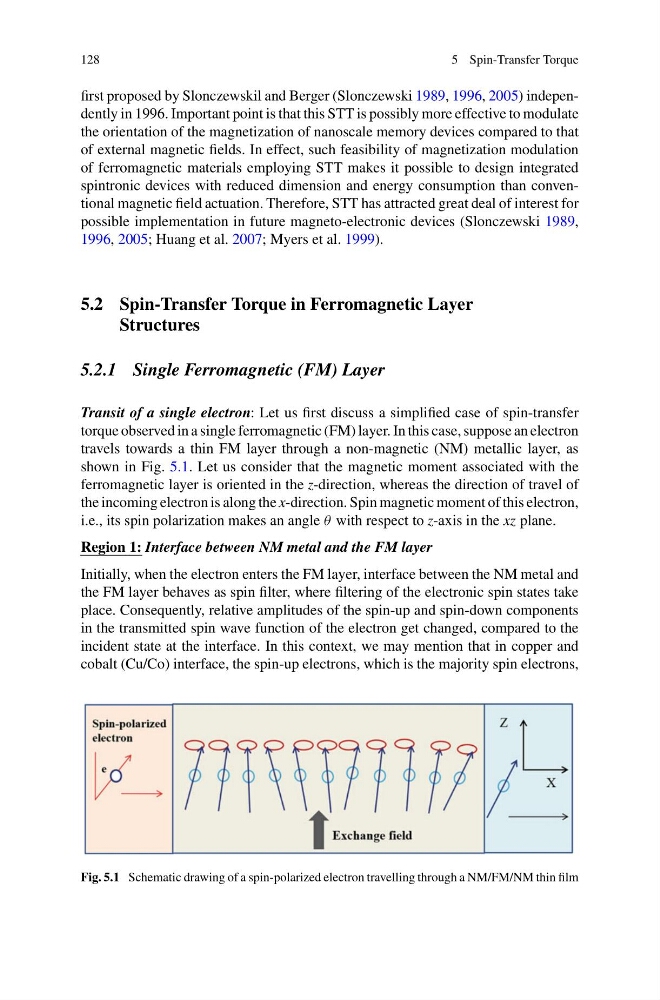
Transit of a single electron: Let us first discuss a simplified case of spin-transfer
torque observed in a single ferromagnetic (FM) layer. In this case, suppose an electron
travels towards a thin FM layer through a non-magnetic (NM) metallic layer, as
shown in Fig. 5.1. Let us consider that the magnetic moment associated with the
ferromagnetic layer is oriented in the z-direction, whereas the direction of travel of
the incoming electron is along the x-direction. Spin magnetic moment of this electron,
i.e., its spin polarization makes an angle θ with respect to z-axis in the xz plane.
Region 1: Interface between NM metal and the FM layer
Initially, when the electron enters the FM layer, interface between the NM metal and
the FM layer behaves as spin filter, where filtering of the electronic spin states take
place. Consequently, relative amplitudes of the spin-up and spin-down components
in the transmitted spin wave function of the electron get changed, compared to the
incident state at the interface. In this context, we may mention that in copper and
cobalt (Cu/Co) interface, the spin-up electrons, which is the majority spin electrons,
Fig. 5.1 Schematic drawing of a spin-polarized electron travelling through a NM/FM/NM thin film
5 Spin-Transfer Torque
first proposed by Slonczewskil and Berger (Slonczewski 1989, 1996, 2005) independently in 1996. Important point is that this STT is possibly more effective to modulate
the orientation of the magnetization of nanoscale memory devices compared to that
of external magnetic fields. In effect, such feasibility of magnetization modulation
of ferromagnetic materials employing STT makes it possible to design integrated
spintronic devices with reduced dimension and energy consumption than conventional magnetic field actuation. Therefore, STT has attracted great deal of interest for
possible implementation in future magneto-electronic devices (Slonczewski 1989,
1996, 2005; Huang et al. 2007; Myers et al. 1999).
5.2 Spin-Transfer Torque in Ferromagnetic Layer
Structures
5.2.1 Single Ferromagnetic (FM) Layer
Transit of a single electron: Let us first discuss a simplified case of spin-transfer
torque observed in a single ferromagnetic (FM) layer. In this case, suppose an electron
travels towards a thin FM layer through a non-magnetic (NM) metallic layer, as
shown in Fig. 5.1. Let us consider that the magnetic moment associated with the
ferromagnetic layer is oriented in the z-direction, whereas the direction of travel of
the incoming electron is along the x-direction. Spin magnetic moment of this electron,
i.e., its spin polarization makes an angle θ with respect to z-axis in the xz plane.
Region 1: Interface between NM metal and the FM layer
Initially, when the electron enters the FM layer, interface between the NM metal and
the FM layer behaves as spin filter, where filtering of the electronic spin states take
place. Consequently, relative amplitudes of the spin-up and spin-down components
in the transmitted spin wave function of the electron get changed, compared to the
incident state at the interface. In this context, we may mention that in copper and
cobalt (Cu/Co) interface, the spin-up electrons, which is the majority spin electrons,
Fig. 5.1 Schematic drawing of a spin-polarized electron travelling through a NM/FM/NM thin film