

4.4 Effect of Various Parameters on Tunnel Magnetoresistance
119
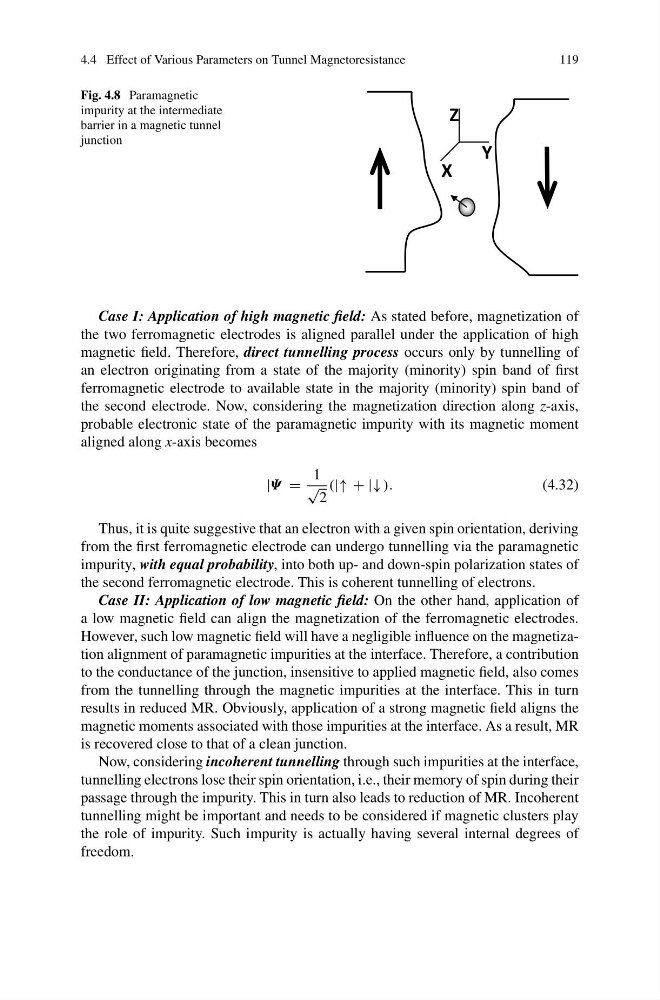
Fig. 4.8 Paramagnetic
impurity at the intermediate
barrier in a magnetic tunnel
junction
Z
Y
X
Case I: Application of high magnetic field: As stated before, magnetization of
the two ferromagnetic electrodes is aligned parallel under the application of high
magnetic field. Therefore, direct tunnelling process occurs only by tunnelling of
an electron originating from a state of the majority (minority) spin band of first
ferromagnetic electrode to available state in the majority (minority) spin band of
the second electrode. Now, considering the magnetization direction along z-axis,
probable electronic state of the paramagnetic impurity with its magnetic moment
aligned along x-axis becomes
|Ψ =
1
√
2
(|↑ + |↓ ).
(4.32)
Thus, it is quite suggestive that an electron with a given spin orientation, deriving
from the first ferromagnetic electrode can undergo tunnelling via the paramagnetic
impurity, with equal probability, into both up- and down-spin polarization states of
the second ferromagnetic electrode. This is coherent tunnelling of electrons.
Case II: Application of low magnetic field: On the other hand, application of
a low magnetic field can align the magnetization of the ferromagnetic electrodes.
However, such low magnetic field will have a negligible influence on the magnetization alignment of paramagnetic impurities at the interface. Therefore, a contribution
to the conductance of the junction, insensitive to applied magnetic field, also comes
from the tunnelling through the magnetic impurities at the interface. This in turn
results in reduced MR. Obviously, application of a strong magnetic field aligns the
magnetic moments associated with those impurities at the interface. As a result, MR
is recovered close to that of a clean junction.
Now, considering incoherent tunnelling through such impurities at the interface,
tunnelling electrons lose their spin orientation, i.e., their memory of spin during their
passage through the impurity. This in turn also leads to reduction of MR. Incoherent
tunnelling might be important and needs to be considered if magnetic clusters play
the role of impurity. Such impurity is actually having several internal degrees of
freedom.
119
Fig. 4.8 Paramagnetic
impurity at the intermediate
barrier in a magnetic tunnel
junction
Z
Y
X
Case I: Application of high magnetic field: As stated before, magnetization of
the two ferromagnetic electrodes is aligned parallel under the application of high
magnetic field. Therefore, direct tunnelling process occurs only by tunnelling of
an electron originating from a state of the majority (minority) spin band of first
ferromagnetic electrode to available state in the majority (minority) spin band of
the second electrode. Now, considering the magnetization direction along z-axis,
probable electronic state of the paramagnetic impurity with its magnetic moment
aligned along x-axis becomes
|Ψ =
1
√
2
(|↑ + |↓ ).
(4.32)
Thus, it is quite suggestive that an electron with a given spin orientation, deriving
from the first ferromagnetic electrode can undergo tunnelling via the paramagnetic
impurity, with equal probability, into both up- and down-spin polarization states of
the second ferromagnetic electrode. This is coherent tunnelling of electrons.
Case II: Application of low magnetic field: On the other hand, application of
a low magnetic field can align the magnetization of the ferromagnetic electrodes.
However, such low magnetic field will have a negligible influence on the magnetization alignment of paramagnetic impurities at the interface. Therefore, a contribution
to the conductance of the junction, insensitive to applied magnetic field, also comes
from the tunnelling through the magnetic impurities at the interface. This in turn
results in reduced MR. Obviously, application of a strong magnetic field aligns the
magnetic moments associated with those impurities at the interface. As a result, MR
is recovered close to that of a clean junction.
Now, considering incoherent tunnelling through such impurities at the interface,
tunnelling electrons lose their spin orientation, i.e., their memory of spin during their
passage through the impurity. This in turn also leads to reduction of MR. Incoherent
tunnelling might be important and needs to be considered if magnetic clusters play
the role of impurity. Such impurity is actually having several internal degrees of
freedom.