

100
3 Giant Magnetoresistance (GMR)
25. Show the experimental variation of GMR ratio with the spacer layer thickness
of a GMR structure. Explain the feature.
26. Using the resistor network model, derive an expression of the magnetoresistance ratio of GMR in terms of the spin asymmetry.
27. Multiple Choice Questions:
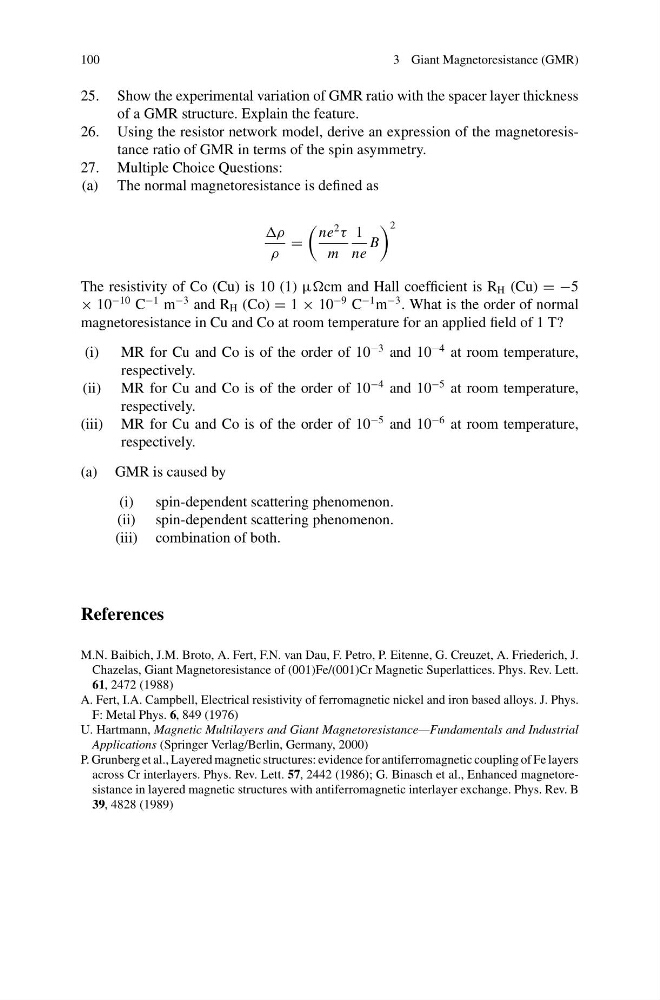
(a) The normal magnetoresistance is defined as
ρ
ρ
=
ne
2
τ
m
1
ne
B
2
The resistivity of Co (Cu) is 10 (1) μcm and Hall coefficient is R H (Cu) = −5
× 10
−10 C
−1 m
−3 and R H (Co) = 1 × 10
−9 C
−1 m
−3 . What is the order of normal
magnetoresistance in Cu and Co at room temperature for an applied field of 1 T?
(i) MR for Cu and Co is of the order of 10
−3 and 10
−4 at room temperature,
respectively.
(ii) MR for Cu and Co is of the order of 10
−4 and 10
−5 at room temperature,
respectively.
(iii) MR for Cu and Co is of the order of 10
−5 and 10
−6 at room temperature,
respectively.
(a) GMR is caused by
(i) spin-dependent scattering phenomenon.
(ii) spin-dependent scattering phenomenon.
(iii) combination of both.
References
M.N. Baibich, J.M. Broto, A. Fert, F.N. van Dau, F. Petro, P. Eitenne, G. Creuzet, A. Friederich, J.
Chazelas, Giant Magnetoresistance of (001)Fe/(001)Cr Magnetic Superlattices. Phys. Rev. Lett.
61, 2472 (1988)
A. Fert, I.A. Campbell, Electrical resistivity of ferromagnetic nickel and iron based alloys. J. Phys.
F: Metal Phys. 6, 849 (1976)
U. Hartmann, Magnetic Multilayers and Giant Magnetoresistance—Fundamentals and Industrial
Applications (Springer Verlag/Berlin, Germany, 2000)
P. Grunberg et al., Layered magnetic structures: evidence for antiferromagnetic coupling of Fe layers
across Cr interlayers. Phys. Rev. Lett. 57, 2442 (1986); G. Binasch et al., Enhanced magnetoresistance in layered magnetic structures with antiferromagnetic interlayer exchange. Phys. Rev. B
39, 4828 (1989)
3 Giant Magnetoresistance (GMR)
25. Show the experimental variation of GMR ratio with the spacer layer thickness
of a GMR structure. Explain the feature.
26. Using the resistor network model, derive an expression of the magnetoresistance ratio of GMR in terms of the spin asymmetry.
27. Multiple Choice Questions:
(a) The normal magnetoresistance is defined as
ρ
ρ
=
ne
2
τ
m
1
ne
B
2
The resistivity of Co (Cu) is 10 (1) μcm and Hall coefficient is R H (Cu) = −5
× 10
−10 C
−1 m
−3 and R H (Co) = 1 × 10
−9 C
−1 m
−3 . What is the order of normal
magnetoresistance in Cu and Co at room temperature for an applied field of 1 T?
(i) MR for Cu and Co is of the order of 10
−3 and 10
−4 at room temperature,
respectively.
(ii) MR for Cu and Co is of the order of 10
−4 and 10
−5 at room temperature,
respectively.
(iii) MR for Cu and Co is of the order of 10
−5 and 10
−6 at room temperature,
respectively.
(a) GMR is caused by
(i) spin-dependent scattering phenomenon.
(ii) spin-dependent scattering phenomenon.
(iii) combination of both.
References
M.N. Baibich, J.M. Broto, A. Fert, F.N. van Dau, F. Petro, P. Eitenne, G. Creuzet, A. Friederich, J.
Chazelas, Giant Magnetoresistance of (001)Fe/(001)Cr Magnetic Superlattices. Phys. Rev. Lett.
61, 2472 (1988)
A. Fert, I.A. Campbell, Electrical resistivity of ferromagnetic nickel and iron based alloys. J. Phys.
F: Metal Phys. 6, 849 (1976)
U. Hartmann, Magnetic Multilayers and Giant Magnetoresistance—Fundamentals and Industrial
Applications (Springer Verlag/Berlin, Germany, 2000)
P. Grunberg et al., Layered magnetic structures: evidence for antiferromagnetic coupling of Fe layers
across Cr interlayers. Phys. Rev. Lett. 57, 2442 (1986); G. Binasch et al., Enhanced magnetoresistance in layered magnetic structures with antiferromagnetic interlayer exchange. Phys. Rev. B
39, 4828 (1989)