

98
3 Giant Magnetoresistance (GMR)
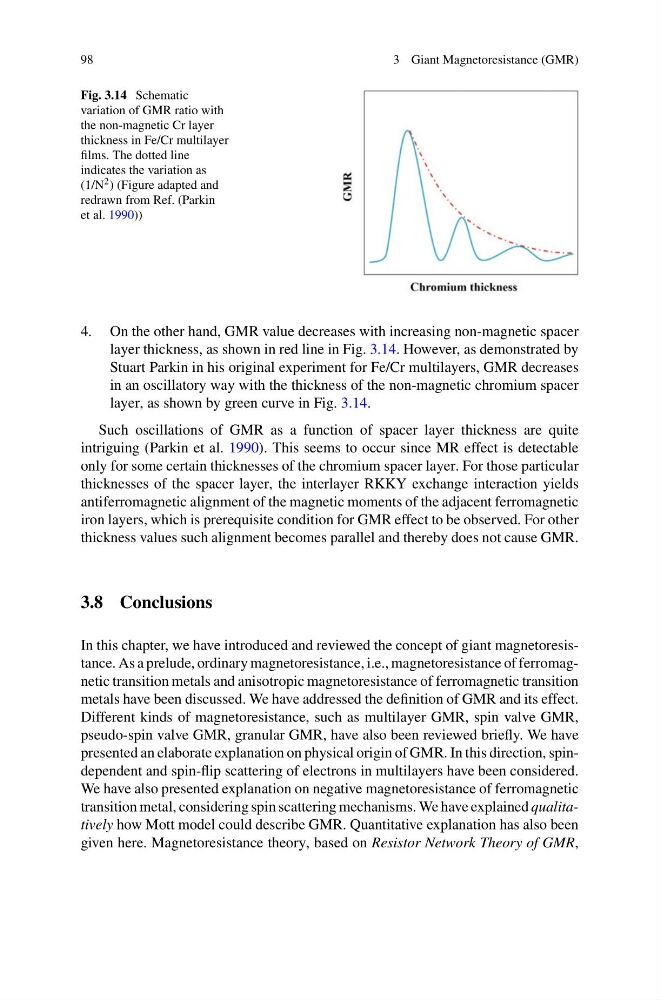
Fig. 3.14 Schematic
variation of GMR ratio with
the non-magnetic Cr layer
thickness in Fe/Cr multilayer
films. The dotted line
indicates the variation as
(1/N 2 ) (Figure adapted and
redrawn from Ref. (Parkin
et al. 1990))
4. On the other hand, GMR value decreases with increasing non-magnetic spacer
layer thickness, as shown in red line in Fig. 3.14. However, as demonstrated by
Stuart Parkin in his original experiment for Fe/Cr multilayers, GMR decreases
in an oscillatory way with the thickness of the non-magnetic chromium spacer
layer, as shown by green curve in Fig. 3.14.
Such oscillations of GMR as a function of spacer layer thickness are quite
intriguing (Parkin et al. 1990). This seems to occur since MR effect is detectable
only for some certain thicknesses of the chromium spacer layer. For those particular
thicknesses of the spacer layer, the interlayer RKKY exchange interaction yields
antiferromagnetic alignment of the magnetic moments of the adjacent ferromagnetic
iron layers, which is prerequisite condition for GMR effect to be observed. For other
thickness values such alignment becomes parallel and thereby does not cause GMR.
3.8 Conclusions
In this chapter, we have introduced and reviewed the concept of giant magnetoresistance. As a prelude, ordinary magnetoresistance, i.e., magnetoresistance of ferromagnetic transition metals and anisotropic magnetoresistance of ferromagnetic transition
metals have been discussed. We have addressed the definition of GMR and its effect.
Different kinds of magnetoresistance, such as multilayer GMR, spin valve GMR,
pseudo-spin valve GMR, granular GMR, have also been reviewed briefly. We have
presented an elaborate explanation on physical origin of GMR. In this direction, spindependent and spin-flip scattering of electrons in multilayers have been considered.
We have also presented explanation on negative magnetoresistance of ferromagnetic
transition metal, considering spin scattering mechanisms. We have explained qualitatively how Mott model could describe GMR. Quantitative explanation has also been
given here. Magnetoresistance theory, based on Resistor Network Theory of GMR,
3 Giant Magnetoresistance (GMR)
Fig. 3.14 Schematic
variation of GMR ratio with
the non-magnetic Cr layer
thickness in Fe/Cr multilayer
films. The dotted line
indicates the variation as
(1/N 2 ) (Figure adapted and
redrawn from Ref. (Parkin
et al. 1990))
4. On the other hand, GMR value decreases with increasing non-magnetic spacer
layer thickness, as shown in red line in Fig. 3.14. However, as demonstrated by
Stuart Parkin in his original experiment for Fe/Cr multilayers, GMR decreases
in an oscillatory way with the thickness of the non-magnetic chromium spacer
layer, as shown by green curve in Fig. 3.14.
Such oscillations of GMR as a function of spacer layer thickness are quite
intriguing (Parkin et al. 1990). This seems to occur since MR effect is detectable
only for some certain thicknesses of the chromium spacer layer. For those particular
thicknesses of the spacer layer, the interlayer RKKY exchange interaction yields
antiferromagnetic alignment of the magnetic moments of the adjacent ferromagnetic
iron layers, which is prerequisite condition for GMR effect to be observed. For other
thickness values such alignment becomes parallel and thereby does not cause GMR.
3.8 Conclusions
In this chapter, we have introduced and reviewed the concept of giant magnetoresistance. As a prelude, ordinary magnetoresistance, i.e., magnetoresistance of ferromagnetic transition metals and anisotropic magnetoresistance of ferromagnetic transition
metals have been discussed. We have addressed the definition of GMR and its effect.
Different kinds of magnetoresistance, such as multilayer GMR, spin valve GMR,
pseudo-spin valve GMR, granular GMR, have also been reviewed briefly. We have
presented an elaborate explanation on physical origin of GMR. In this direction, spindependent and spin-flip scattering of electrons in multilayers have been considered.
We have also presented explanation on negative magnetoresistance of ferromagnetic
transition metal, considering spin scattering mechanisms. We have explained qualitatively how Mott model could describe GMR. Quantitative explanation has also been
given here. Magnetoresistance theory, based on Resistor Network Theory of GMR,