

3.5 Physical Origin of GMR: Qualitative Explanation
91
spin channels. Hence, negative MR of ferromagnetic metal gets reduced with rise in
temperature.
3.5.4 Explanation of GMR by Mott Model
As far as qualitative description is concerned, it is straightforward to explain GMR
using Mott’s arguments. In this direction, let us consider a simple trilayer magnetic
film with two magnetic layers separated by a non-magnetic metallic spacer layer.
Mott’s second argument, which reflects asymmetric density of states at Fermi level,
suggests for the spin-dependent scattering. We understand that for minority spin
electrons with spin antiparallel to the magnetization, the scattering is expected to be
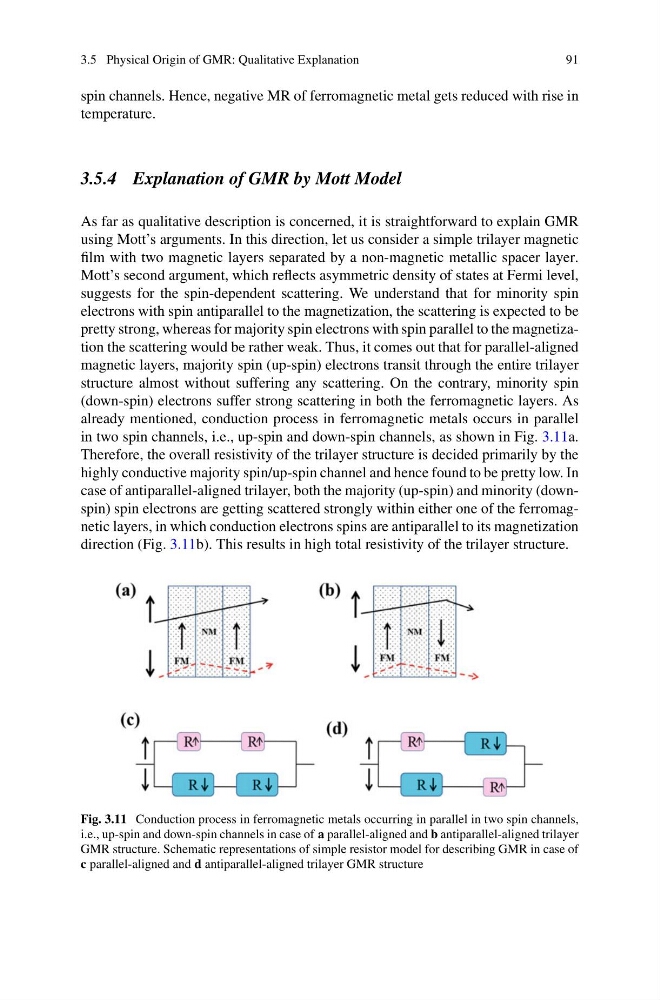
pretty strong, whereas for majority spin electrons with spin parallel to the magnetization the scattering would be rather weak. Thus, it comes out that for parallel-aligned
magnetic layers, majority spin (up-spin) electrons transit through the entire trilayer
structure almost without suffering any scattering. On the contrary, minority spin
(down-spin) electrons suffer strong scattering in both the ferromagnetic layers. As
already mentioned, conduction process in ferromagnetic metals occurs in parallel
in two spin channels, i.e., up-spin and down-spin channels, as shown in Fig. 3.11a.
Therefore, the overall resistivity of the trilayer structure is decided primarily by the
highly conductive majority spin/up-spin channel and hence found to be pretty low. In
case of antiparallel-aligned trilayer, both the majority (up-spin) and minority (downspin) spin electrons are getting scattered strongly within either one of the ferromagnetic layers, in which conduction electrons spins are antiparallel to its magnetization
direction (Fig. 3.11b). This results in high total resistivity of the trilayer structure.
Fig. 3.11 Conduction process in ferromagnetic metals occurring in parallel in two spin channels,
i.e., up-spin and down-spin channels in case of a parallel-aligned and b antiparallel-aligned trilayer
GMR structure. Schematic representations of simple resistor model for describing GMR in case of
c parallel-aligned and d antiparallel-aligned trilayer GMR structure
91
spin channels. Hence, negative MR of ferromagnetic metal gets reduced with rise in
temperature.
3.5.4 Explanation of GMR by Mott Model
As far as qualitative description is concerned, it is straightforward to explain GMR
using Mott’s arguments. In this direction, let us consider a simple trilayer magnetic
film with two magnetic layers separated by a non-magnetic metallic spacer layer.
Mott’s second argument, which reflects asymmetric density of states at Fermi level,
suggests for the spin-dependent scattering. We understand that for minority spin
electrons with spin antiparallel to the magnetization, the scattering is expected to be
pretty strong, whereas for majority spin electrons with spin parallel to the magnetization the scattering would be rather weak. Thus, it comes out that for parallel-aligned
magnetic layers, majority spin (up-spin) electrons transit through the entire trilayer
structure almost without suffering any scattering. On the contrary, minority spin
(down-spin) electrons suffer strong scattering in both the ferromagnetic layers. As
already mentioned, conduction process in ferromagnetic metals occurs in parallel
in two spin channels, i.e., up-spin and down-spin channels, as shown in Fig. 3.11a.
Therefore, the overall resistivity of the trilayer structure is decided primarily by the
highly conductive majority spin/up-spin channel and hence found to be pretty low. In
case of antiparallel-aligned trilayer, both the majority (up-spin) and minority (downspin) spin electrons are getting scattered strongly within either one of the ferromagnetic layers, in which conduction electrons spins are antiparallel to its magnetization
direction (Fig. 3.11b). This results in high total resistivity of the trilayer structure.
Fig. 3.11 Conduction process in ferromagnetic metals occurring in parallel in two spin channels,
i.e., up-spin and down-spin channels in case of a parallel-aligned and b antiparallel-aligned trilayer
GMR structure. Schematic representations of simple resistor model for describing GMR in case of
c parallel-aligned and d antiparallel-aligned trilayer GMR structure