

88
3 Giant Magnetoresistance (GMR)
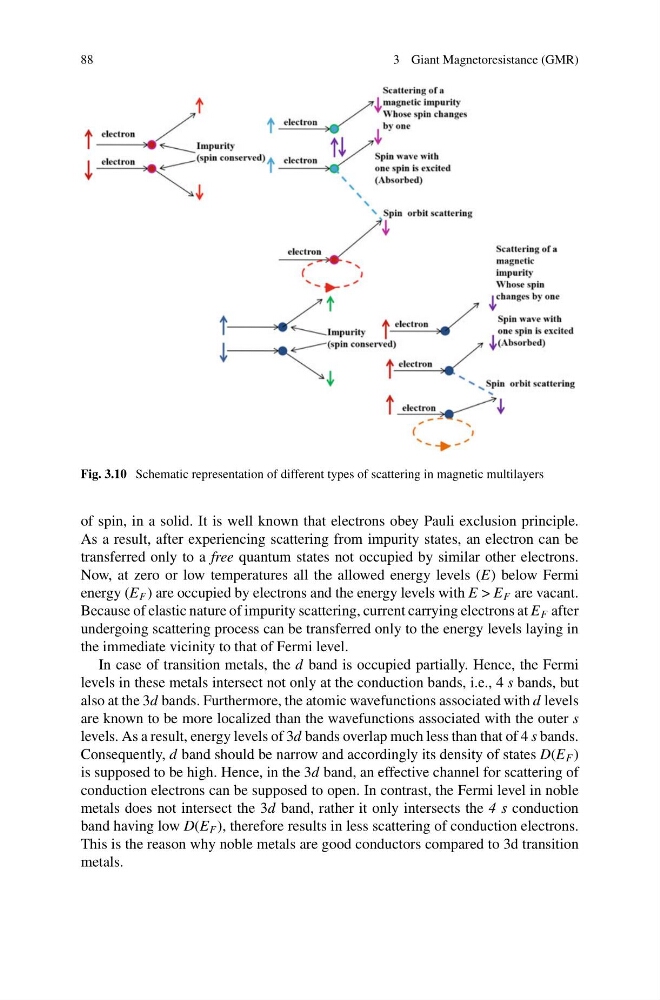
Fig. 3.10 Schematic representation of different types of scattering in magnetic multilayers
of spin, in a solid. It is well known that electrons obey Pauli exclusion principle.
As a result, after experiencing scattering from impurity states, an electron can be
transferred only to a free quantum states not occupied by similar other electrons.
Now, at zero or low temperatures all the allowed energy levels (E) below Fermi
energy (E F ) are occupied by electrons and the energy levels with E > E F are vacant.
Because of elastic nature of impurity scattering, current carrying electrons at E F after
undergoing scattering process can be transferred only to the energy levels laying in
the immediate vicinity to that of Fermi level.
In case of transition metals, the d band is occupied partially. Hence, the Fermi
levels in these metals intersect not only at the conduction bands, i.e., 4 s bands, but
also at the 3d bands. Furthermore, the atomic wavefunctions associated with d levels
are known to be more localized than the wavefunctions associated with the outer s
levels. As a result, energy levels of 3d bands overlap much less than that of 4 s bands.
Consequently, d band should be narrow and accordingly its density of states D(E F )
is supposed to be high. Hence, in the 3d band, an effective channel for scattering of
conduction electrons can be supposed to open. In contrast, the Fermi level in noble
metals does not intersect the 3d band, rather it only intersects the 4 s conduction
band having low D(E F ), therefore results in less scattering of conduction electrons.
This is the reason why noble metals are good conductors compared to 3d transition
metals.
3 Giant Magnetoresistance (GMR)
Fig. 3.10 Schematic representation of different types of scattering in magnetic multilayers
of spin, in a solid. It is well known that electrons obey Pauli exclusion principle.
As a result, after experiencing scattering from impurity states, an electron can be
transferred only to a free quantum states not occupied by similar other electrons.
Now, at zero or low temperatures all the allowed energy levels (E) below Fermi
energy (E F ) are occupied by electrons and the energy levels with E > E F are vacant.
Because of elastic nature of impurity scattering, current carrying electrons at E F after
undergoing scattering process can be transferred only to the energy levels laying in
the immediate vicinity to that of Fermi level.
In case of transition metals, the d band is occupied partially. Hence, the Fermi
levels in these metals intersect not only at the conduction bands, i.e., 4 s bands, but
also at the 3d bands. Furthermore, the atomic wavefunctions associated with d levels
are known to be more localized than the wavefunctions associated with the outer s
levels. As a result, energy levels of 3d bands overlap much less than that of 4 s bands.
Consequently, d band should be narrow and accordingly its density of states D(E F )
is supposed to be high. Hence, in the 3d band, an effective channel for scattering of
conduction electrons can be supposed to open. In contrast, the Fermi level in noble
metals does not intersect the 3d band, rather it only intersects the 4 s conduction
band having low D(E F ), therefore results in less scattering of conduction electrons.
This is the reason why noble metals are good conductors compared to 3d transition
metals.