

56
2 Worldsheet Path Integral: Vacuum Amplitudes
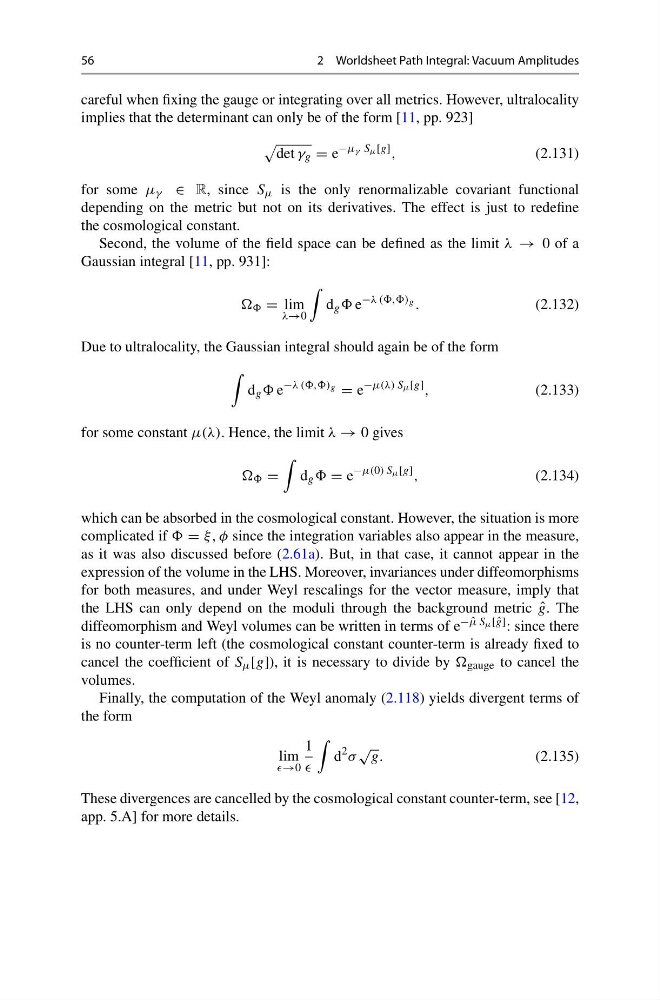
careful when fixing the gauge or integrating over all metrics. However, ultralocality
implies that the determinant can only be of the form [11, pp. 923]
det γ g = e
−μ γ S μ [g] ,
(2.131)
for some μ γ ∈ R, since S μ is the only renormalizable covariant functional
depending on the metric but not on its derivatives. The effect is just to redefine
the cosmological constant.
Second, the volume of the field space can be defined as the limit λ → 0 of a
Gaussian integral [11, pp. 931]:
= lim
λ→0
d g e
−λ ((,,) g .
(2.132)
Due to ultralocality, the Gaussian integral should again be of the form
d g e
−λ ((,,) g = e
−μ(λ) S μ [g] ,
(2.133)
for some constant μ(λ). Hence, the limit λ → 0 gives
=
d g = e
−μ(0) S μ [g] ,
(2.134)
which can be absorbed in the cosmological constant. However, the situation is more
complicated if = ξ, φ since the integration variables also appear in the measure,
as it was also discussed before (2.61a). But, in that case, it cannot appear in the
expression of the volume in the LHS. Moreover, invariances under diffeomorphisms
for both measures, and under Weyl rescalings for the vector measure, imply that
the LHS can only depend on the moduli through the background metric ˆ
g. The
diffeomorphism and Weyl volumes can be written in terms of e − ˆ
μ S μ [ ˆ
g] : since there
is no counter-term left (the cosmological constant counter-term is already fixed to
cancel the coefficient of S μ [g]), it is necessary to divide by gauge to cancel the
volumes.
Finally, the computation of the Weyl anomaly (2.118) yields divergent terms of
the form
lim
→0
1
d
2 σ
√
g.
(2.135)
These divergences are cancelled by the cosmological constant counter-term, see [12,
app. 5.A] for more details.
2 Worldsheet Path Integral: Vacuum Amplitudes
careful when fixing the gauge or integrating over all metrics. However, ultralocality
implies that the determinant can only be of the form [11, pp. 923]
det γ g = e
−μ γ S μ [g] ,
(2.131)
for some μ γ ∈ R, since S μ is the only renormalizable covariant functional
depending on the metric but not on its derivatives. The effect is just to redefine
the cosmological constant.
Second, the volume of the field space can be defined as the limit λ → 0 of a
Gaussian integral [11, pp. 931]:
= lim
λ→0
d g e
−λ ((,,) g .
(2.132)
Due to ultralocality, the Gaussian integral should again be of the form
d g e
−λ ((,,) g = e
−μ(λ) S μ [g] ,
(2.133)
for some constant μ(λ). Hence, the limit λ → 0 gives
=
d g = e
−μ(0) S μ [g] ,
(2.134)
which can be absorbed in the cosmological constant. However, the situation is more
complicated if = ξ, φ since the integration variables also appear in the measure,
as it was also discussed before (2.61a). But, in that case, it cannot appear in the
expression of the volume in the LHS. Moreover, invariances under diffeomorphisms
for both measures, and under Weyl rescalings for the vector measure, imply that
the LHS can only depend on the moduli through the background metric ˆ
g. The
diffeomorphism and Weyl volumes can be written in terms of e − ˆ
μ S μ [ ˆ
g] : since there
is no counter-term left (the cosmological constant counter-term is already fixed to
cancel the coefficient of S μ [g]), it is necessary to divide by gauge to cancel the
volumes.
Finally, the computation of the Weyl anomaly (2.118) yields divergent terms of
the form
lim
→0
1
d
2 σ
√
g.
(2.135)
These divergences are cancelled by the cosmological constant counter-term, see [12,
app. 5.A] for more details.