

2.3 Faddeev–Popov Gauge Fixing
53
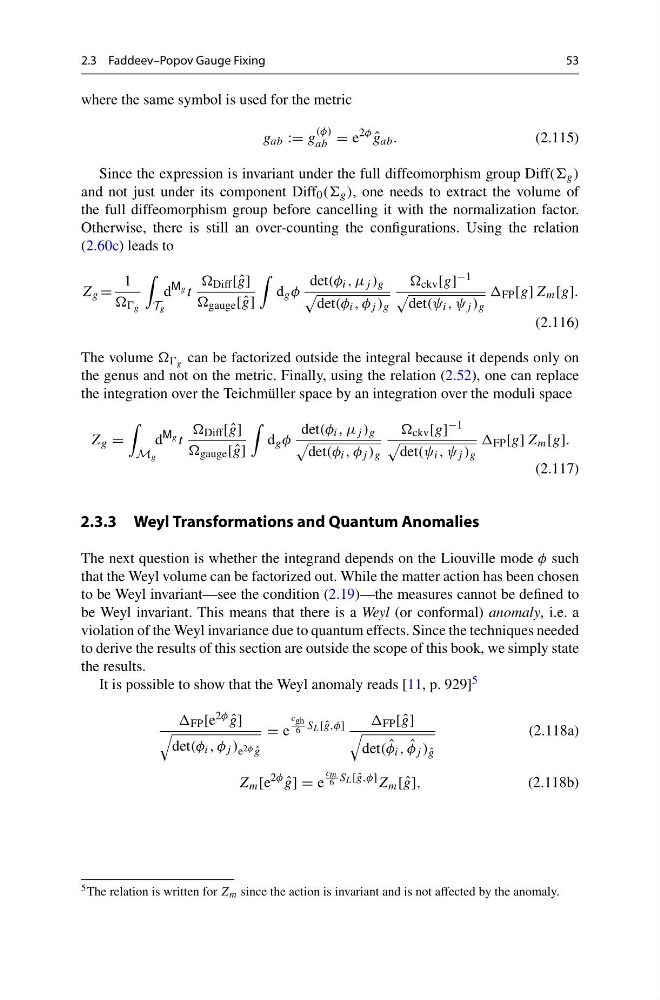
where the same symbol is used for the metric
g ab := g
(φ)
ab = e
2φ
ˆ
g ab .
(2.115)
Since the expression is invariant under the full diffeomorphism group Diff(( g )
and not just under its component Diff 0 (( g ), one needs to extract the volume of
the full diffeomorphism group before cancelling it with the normalization factor.
Otherwise, there is still an over-counting the configurations. Using the relation
(2.60c) leads to
Z g =
1
g
T g
d
M g t
Diff [ ˆ
g]
gauge [ ˆ
g]
d g φ
det(φ i , μ j ) g
det(φ i , φ j ) g
ckv [g] −1
det(ψ i , ψ j ) g
FP [g] Z m [g].
(2.116)
The volume g can be factorized outside the integral because it depends only on
the genus and not on the metric. Finally, using the relation (2.52), one can replace
the integration over the Teichmüller space by an integration over the moduli space
Z g =
M g
d
M g t
Diff [ ˆ
g]
gauge [ ˆ
g]
d g φ
det(φ i , μ j ) g
det(φ i , φ j ) g
ckv [g] −1
det(ψ i , ψ j ) g
FP [g] Z m [g].
(2.117)
2.3.3 Weyl Transformations and Quantum Anomalies
The next question is whether the integrand depends on the Liouville mode φ such
that the Weyl volume can be factorized out. While the matter action has been chosen
to be Weyl invariant—see the condition (2.19)—the measures cannot be defined to
be Weyl invariant. This means that there is a Weyl (or conformal) anomaly, i.e. a
violation of the Weyl invariance due to quantum effects. Since the techniques needed
to derive the results of this section are outside the scope of this book, we simply state
the results.
It is possible to show that the Weyl anomaly reads [11, p. 929] 5
FP [e 2φ ˆ
g]
det(φ i , φ j ) e 2φ ˆ
g
= e
c gh
6 S L [ ˆ
g,φ]
FP [ ˆ
g]
det( ˆ
φ i , ˆ
φ j ) ˆ
g
(2.118a)
Z m [e
2φ
ˆ
g] = e
cm
6 S L [ ˆ
g,φ] Z m [ ˆ
g],
(2.118b)
5 The relation is written for Z m since the action is invariant and is not affected by the anomaly.
53
where the same symbol is used for the metric
g ab := g
(φ)
ab = e
2φ
ˆ
g ab .
(2.115)
Since the expression is invariant under the full diffeomorphism group Diff(( g )
and not just under its component Diff 0 (( g ), one needs to extract the volume of
the full diffeomorphism group before cancelling it with the normalization factor.
Otherwise, there is still an over-counting the configurations. Using the relation
(2.60c) leads to
Z g =
1
g
T g
d
M g t
Diff [ ˆ
g]
gauge [ ˆ
g]
d g φ
det(φ i , μ j ) g
det(φ i , φ j ) g
ckv [g] −1
det(ψ i , ψ j ) g
FP [g] Z m [g].
(2.116)
The volume g can be factorized outside the integral because it depends only on
the genus and not on the metric. Finally, using the relation (2.52), one can replace
the integration over the Teichmüller space by an integration over the moduli space
Z g =
M g
d
M g t
Diff [ ˆ
g]
gauge [ ˆ
g]
d g φ
det(φ i , μ j ) g
det(φ i , φ j ) g
ckv [g] −1
det(ψ i , ψ j ) g
FP [g] Z m [g].
(2.117)
2.3.3 Weyl Transformations and Quantum Anomalies
The next question is whether the integrand depends on the Liouville mode φ such
that the Weyl volume can be factorized out. While the matter action has been chosen
to be Weyl invariant—see the condition (2.19)—the measures cannot be defined to
be Weyl invariant. This means that there is a Weyl (or conformal) anomaly, i.e. a
violation of the Weyl invariance due to quantum effects. Since the techniques needed
to derive the results of this section are outside the scope of this book, we simply state
the results.
It is possible to show that the Weyl anomaly reads [11, p. 929] 5
FP [e 2φ ˆ
g]
det(φ i , φ j ) e 2φ ˆ
g
= e
c gh
6 S L [ ˆ
g,φ]
FP [ ˆ
g]
det( ˆ
φ i , ˆ
φ j ) ˆ
g
(2.118a)
Z m [e
2φ
ˆ
g] = e
cm
6 S L [ ˆ
g,φ] Z m [ ˆ
g],
(2.118b)
5 The relation is written for Z m since the action is invariant and is not affected by the anomaly.