

50
2 Worldsheet Path Integral: Vacuum Amplitudes
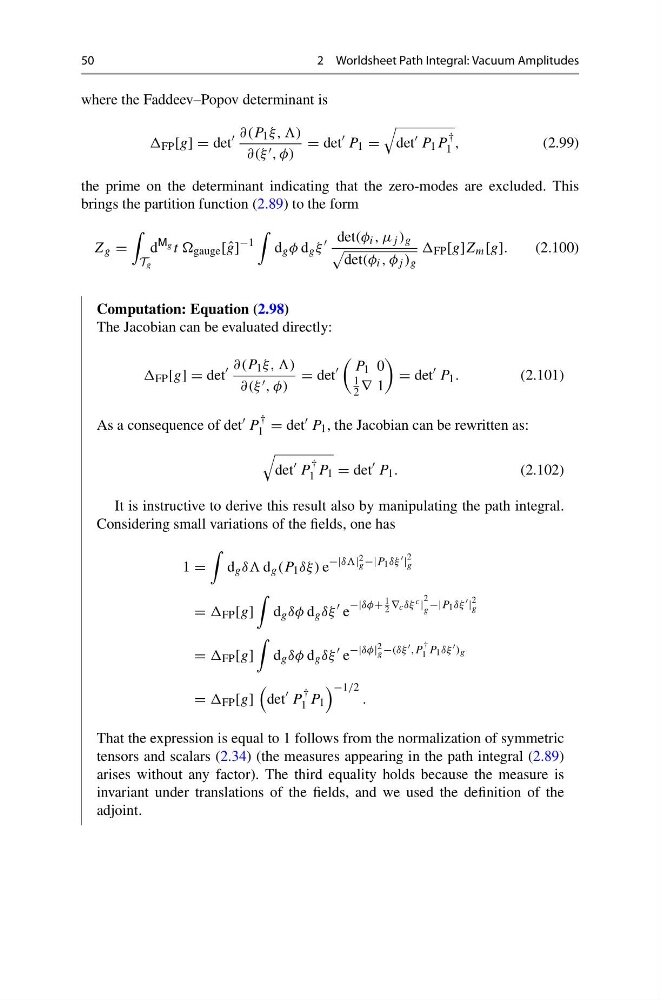
where the Faddeev–Popov determinant is
FP [g] = det
∂(P 1 ξ, ,)
∂(ξ , φ)
= det
P 1 =
det
P 1 P
†
1 ,
(2.99)
the prime on the determinant indicating that the zero-modes are excluded. This
brings the partition function (2.89) to the form
Z g =
T g
d
M g t t gauge [ ˆ
g]
−1
d g φ d g ξ
det(φ i , μ j ) g
det(φ i , φ j ) g
FP [g]Z m [g].
(2.100)
Computation: Equation (2.98)
The Jacobian can be evaluated directly:
FP [g] = det
∂(P 1 ξ, ,)
∂(ξ , φ)
= det
P 1 0
1
2 ∇ 1
= det
P 1 .
(2.101)
As a consequence of det
P
†
1 = det
P 1 , the Jacobian can be rewritten as:
det
P
†
1 P 1 = det
P 1 .
(2.102)
It is instructive to derive this result also by manipulating the path integral.
Considering small variations of the fields, one has
1 =
d g δδ d g (P 1 δξ ) e
−|δδ| 2
g −|P 1 δξ |
2
g
= FP [g]
d g δφ d g δξ
e
−|δφ+
1
2 ∇ c δξ c |
2
g −|P 1 δξ |
2
g
= FP [g]
d g δφ d g δξ
e
−|δφ| 2
g −(δξ ,P
†
1 P 1 δξ ) g
= FP [g]
det
P
†
1 P 1
−1/2
.
That the expression is equal to 1 follows from the normalization of symmetric
tensors and scalars (2.34) (the measures appearing in the path integral (2.89)
arises without any factor). The third equality holds because the measure is
invariant under translations of the fields, and we used the definition of the
adjoint.
2 Worldsheet Path Integral: Vacuum Amplitudes
where the Faddeev–Popov determinant is
FP [g] = det
∂(P 1 ξ, ,)
∂(ξ , φ)
= det
P 1 =
det
P 1 P
†
1 ,
(2.99)
the prime on the determinant indicating that the zero-modes are excluded. This
brings the partition function (2.89) to the form
Z g =
T g
d
M g t t gauge [ ˆ
g]
−1
d g φ d g ξ
det(φ i , μ j ) g
det(φ i , φ j ) g
FP [g]Z m [g].
(2.100)
Computation: Equation (2.98)
The Jacobian can be evaluated directly:
FP [g] = det
∂(P 1 ξ, ,)
∂(ξ , φ)
= det
P 1 0
1
2 ∇ 1
= det
P 1 .
(2.101)
As a consequence of det
P
†
1 = det
P 1 , the Jacobian can be rewritten as:
det
P
†
1 P 1 = det
P 1 .
(2.102)
It is instructive to derive this result also by manipulating the path integral.
Considering small variations of the fields, one has
1 =
d g δδ d g (P 1 δξ ) e
−|δδ| 2
g −|P 1 δξ |
2
g
= FP [g]
d g δφ d g δξ
e
−|δφ+
1
2 ∇ c δξ c |
2
g −|P 1 δξ |
2
g
= FP [g]
d g δφ d g δξ
e
−|δφ| 2
g −(δξ ,P
†
1 P 1 δξ ) g
= FP [g]
det
P
†
1 P 1
−1/2
.
That the expression is equal to 1 follows from the normalization of symmetric
tensors and scalars (2.34) (the measures appearing in the path integral (2.89)
arises without any factor). The third equality holds because the measure is
invariant under translations of the fields, and we used the definition of the
adjoint.