

2.3 Faddeev–Popov Gauge Fixing
41
remaining gauge-independent degrees of freedom. As there are as many gauge
parameters as metric components (Sect. 2.1), one could expect that there are no
remaining physical parameters and then that ˆ
g is totally fixed. But, this is not the
case and the metric ˆ
g depends on a finite number of parameters t i (moduli). The
reason for this is topological: while locally it is always possible to completely fix
the metric, topological obstructions may prevent doing it globally. This means that
not all conformal classes in (2.12) can be (globally) related by a diffeomorphism.
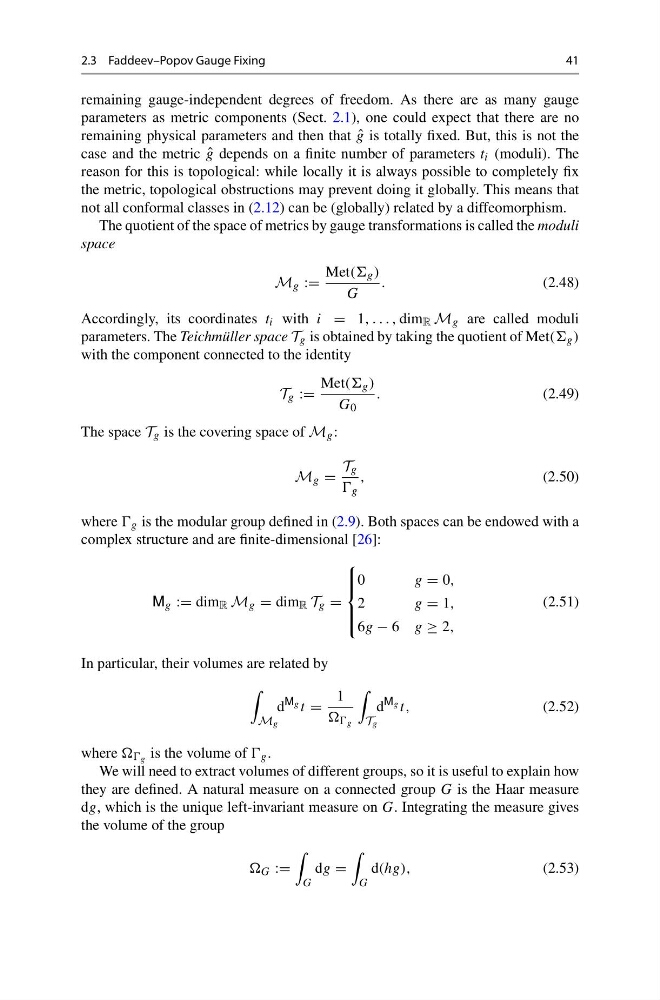
The quotient of the space of metrics by gauge transformations is called the moduli
space
M g :=
Met(( g )
G
.
(2.48)
Accordingly, its coordinates t i with i = 1, . . . , dim R M g are called moduli
parameters. The Teichmüller space T g is obtained by taking the quotient of Met(( g )
with the component connected to the identity
T g :=
Met(( g )
G 0
.
(2.49)
The space T g is the covering space of M g :
M g =
T g
g
,
(2.50)
where g is the modular group defined in (2.9). Both spaces can be endowed with a
complex structure and are finite-dimensional [26]:
M g := dim R M g = dim R T g =
⎧
⎪ ⎪ ⎨
⎪ ⎪ ⎩
0
g = 0,
2
g = 1,
6g − 6 g ≥ 2,
(2.51)
In particular, their volumes are related by
M g
d
M g t =
1
g
T g
d
M g t,
(2.52)
where g is the volume of g .
We will need to extract volumes of different groups, so it is useful to explain how
they are defined. A natural measure on a connected group G is the Haar measure
dg, which is the unique left-invariant measure on G. Integrating the measure gives
the volume of the group
G :=
G
dg =
G
d(hg),
(2.53)
41
remaining gauge-independent degrees of freedom. As there are as many gauge
parameters as metric components (Sect. 2.1), one could expect that there are no
remaining physical parameters and then that ˆ
g is totally fixed. But, this is not the
case and the metric ˆ
g depends on a finite number of parameters t i (moduli). The
reason for this is topological: while locally it is always possible to completely fix
the metric, topological obstructions may prevent doing it globally. This means that
not all conformal classes in (2.12) can be (globally) related by a diffeomorphism.
The quotient of the space of metrics by gauge transformations is called the moduli
space
M g :=
Met(( g )
G
.
(2.48)
Accordingly, its coordinates t i with i = 1, . . . , dim R M g are called moduli
parameters. The Teichmüller space T g is obtained by taking the quotient of Met(( g )
with the component connected to the identity
T g :=
Met(( g )
G 0
.
(2.49)
The space T g is the covering space of M g :
M g =
T g
g
,
(2.50)
where g is the modular group defined in (2.9). Both spaces can be endowed with a
complex structure and are finite-dimensional [26]:
M g := dim R M g = dim R T g =
⎧
⎪ ⎪ ⎨
⎪ ⎪ ⎩
0
g = 0,
2
g = 1,
6g − 6 g ≥ 2,
(2.51)
In particular, their volumes are related by
M g
d
M g t =
1
g
T g
d
M g t,
(2.52)
where g is the volume of g .
We will need to extract volumes of different groups, so it is useful to explain how
they are defined. A natural measure on a connected group G is the Haar measure
dg, which is the unique left-invariant measure on G. Integrating the measure gives
the volume of the group
G :=
G
dg =
G
d(hg),
(2.53)