

30
2 Worldsheet Path Integral: Vacuum Amplitudes
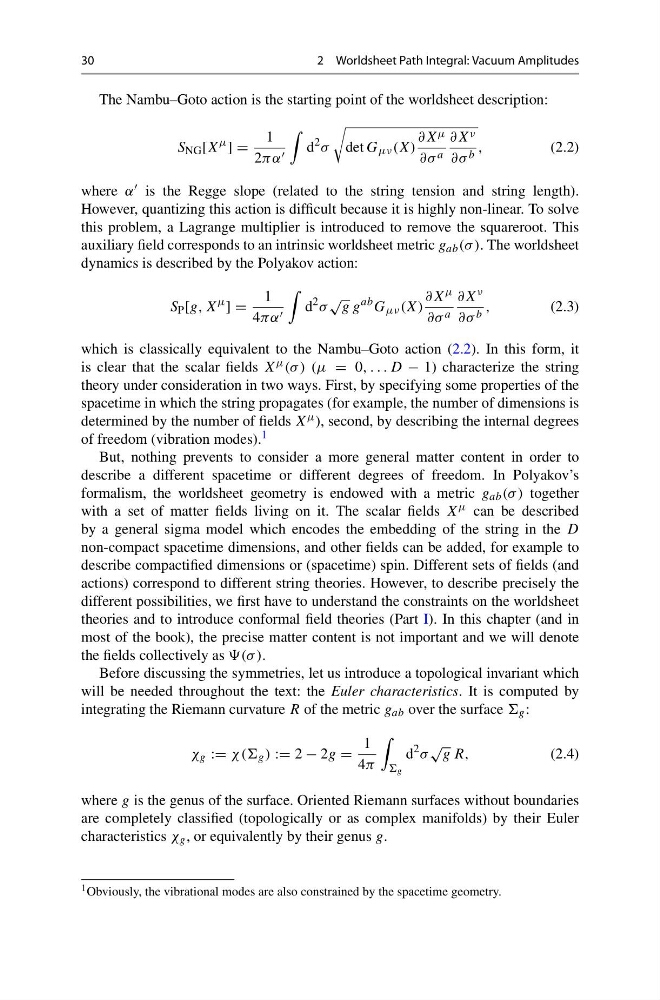
The Nambu–Goto action is the starting point of the worldsheet description:
S NG [X
μ
] =
1
2πα
d
2 σ
det G μν (X)
∂X μ
∂σ a
∂X ν
∂σ b ,
(2.2)
where α is the Regge slope (related to the string tension and string length).
However, quantizing this action is difficult because it is highly non-linear. To solve
this problem, a Lagrange multiplier is introduced to remove the squareroot. This
auxiliary field corresponds to an intrinsic worldsheet metric g ab (σ ). The worldsheet
dynamics is described by the Polyakov action:
S P [g, X
μ
] =
1
4πα
d
2 σ
√ g g
ab G μν (X)
∂X μ
∂σ a
∂X ν
∂σ b ,
(2.3)
which is classically equivalent to the Nambu–Goto action (2.2). In this form, it
is clear that the scalar fields X μ (σ ) (μ = 0, . . . D − 1) characterize the string
theory under consideration in two ways. First, by specifying some properties of the
spacetime in which the string propagates (for example, the number of dimensions is
determined by the number of fields X μ ), second, by describing the internal degrees
of freedom (vibration modes). 1
But, nothing prevents to consider a more general matter content in order to
describe a different spacetime or different degrees of freedom. In Polyakov’s
formalism, the worldsheet geometry is endowed with a metric g ab (σ ) together
with a set of matter fields living on it. The scalar fields X μ can be described
by a general sigma model which encodes the embedding of the string in the D
non-compact spacetime dimensions, and other fields can be added, for example to
describe compactified dimensions or (spacetime) spin. Different sets of fields (and
actions) correspond to different string theories. However, to describe precisely the
different possibilities, we first have to understand the constraints on the worldsheet
theories and to introduce conformal field theories (Part I). In this chapter (and in
most of the book), the precise matter content is not important and we will denote
the fields collectively as ).
Before discussing the symmetries, let us introduce a topological invariant which
will be needed throughout the text: the Euler characteristics. It is computed by
integrating the Riemann curvature R of the metric g ab over the surface g :
χ g := χ(( g ) := 2 − 2g =
1
4π
g
d
2 σ
√ g R,
(2.4)
where g is the genus of the surface. Oriented Riemann surfaces without boundaries
are completely classified (topologically or as complex manifolds) by their Euler
characteristics χ g , or equivalently by their genus g.
1 Obviously, the vibrational modes are also constrained by the spacetime geometry.
2 Worldsheet Path Integral: Vacuum Amplitudes
The Nambu–Goto action is the starting point of the worldsheet description:
S NG [X
μ
] =
1
2πα
d
2 σ
det G μν (X)
∂X μ
∂σ a
∂X ν
∂σ b ,
(2.2)
where α is the Regge slope (related to the string tension and string length).
However, quantizing this action is difficult because it is highly non-linear. To solve
this problem, a Lagrange multiplier is introduced to remove the squareroot. This
auxiliary field corresponds to an intrinsic worldsheet metric g ab (σ ). The worldsheet
dynamics is described by the Polyakov action:
S P [g, X
μ
] =
1
4πα
d
2 σ
√ g g
ab G μν (X)
∂X μ
∂σ a
∂X ν
∂σ b ,
(2.3)
which is classically equivalent to the Nambu–Goto action (2.2). In this form, it
is clear that the scalar fields X μ (σ ) (μ = 0, . . . D − 1) characterize the string
theory under consideration in two ways. First, by specifying some properties of the
spacetime in which the string propagates (for example, the number of dimensions is
determined by the number of fields X μ ), second, by describing the internal degrees
of freedom (vibration modes). 1
But, nothing prevents to consider a more general matter content in order to
describe a different spacetime or different degrees of freedom. In Polyakov’s
formalism, the worldsheet geometry is endowed with a metric g ab (σ ) together
with a set of matter fields living on it. The scalar fields X μ can be described
by a general sigma model which encodes the embedding of the string in the D
non-compact spacetime dimensions, and other fields can be added, for example to
describe compactified dimensions or (spacetime) spin. Different sets of fields (and
actions) correspond to different string theories. However, to describe precisely the
different possibilities, we first have to understand the constraints on the worldsheet
theories and to introduce conformal field theories (Part I). In this chapter (and in
most of the book), the precise matter content is not important and we will denote
the fields collectively as ).
Before discussing the symmetries, let us introduce a topological invariant which
will be needed throughout the text: the Euler characteristics. It is computed by
integrating the Riemann curvature R of the metric g ab over the surface g :
χ g := χ(( g ) := 2 − 2g =
1
4π
g
d
2 σ
√ g R,
(2.4)
where g is the genus of the surface. Oriented Riemann surfaces without boundaries
are completely classified (topologically or as complex manifolds) by their Euler
characteristics χ g , or equivalently by their genus g.
1 Obviously, the vibrational modes are also constrained by the spacetime geometry.