

C Quantum Field Theory
411
where
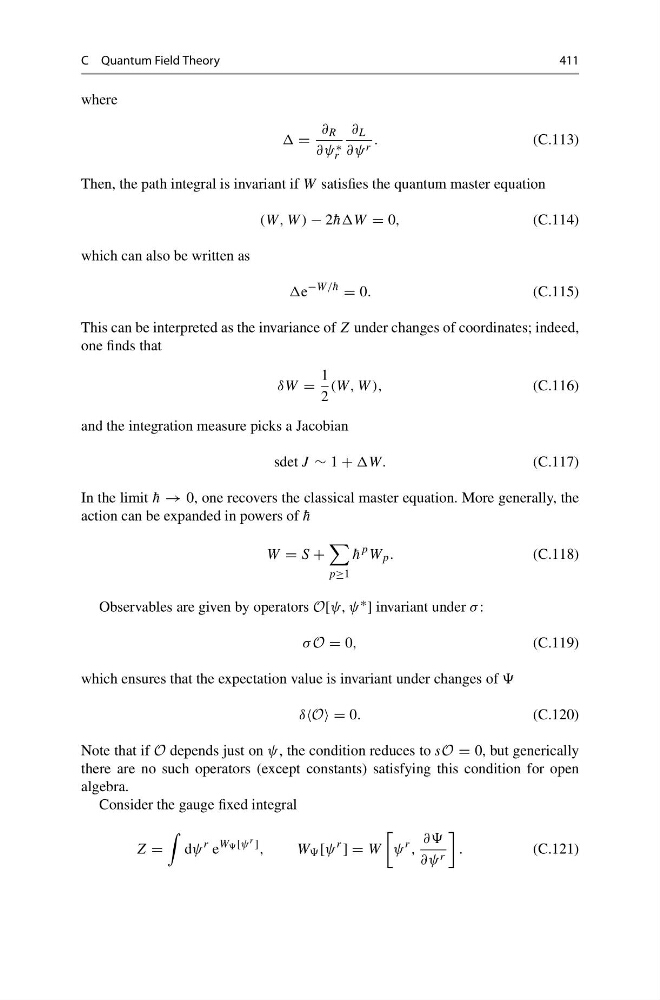
=
∂ R
∂ψ ∗
r
∂ L
∂ψ r .
(C.113)
Then, the path integral is invariant if W satisfies the quantum master equation
(W, W ) − 2 ¯
hhW = 0,
(C.114)
which can also be written as
e
−W/¯ h
= 0.
(C.115)
This can be interpreted as the invariance of Z under changes of coordinates; indeed,
one finds that
δW =
1
2
(W, W ),
(C.116)
and the integration measure picks a Jacobian
sdet J ∼ 1 +
(C.117)
In the limit ¯
h → 0, one recovers the classical master equation. More generally, the
action can be expanded in powers of ¯
h
W = S +
p≥1
¯
h
p W p .
(C.118)
Observables are given by operators O[ψ, ψ ∗ ] invariant under σ :
σ O = 0,
(C.119)
which ensures that the expectation value is invariant under changes of
δO = 0.
(C.120)
Note that if O depends just on ψ, the condition reduces to sO = 0, but generically
there are no such operators (except constants) satisfying this condition for open
algebra.
Consider the gauge fixed integral
Z =
dψ
r e
W [ψ r ] ,
W [ψ
r
] = W
ψ
r ,
∂∂
∂ψ r
.
(C.121)
411
where
=
∂ R
∂ψ ∗
r
∂ L
∂ψ r .
(C.113)
Then, the path integral is invariant if W satisfies the quantum master equation
(W, W ) − 2 ¯
hhW = 0,
(C.114)
which can also be written as
e
−W/¯ h
= 0.
(C.115)
This can be interpreted as the invariance of Z under changes of coordinates; indeed,
one finds that
δW =
1
2
(W, W ),
(C.116)
and the integration measure picks a Jacobian
sdet J ∼ 1 +
(C.117)
In the limit ¯
h → 0, one recovers the classical master equation. More generally, the
action can be expanded in powers of ¯
h
W = S +
p≥1
¯
h
p W p .
(C.118)
Observables are given by operators O[ψ, ψ ∗ ] invariant under σ :
σ O = 0,
(C.119)
which ensures that the expectation value is invariant under changes of
δO = 0.
(C.120)
Note that if O depends just on ψ, the condition reduces to sO = 0, but generically
there are no such operators (except constants) satisfying this condition for open
algebra.
Consider the gauge fixed integral
Z =
dψ
r e
W [ψ r ] ,
W [ψ
r
] = W
ψ
r ,
∂∂
∂ψ r
.
(C.121)