

402
C Quantum Field Theory
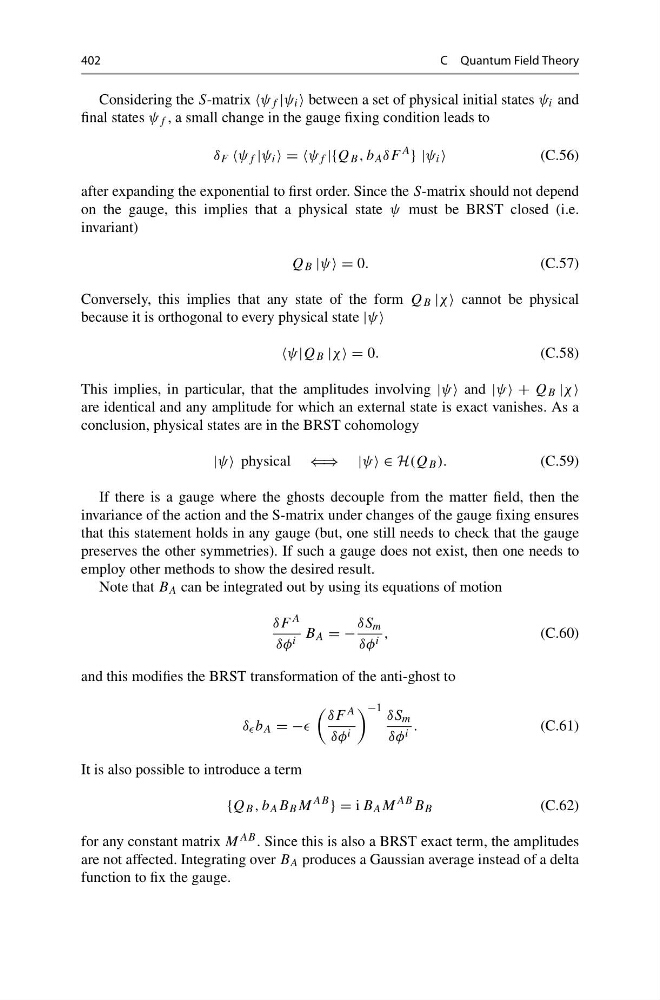
Considering the S-matrix ψ f |ψ i between a set of physical initial states ψ i and
final states ψ f , a small change in the gauge fixing condition leads to
δ F ψ f |ψ i = =ψ f |{Q B , b A δF
A
} |ψ i
(C.56)
after expanding the exponential to first order. Since the S-matrix should not depend
on the gauge, this implies that a physical state ψ must be BRST closed (i.e.
invariant)
Q B |ψ = 0.
(C.57)
Conversely, this implies that any state of the form Q B |χ cannot be physical
because it is orthogonal to every physical state |ψ
ψ|Q B |χ = 0.
(C.58)
This implies, in particular, that the amplitudes involving |ψ and |ψ + Q B |χ
are identical and any amplitude for which an external state is exact vanishes. As a
conclusion, physical states are in the BRST cohomology
|ψ physical ⇐⇒ |ψ ∈ H(Q B ).
(C.59)
If there is a gauge where the ghosts decouple from the matter field, then the
invariance of the action and the S-matrix under changes of the gauge fixing ensures
that this statement holds in any gauge (but, one still needs to check that the gauge
preserves the other symmetries). If such a gauge does not exist, then one needs to
employ other methods to show the desired result.
Note that B A can be integrated out by using its equations of motion
δF A
δφ i B A = −
δS m
δφ i ,
(C.60)
and this modifies the BRST transformation of the anti-ghost to
δ b A = −
δF A
δφ i
−1 δS m
δφ i .
(C.61)
It is also possible to introduce a term
{Q B , b A B B M
AB
} = i B A M
AB B B
(C.62)
for any constant matrix M AB . Since this is also a BRST exact term, the amplitudes
are not affected. Integrating over B A produces a Gaussian average instead of a delta
function to fix the gauge.
C Quantum Field Theory
Considering the S-matrix ψ f |ψ i between a set of physical initial states ψ i and
final states ψ f , a small change in the gauge fixing condition leads to
δ F ψ f |ψ i = =ψ f |{Q B , b A δF
A
} |ψ i
(C.56)
after expanding the exponential to first order. Since the S-matrix should not depend
on the gauge, this implies that a physical state ψ must be BRST closed (i.e.
invariant)
Q B |ψ = 0.
(C.57)
Conversely, this implies that any state of the form Q B |χ cannot be physical
because it is orthogonal to every physical state |ψ
ψ|Q B |χ = 0.
(C.58)
This implies, in particular, that the amplitudes involving |ψ and |ψ + Q B |χ
are identical and any amplitude for which an external state is exact vanishes. As a
conclusion, physical states are in the BRST cohomology
|ψ physical ⇐⇒ |ψ ∈ H(Q B ).
(C.59)
If there is a gauge where the ghosts decouple from the matter field, then the
invariance of the action and the S-matrix under changes of the gauge fixing ensures
that this statement holds in any gauge (but, one still needs to check that the gauge
preserves the other symmetries). If such a gauge does not exist, then one needs to
employ other methods to show the desired result.
Note that B A can be integrated out by using its equations of motion
δF A
δφ i B A = −
δS m
δφ i ,
(C.60)
and this modifies the BRST transformation of the anti-ghost to
δ b A = −
δF A
δφ i
−1 δS m
δφ i .
(C.61)
It is also possible to introduce a term
{Q B , b A B B M
AB
} = i B A M
AB B B
(C.62)
for any constant matrix M AB . Since this is also a BRST exact term, the amplitudes
are not affected. Integrating over B A produces a Gaussian average instead of a delta
function to fix the gauge.