

400
C Quantum Field Theory
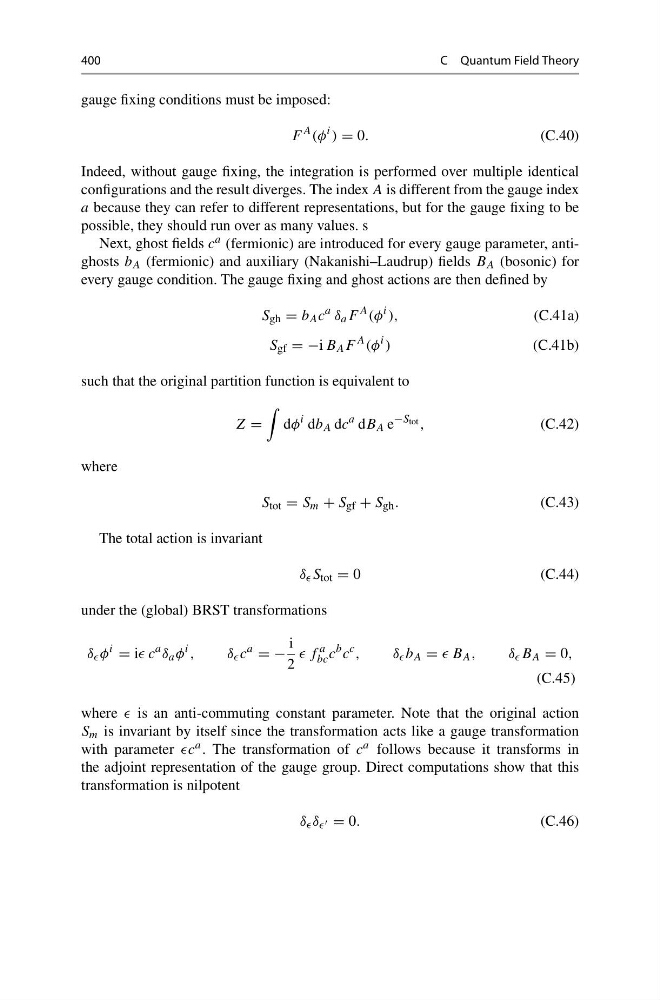
gauge fixing conditions must be imposed:
F
A (φ
i ) = 0.
(C.40)
Indeed, without gauge fixing, the integration is performed over multiple identical
configurations and the result diverges. The index A is different from the gauge index
a because they can refer to different representations, but for the gauge fixing to be
possible, they should run over as many values. s
Next, ghost fields c a (fermionic) are introduced for every gauge parameter, antighosts b A (fermionic) and auxiliary (Nakanishi–Laudrup) fields B A (bosonic) for
every gauge condition. The gauge fixing and ghost actions are then defined by
S gh = b A c
a δ a F
A (φ
i ),
(C.41a)
S gf = −i B A F
A (φ
i )
(C.41b)
such that the original partition function is equivalent to
Z =
dφ
i db A dc
a dB A e
−S tot ,
(C.42)
where
S tot = S m + S gf + S gh .
(C.43)
The total action is invariant
δ S tot = 0
(C.44)
under the (global) BRST transformations
δ φ
i
= i c
a δ a φ
i ,
δ c
a
= −
i
2
f
a
bc c
b c
c ,
δ b A = B A ,
δ B A = 0,
(C.45)
where is an anti-commuting constant parameter. Note that the original action
S m is invariant by itself since the transformation acts like a gauge transformation
with parameter c a . The transformation of c a follows because it transforms in
the adjoint representation of the gauge group. Direct computations show that this
transformation is nilpotent
δ δ = 0.
(C.46)
C Quantum Field Theory
gauge fixing conditions must be imposed:
F
A (φ
i ) = 0.
(C.40)
Indeed, without gauge fixing, the integration is performed over multiple identical
configurations and the result diverges. The index A is different from the gauge index
a because they can refer to different representations, but for the gauge fixing to be
possible, they should run over as many values. s
Next, ghost fields c a (fermionic) are introduced for every gauge parameter, antighosts b A (fermionic) and auxiliary (Nakanishi–Laudrup) fields B A (bosonic) for
every gauge condition. The gauge fixing and ghost actions are then defined by
S gh = b A c
a δ a F
A (φ
i ),
(C.41a)
S gf = −i B A F
A (φ
i )
(C.41b)
such that the original partition function is equivalent to
Z =
dφ
i db A dc
a dB A e
−S tot ,
(C.42)
where
S tot = S m + S gf + S gh .
(C.43)
The total action is invariant
δ S tot = 0
(C.44)
under the (global) BRST transformations
δ φ
i
= i c
a δ a φ
i ,
δ c
a
= −
i
2
f
a
bc c
b c
c ,
δ b A = B A ,
δ B A = 0,
(C.45)
where is an anti-commuting constant parameter. Note that the original action
S m is invariant by itself since the transformation acts like a gauge transformation
with parameter c a . The transformation of c a follows because it transforms in
the adjoint representation of the gauge group. Direct computations show that this
transformation is nilpotent
δ δ = 0.
(C.46)