

382
B Summary of Important Formulas
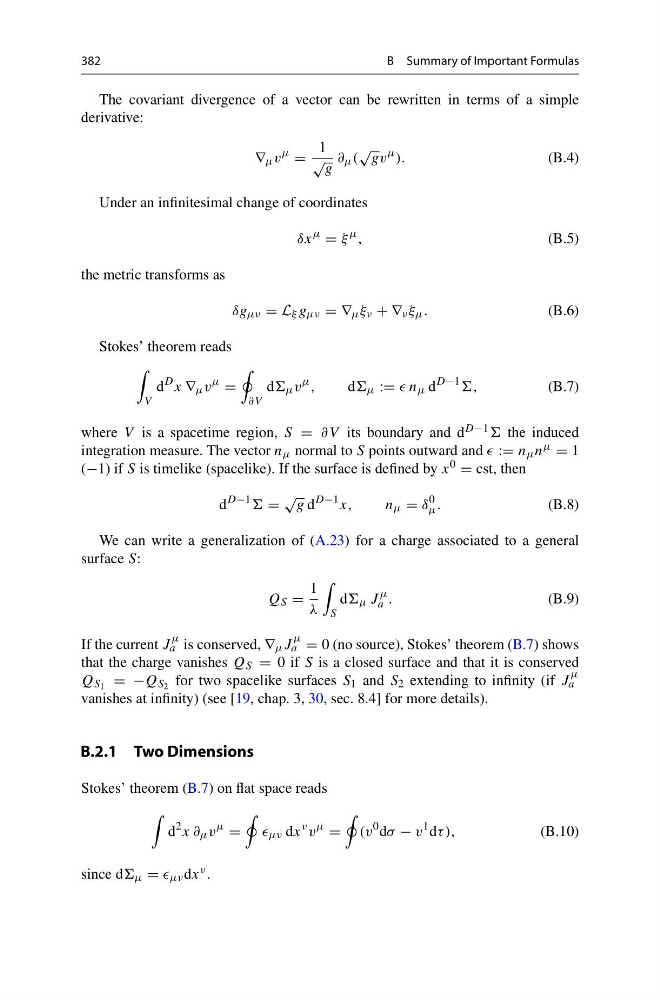
The covariant divergence of a vector can be rewritten in terms of a simple
derivative:
∇ μ v
μ
=
1
√ g
∂ μ (
√
gv
μ ).
(B.4)
Under an infinitesimal change of coordinates
δx
μ
= ξ
μ ,
(B.5)
the metric transforms as
δg μν = L ξ g μν = ∇ μ ξ ν + ∇ ν ξ μ .
(B.6)
Stokes’ theorem reads
V
d
D x ∇ μ v
μ
=
∂V
d μ v
μ ,
d μ := n μ d
D−1 ,
(B.7)
where V is a spacetime region, S = ∂V its boundary and d D−1 the induced
integration measure. The vector n μ normal to S points outward and := n μ n μ = 1
(−1) if S is timelike (spacelike). If the surface is defined by x 0 = cst, then
d
D−1 =
√
g d
D−1 x,
n μ = δ
0
μ .
(B.8)
We can write a generalization of (A.23) for a charge associated to a general
surface S:
Q S =
1
λ
S
d μ J
μ
a .
(B.9)
If the current J
μ
a is conserved, ∇ μ J
μ
a = 0 (no source), Stokes’ theorem (B.7) shows
that the charge vanishes Q S = 0 if S is a closed surface and that it is conserved
Q S 1 = −Q S 2 for two spacelike surfaces S 1 and S 2 extending to infinity (if J
μ
a
vanishes at infinity) (see [19, chap. 3, 30, sec. 8.4] for more details).
B.2.1 Two Dimensions
Stokes’ theorem (B.7) on flat space reads
d
2 x ∂ μ v
μ
=
μν dx
ν v
μ
=
(v
0 dσ − v
1 dτ ),
(B.10)
since d μ = μν dx ν .
B Summary of Important Formulas
The covariant divergence of a vector can be rewritten in terms of a simple
derivative:
∇ μ v
μ
=
1
√ g
∂ μ (
√
gv
μ ).
(B.4)
Under an infinitesimal change of coordinates
δx
μ
= ξ
μ ,
(B.5)
the metric transforms as
δg μν = L ξ g μν = ∇ μ ξ ν + ∇ ν ξ μ .
(B.6)
Stokes’ theorem reads
V
d
D x ∇ μ v
μ
=
∂V
d μ v
μ ,
d μ := n μ d
D−1 ,
(B.7)
where V is a spacetime region, S = ∂V its boundary and d D−1 the induced
integration measure. The vector n μ normal to S points outward and := n μ n μ = 1
(−1) if S is timelike (spacelike). If the surface is defined by x 0 = cst, then
d
D−1 =
√
g d
D−1 x,
n μ = δ
0
μ .
(B.8)
We can write a generalization of (A.23) for a charge associated to a general
surface S:
Q S =
1
λ
S
d μ J
μ
a .
(B.9)
If the current J
μ
a is conserved, ∇ μ J
μ
a = 0 (no source), Stokes’ theorem (B.7) shows
that the charge vanishes Q S = 0 if S is a closed surface and that it is conserved
Q S 1 = −Q S 2 for two spacelike surfaces S 1 and S 2 extending to infinity (if J
μ
a
vanishes at infinity) (see [19, chap. 3, 30, sec. 8.4] for more details).
B.2.1 Two Dimensions
Stokes’ theorem (B.7) on flat space reads
d
2 x ∂ μ v
μ
=
μν dx
ν v
μ
=
(v
0 dσ − v
1 dτ ),
(B.10)
since d μ = μν dx ν .