

348
17 Superstring
17.2.2 Factorization
The plumbing fixture of two Riemann surfaces g 1 ,m 1 ,n 1 and g 2 ,m 2 ,n 2 can be
performed in two different ways since two NS or two R punctures can be glued.
If two NS punctures are glued, the resulting Riemann surface is
(NS)
g 1 +g 2 ,m 1 +m 2 −2,n 1 +n 2
. The number of PCOs inherited from the two original
surfaces is
n
(1)
pco + n
(2)
pco = 2(g 1 + g 2 ) − 2 + (m 1 + m 2 − 2) +
n 1 + n 2
2
= n
(NS)
pco ,
(17.41)
which is the required number for a non-vanishing amplitude. As a consequence, the
propagator is the same as in the bosonic case:
NS = b
+
0 b
−
0
1
L 0 + ¯
L 0
δ(L
−
0 ).
(17.42)
If two R punctures are glued, the numbers of PCO do not match by one unit:
n
(1)
pco +n
(2)
pco = 2(g 1 +g 2 )−2+(m 1 +m 2 )+
n 1 + n 2 − 2
2
−1 = n
(R)
pco −1.
(17.43)
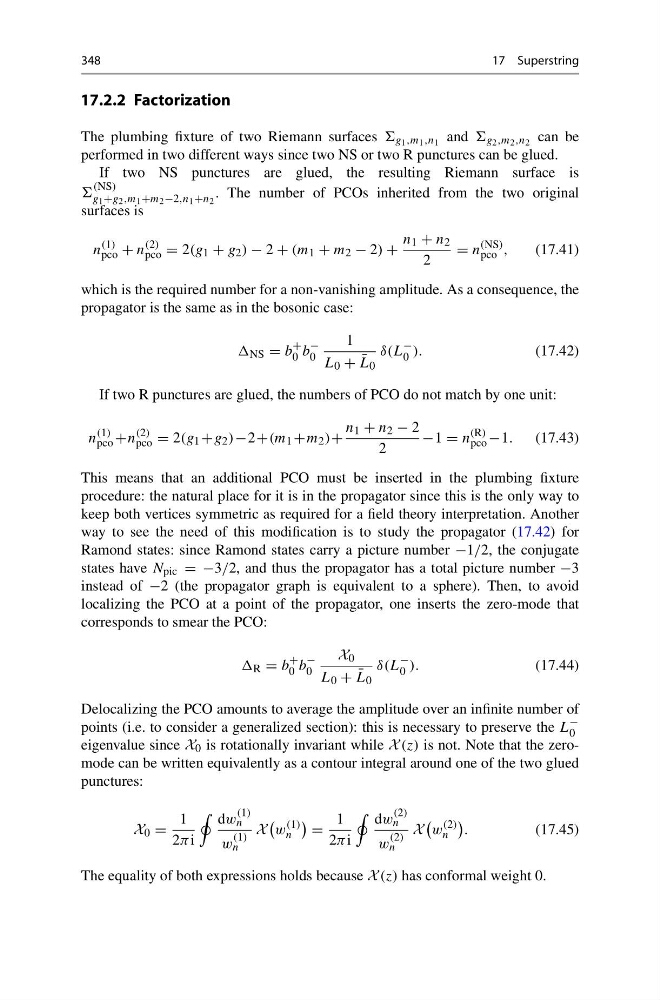
This means that an additional PCO must be inserted in the plumbing fixture
procedure: the natural place for it is in the propagator since this is the only way to
keep both vertices symmetric as required for a field theory interpretation. Another
way to see the need of this modification is to study the propagator (17.42) for
Ramond states: since Ramond states carry a picture number −1/2, the conjugate
states have N pic = −3/2, and thus the propagator has a total picture number −3
instead of −2 (the propagator graph is equivalent to a sphere). Then, to avoid
localizing the PCO at a point of the propagator, one inserts the zero-mode that
corresponds to smear the PCO:
R = b
+
0 b
−
0
X 0
L 0 + ¯
L 0
δ(L
−
0 ).
(17.44)
Delocalizing the PCO amounts to average the amplitude over an infinite number of
points (i.e. to consider a generalized section): this is necessary to preserve the L
−
0
eigenvalue since X 0 is rotationally invariant while X (z) is not. Note that the zeromode can be written equivalently as a contour integral around one of the two glued
punctures:
X 0 =
1
2π i
dw
(1)
n
w
(1)
n
X
w
(1)
n
=
1
2π i
dw
(2)
n
w
(2)
n
X
w
(2)
n
.
(17.45)
The equality of both expressions holds because X (z) has conformal weight 0.
17 Superstring
17.2.2 Factorization
The plumbing fixture of two Riemann surfaces g 1 ,m 1 ,n 1 and g 2 ,m 2 ,n 2 can be
performed in two different ways since two NS or two R punctures can be glued.
If two NS punctures are glued, the resulting Riemann surface is
(NS)
g 1 +g 2 ,m 1 +m 2 −2,n 1 +n 2
. The number of PCOs inherited from the two original
surfaces is
n
(1)
pco + n
(2)
pco = 2(g 1 + g 2 ) − 2 + (m 1 + m 2 − 2) +
n 1 + n 2
2
= n
(NS)
pco ,
(17.41)
which is the required number for a non-vanishing amplitude. As a consequence, the
propagator is the same as in the bosonic case:
NS = b
+
0 b
−
0
1
L 0 + ¯
L 0
δ(L
−
0 ).
(17.42)
If two R punctures are glued, the numbers of PCO do not match by one unit:
n
(1)
pco +n
(2)
pco = 2(g 1 +g 2 )−2+(m 1 +m 2 )+
n 1 + n 2 − 2
2
−1 = n
(R)
pco −1.
(17.43)
This means that an additional PCO must be inserted in the plumbing fixture
procedure: the natural place for it is in the propagator since this is the only way to
keep both vertices symmetric as required for a field theory interpretation. Another
way to see the need of this modification is to study the propagator (17.42) for
Ramond states: since Ramond states carry a picture number −1/2, the conjugate
states have N pic = −3/2, and thus the propagator has a total picture number −3
instead of −2 (the propagator graph is equivalent to a sphere). Then, to avoid
localizing the PCO at a point of the propagator, one inserts the zero-mode that
corresponds to smear the PCO:
R = b
+
0 b
−
0
X 0
L 0 + ¯
L 0
δ(L
−
0 ).
(17.44)
Delocalizing the PCO amounts to average the amplitude over an infinite number of
points (i.e. to consider a generalized section): this is necessary to preserve the L
−
0
eigenvalue since X 0 is rotationally invariant while X (z) is not. Note that the zeromode can be written equivalently as a contour integral around one of the two glued
punctures:
X 0 =
1
2π i
dw
(1)
n
w
(1)
n
X
w
(1)
n
=
1
2π i
dw
(2)
n
w
(2)
n
X
w
(2)
n
.
(17.45)
The equality of both expressions holds because X (z) has conformal weight 0.