

346
17 Superstring
The form M g,m,n is defined as a SCFT correlation function of the physical vertex
operators together with ghost and PCO insertions.
Remark 17.2 A simple way to avoid making errors with signs is to multiply every
Grassmann odd external state with a Grassmann odd number. These can be removed
at the end to read the sign.
The two conditions from the U(1) anomalies on the scattering amplitude are
N gh = 6 − 6g,
N pic = 2g − 2.
(17.36)
Given an amplitude with m NS states V NS
i
∈ H −1 and n R states V R
j ∈ H −1/2 ,
the above picture number can be reached by introducing a certain number of PCOs
X (y A )
n pco := 2g − 2 + m +
n
2
.
(17.37)
These PCOs are inserted at various positions: while the amplitude does not depend
on these locations on-shell, off-shell it will (because the vertex operators are not
BRST invariant). The choices of PCO locations are arbitrary except for several
consistency conditions:
1. avoid spurious poles (Sect. 17.2.3);
2. consistent with factorization (each component of the surface in the degeneration
limits must saturate the picture number condition).
This parallels the discussion of the choices of local coordinates: as a consequence, the natural object is a fibre bundle
P g,m,n with the local coordinate choices
(up to global phase rotations) and the PCO locations as fibre, and the moduli space
M g,m,n as base. Forgetting about the PCO locations leads to a fibre bundle
P g,m,n
that is a generalization of the one found in the bosonic case. The coordinate system
of the fibre bundle presented in the bosonic case is extended by including the PCO
locations {y A }.
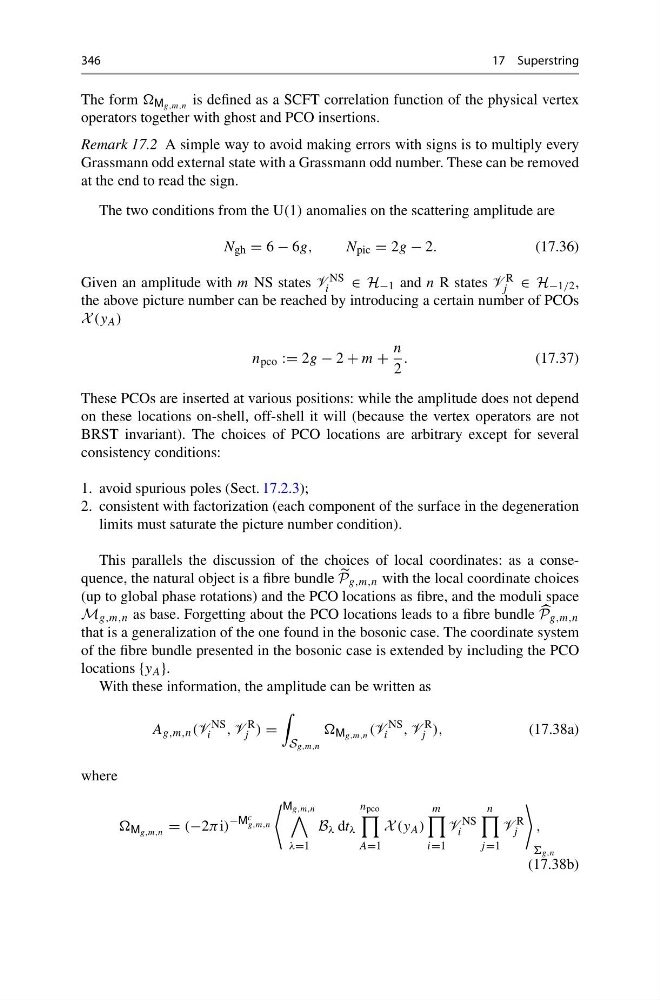
With these information, the amplitude can be written as
A g,m,n (V
NS
i , V
R
j ) =
S g,m,n
M g,m,n (V
NS
i , V
R
j ),
(17.38a)
where
M g,m,n = (−2π i)
−M c
g,m,n
M g,m,n
λ=1
B λ dt λ
n pco
A=1
X (y A )
m
i=1
V
NS
i
n
j =1
V
R
j
g,n
,
(17.38b)
17 Superstring
The form M g,m,n is defined as a SCFT correlation function of the physical vertex
operators together with ghost and PCO insertions.
Remark 17.2 A simple way to avoid making errors with signs is to multiply every
Grassmann odd external state with a Grassmann odd number. These can be removed
at the end to read the sign.
The two conditions from the U(1) anomalies on the scattering amplitude are
N gh = 6 − 6g,
N pic = 2g − 2.
(17.36)
Given an amplitude with m NS states V NS
i
∈ H −1 and n R states V R
j ∈ H −1/2 ,
the above picture number can be reached by introducing a certain number of PCOs
X (y A )
n pco := 2g − 2 + m +
n
2
.
(17.37)
These PCOs are inserted at various positions: while the amplitude does not depend
on these locations on-shell, off-shell it will (because the vertex operators are not
BRST invariant). The choices of PCO locations are arbitrary except for several
consistency conditions:
1. avoid spurious poles (Sect. 17.2.3);
2. consistent with factorization (each component of the surface in the degeneration
limits must saturate the picture number condition).
This parallels the discussion of the choices of local coordinates: as a consequence, the natural object is a fibre bundle
P g,m,n with the local coordinate choices
(up to global phase rotations) and the PCO locations as fibre, and the moduli space
M g,m,n as base. Forgetting about the PCO locations leads to a fibre bundle
P g,m,n
that is a generalization of the one found in the bosonic case. The coordinate system
of the fibre bundle presented in the bosonic case is extended by including the PCO
locations {y A }.
With these information, the amplitude can be written as
A g,m,n (V
NS
i , V
R
j ) =
S g,m,n
M g,m,n (V
NS
i , V
R
j ),
(17.38a)
where
M g,m,n = (−2π i)
−M c
g,m,n
M g,m,n
λ=1
B λ dt λ
n pco
A=1
X (y A )
m
i=1
V
NS
i
n
j =1
V
R
j
g,n
,
(17.38b)