

16.6 Idea of the Proof
335
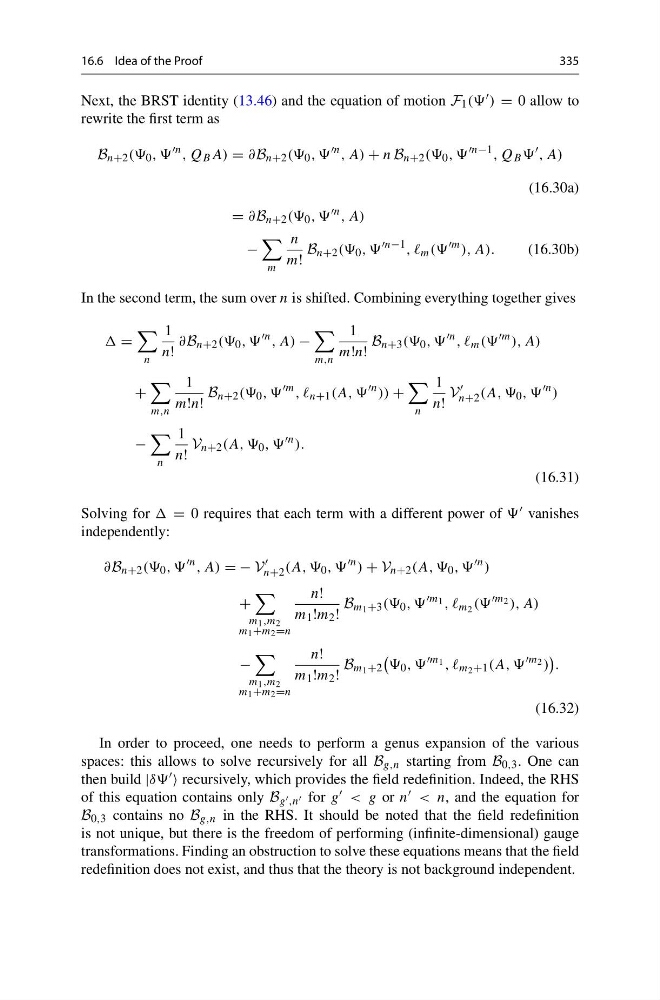
Next, the BRST identity (13.46) and the equation of motion F 1 (( ) = 0 allow to
rewrite the first term as
B n+2 (( 0 , ,
n , Q B A) = ∂B n+2 (( 0 , ,
n , A) + n B n+2 (( 0 , ,
n−1 , Q B
, A)
(16.30a)
= ∂B n+2 (( 0 , ,
n , A)
−
m
n
m!
B n+2 (( 0 , ,
n−1 , , m ((
m ), A).
(16.30b)
In the second term, the sum over n is shifted. Combining everything together gives
=
n
1
n!
∂B n+2 (( 0 , ,
n , A) −
m,n
1
m!n!
B n+3 (( 0 , ,
n , , m ((
m ), A)
+
m,n
1
m!n!
B n+2 (( 0 , ,
m , , n+1 (A, ,
n )) +
n
1
n!
V
n+2 (A, , 0 , ,
n )
−
n
1
n!
V n+2 (A, , 0 , ,
n ).
(16.31)
Solving for = 0 requires that each term with a different power of vanishes
independently:
∂B n+2 (( 0 , ,
n , A) = − V
n+2 (A, , 0 , ,
n ) + V n+2 (A, , 0 , ,
n )
+
m 1 ,m 2
m 1 +m 2 =n
n!
m 1 !m 2 !
B m 1 +3 (( 0 , ,
m 1 , , m 2 ((
m 2 ), A)
−
m 1 ,m 2
m 1 +m 2 =n
n!
m 1 !m 2 !
B m 1 +2
0 , ,
m 1 , , m 2 +1 (A, ,
m 2 )
.
(16.32)
In order to proceed, one needs to perform a genus expansion of the various
spaces: this allows to solve recursively for all B g,n starting from B 0,3 . One can
then build |δδ recursively, which provides the field redefinition. Indeed, the RHS
of this equation contains only B g ,n for g < g or n < n, and the equation for
B 0,3 contains no B g,n in the RHS. It should be noted that the field redefinition
is not unique, but there is the freedom of performing (infinite-dimensional) gauge
transformations. Finding an obstruction to solve these equations means that the field
redefinition does not exist, and thus that the theory is not background independent.
335
Next, the BRST identity (13.46) and the equation of motion F 1 (( ) = 0 allow to
rewrite the first term as
B n+2 (( 0 , ,
n , Q B A) = ∂B n+2 (( 0 , ,
n , A) + n B n+2 (( 0 , ,
n−1 , Q B
, A)
(16.30a)
= ∂B n+2 (( 0 , ,
n , A)
−
m
n
m!
B n+2 (( 0 , ,
n−1 , , m ((
m ), A).
(16.30b)
In the second term, the sum over n is shifted. Combining everything together gives
=
n
1
n!
∂B n+2 (( 0 , ,
n , A) −
m,n
1
m!n!
B n+3 (( 0 , ,
n , , m ((
m ), A)
+
m,n
1
m!n!
B n+2 (( 0 , ,
m , , n+1 (A, ,
n )) +
n
1
n!
V
n+2 (A, , 0 , ,
n )
−
n
1
n!
V n+2 (A, , 0 , ,
n ).
(16.31)
Solving for = 0 requires that each term with a different power of vanishes
independently:
∂B n+2 (( 0 , ,
n , A) = − V
n+2 (A, , 0 , ,
n ) + V n+2 (A, , 0 , ,
n )
+
m 1 ,m 2
m 1 +m 2 =n
n!
m 1 !m 2 !
B m 1 +3 (( 0 , ,
m 1 , , m 2 ((
m 2 ), A)
−
m 1 ,m 2
m 1 +m 2 =n
n!
m 1 !m 2 !
B m 1 +2
0 , ,
m 1 , , m 2 +1 (A, ,
m 2 )
.
(16.32)
In order to proceed, one needs to perform a genus expansion of the various
spaces: this allows to solve recursively for all B g,n starting from B 0,3 . One can
then build |δδ recursively, which provides the field redefinition. Indeed, the RHS
of this equation contains only B g ,n for g < g or n < n, and the equation for
B 0,3 contains no B g,n in the RHS. It should be noted that the field redefinition
is not unique, but there is the freedom of performing (infinite-dimensional) gauge
transformations. Finding an obstruction to solve these equations means that the field
redefinition does not exist, and thus that the theory is not background independent.