

16.5 Relating the Equations of Motion
333
where
S
[
] =
1
g 2
s
1
2
| c
−
0 Q B |
+
n
1
n!
V n ((
n ) + λ V n+1 (( 0 , ,
n )
.
(16.19)
The equation of motion is
F
((
) := F 1 ((
) + λ δF
((
) = 0,
(16.20)
where F 1 is given in (16.3) and
δF
((
) =
n
1
n!
n+1 (( 0 , ,
n ).
(16.21)
16.5 Relating the Equations of Motion
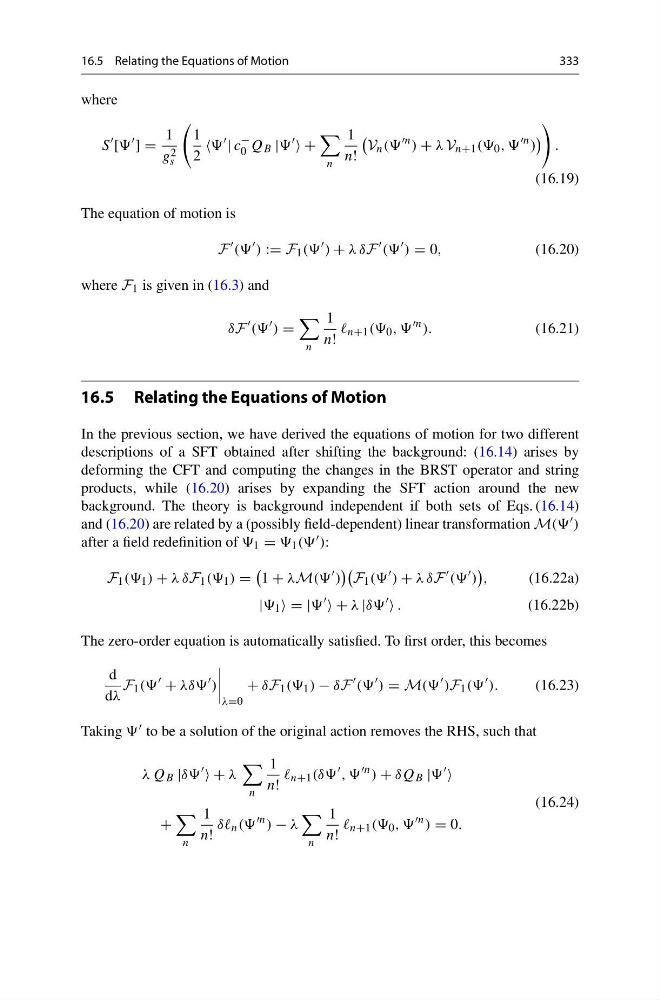
In the previous section, we have derived the equations of motion for two different
descriptions of a SFT obtained after shifting the background: (16.14) arises by
deforming the CFT and computing the changes in the BRST operator and string
products, while (16.20) arises by expanding the SFT action around the new
background. The theory is background independent if both sets of Eqs. (16.14)
and (16.20) are related by a (possibly field-dependent) linear transformation M(( )
after a field redefinition of 1 = 1 (( ):
F 1 (( 1 ) + λ δF 1 (( 1 ) =
1 + λM((
)
F 1 ((
) + λ δF
((
)
,
(16.22a)
| 1 = |
+ λ |δδ
.
(16.22b)
The zero-order equation is automatically satisfied. To first order, this becomes
d
dλ
F 1 ((
+ λδδ
)
λ=0
+ δF 1 (( 1 ) − δF
((
) = M((
)F 1 ((
).
(16.23)
Taking to be a solution of the original action removes the RHS, such that
λ Q B |δδ
+ λ
n
1
n!
n+1 (δδ
, ,
n ) + δQ B |
+
n
1
n!
δδ n ((
n ) − λ
n
1
n!
n+1 (( 0 , ,
n ) = 0.
(16.24)
333
where
S
[
] =
1
g 2
s
1
2
| c
−
0 Q B |
+
n
1
n!
V n ((
n ) + λ V n+1 (( 0 , ,
n )
.
(16.19)
The equation of motion is
F
((
) := F 1 ((
) + λ δF
((
) = 0,
(16.20)
where F 1 is given in (16.3) and
δF
((
) =
n
1
n!
n+1 (( 0 , ,
n ).
(16.21)
16.5 Relating the Equations of Motion
In the previous section, we have derived the equations of motion for two different
descriptions of a SFT obtained after shifting the background: (16.14) arises by
deforming the CFT and computing the changes in the BRST operator and string
products, while (16.20) arises by expanding the SFT action around the new
background. The theory is background independent if both sets of Eqs. (16.14)
and (16.20) are related by a (possibly field-dependent) linear transformation M(( )
after a field redefinition of 1 = 1 (( ):
F 1 (( 1 ) + λ δF 1 (( 1 ) =
1 + λM((
)
F 1 ((
) + λ δF
((
)
,
(16.22a)
| 1 = |
+ λ |δδ
.
(16.22b)
The zero-order equation is automatically satisfied. To first order, this becomes
d
dλ
F 1 ((
+ λδδ
)
λ=0
+ δF 1 (( 1 ) − δF
((
) = M((
)F 1 ((
).
(16.23)
Taking to be a solution of the original action removes the RHS, such that
λ Q B |δδ
+ λ
n
1
n!
n+1 (δδ
, ,
n ) + δQ B |
+
n
1
n!
δδ n ((
n ) − λ
n
1
n!
n+1 (( 0 , ,
n ) = 0.
(16.24)