

316
15 Closed String Field Theory
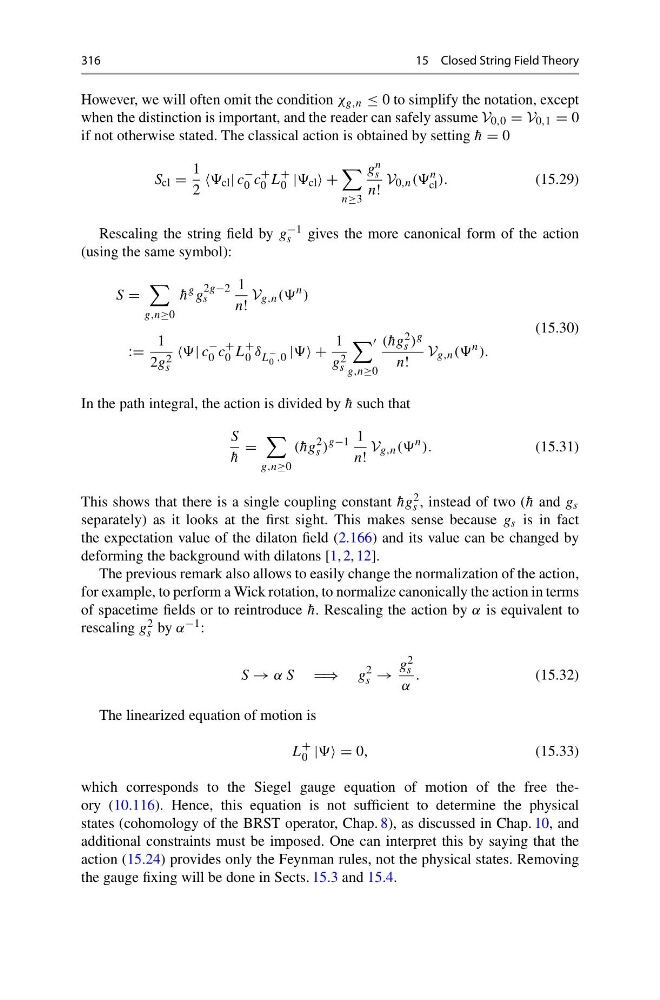
However, we will often omit the condition χ g,n ≤ 0 to simplify the notation, except
when the distinction is important, and the reader can safely assume V 0,0 = V 0,1 = 0
if not otherwise stated. The classical action is obtained by setting ¯
h = 0
S cl =
1
2
cl | c
−
0 c
+
0 L
+
0 | cl +
n≥3
g n
s
n!
V 0,n ((
n
cl ).
(15.29)
Rescaling the string field by g −1
s gives the more canonical form of the action
(using the same symbol):
S =
g,n≥0
¯
h
g g
2g−2
s
1
n!
V g,n ((
n )
:=
1
2g 2
s
| c
−
0 c
+
0 L
+
0 δ L
−
0 ,0 | +
1
g 2
s
g,n≥0
( ¯
hg 2
s ) g
n!
V g,n ((
n ).
(15.30)
In the path integral, the action is divided by ¯
h such that
S
¯
h
=
g,n≥0
( ¯
hg
2
s )
g−1 1
n!
V g,n ((
n ).
(15.31)
This shows that there is a single coupling constant ¯
hg 2
s , instead of two ( ¯
h and g s
separately) as it looks at the first sight. This makes sense because g s is in fact
the expectation value of the dilaton field (2.166) and its value can be changed by
deforming the background with dilatons [1, 2, 12].
The previous remark also allows to easily change the normalization of the action,
for example, to perform a Wick rotation, to normalize canonically the action in terms
of spacetime fields or to reintroduce ¯
h. Rescaling the action by α is equivalent to
rescaling g 2
s by α −1 :
S → α S ⇒ g
2
s →
g 2
s
α
.
(15.32)
The linearized equation of motion is
L
+
0 | = 0,
(15.33)
which corresponds to the Siegel gauge equation of motion of the free theory (10.116). Hence, this equation is not sufficient to determine the physical
states (cohomology of the BRST operator, Chap. 8), as discussed in Chap. 10, and
additional constraints must be imposed. One can interpret this by saying that the
action (15.24) provides only the Feynman rules, not the physical states. Removing
the gauge fixing will be done in Sects. 15.3 and 15.4.
15 Closed String Field Theory
However, we will often omit the condition χ g,n ≤ 0 to simplify the notation, except
when the distinction is important, and the reader can safely assume V 0,0 = V 0,1 = 0
if not otherwise stated. The classical action is obtained by setting ¯
h = 0
S cl =
1
2
cl | c
−
0 c
+
0 L
+
0 | cl +
n≥3
g n
s
n!
V 0,n ((
n
cl ).
(15.29)
Rescaling the string field by g −1
s gives the more canonical form of the action
(using the same symbol):
S =
g,n≥0
¯
h
g g
2g−2
s
1
n!
V g,n ((
n )
:=
1
2g 2
s
| c
−
0 c
+
0 L
+
0 δ L
−
0 ,0 | +
1
g 2
s
g,n≥0
( ¯
hg 2
s ) g
n!
V g,n ((
n ).
(15.30)
In the path integral, the action is divided by ¯
h such that
S
¯
h
=
g,n≥0
( ¯
hg
2
s )
g−1 1
n!
V g,n ((
n ).
(15.31)
This shows that there is a single coupling constant ¯
hg 2
s , instead of two ( ¯
h and g s
separately) as it looks at the first sight. This makes sense because g s is in fact
the expectation value of the dilaton field (2.166) and its value can be changed by
deforming the background with dilatons [1, 2, 12].
The previous remark also allows to easily change the normalization of the action,
for example, to perform a Wick rotation, to normalize canonically the action in terms
of spacetime fields or to reintroduce ¯
h. Rescaling the action by α is equivalent to
rescaling g 2
s by α −1 :
S → α S ⇒ g
2
s →
g 2
s
α
.
(15.32)
The linearized equation of motion is
L
+
0 | = 0,
(15.33)
which corresponds to the Siegel gauge equation of motion of the free theory (10.116). Hence, this equation is not sufficient to determine the physical
states (cohomology of the BRST operator, Chap. 8), as discussed in Chap. 10, and
additional constraints must be imposed. One can interpret this by saying that the
action (15.24) provides only the Feynman rules, not the physical states. Removing
the gauge fixing will be done in Sects. 15.3 and 15.4.