

1.2 String Theory
15
Divergences and Feynman Graphs
Formally the moduli parameters are equivalent to Schwinger (proper-time) parameters s i in usual QFT: these are introduced in order to rewrite propagators as
1
k 2 + m 2 =
∞
0
ds e
−s(k 2 +m 2 ) ,
(1.28)
such that the integration over the momentum k becomes a Gaussian times a
polynomial. This form of the propagator is useful to display the three types of
divergences which can be encountered:
1. IR: regions s i → ∞ (for k 2 + m 2 ≤ 0). These divergences are artificial for
k 2 + m 2 < 0 and means that the parametrization is not appropriate. Divergences
for k 2 + m 2 = 0 are genuine and translates the fact that quantum effects shift
the vacuum and the masses. Taking these effects into account necessitates a field
theory framework in which renormalization can be used.
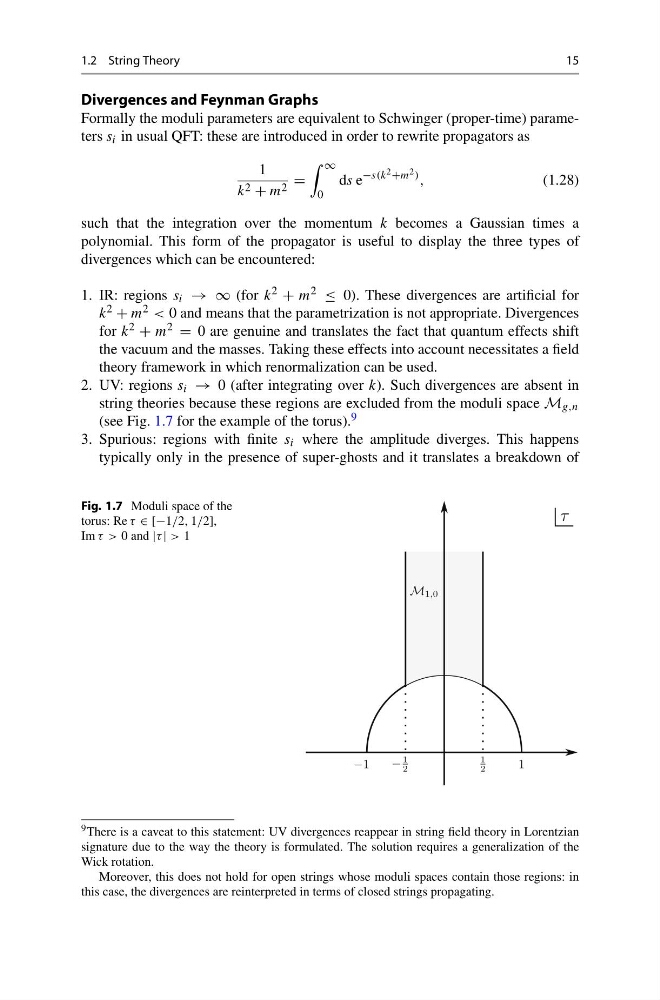
2. UV: regions s i → 0 (after integrating over k). Such divergences are absent in
string theories because these regions are excluded from the moduli space M g,n
(see Fig. 1.7 for the example of the torus). 9
3. Spurious: regions with finite s i where the amplitude diverges. This happens
typically only in the presence of super-ghosts and it translates a breakdown of
Fig. 1.7 Moduli space of the
torus: Re τ ∈ [−1/2, 1/2],
Im τ > 0 and |τ | > 1
9 There is a caveat to this statement: UV divergences reappear in string field theory in Lorentzian
signature due to the way the theory is formulated. The solution requires a generalization of the
Wick rotation.
Moreover, this does not hold for open strings whose moduli spaces contain those regions: in
this case, the divergences are reinterpreted in terms of closed strings propagating.
15
Divergences and Feynman Graphs
Formally the moduli parameters are equivalent to Schwinger (proper-time) parameters s i in usual QFT: these are introduced in order to rewrite propagators as
1
k 2 + m 2 =
∞
0
ds e
−s(k 2 +m 2 ) ,
(1.28)
such that the integration over the momentum k becomes a Gaussian times a
polynomial. This form of the propagator is useful to display the three types of
divergences which can be encountered:
1. IR: regions s i → ∞ (for k 2 + m 2 ≤ 0). These divergences are artificial for
k 2 + m 2 < 0 and means that the parametrization is not appropriate. Divergences
for k 2 + m 2 = 0 are genuine and translates the fact that quantum effects shift
the vacuum and the masses. Taking these effects into account necessitates a field
theory framework in which renormalization can be used.
2. UV: regions s i → 0 (after integrating over k). Such divergences are absent in
string theories because these regions are excluded from the moduli space M g,n
(see Fig. 1.7 for the example of the torus). 9
3. Spurious: regions with finite s i where the amplitude diverges. This happens
typically only in the presence of super-ghosts and it translates a breakdown of
Fig. 1.7 Moduli space of the
torus: Re τ ∈ [−1/2, 1/2],
Im τ > 0 and |τ | > 1
9 There is a caveat to this statement: UV divergences reappear in string field theory in Lorentzian
signature due to the way the theory is formulated. The solution requires a generalization of the
Wick rotation.
Moreover, this does not hold for open strings whose moduli spaces contain those regions: in
this case, the divergences are reinterpreted in terms of closed strings propagating.