

15.2 Gauge Fixed Theory
311
action itself is gauge fixed. To undercover its deeper structure, it is necessary to
release the gauge fixing condition. In view of the analysis of the quadratic action in
Chap. 10, we can expect that the BV formalism is required. Another possibility is to
consider directly the 1PI action.
In this section, we first derive the kinetic term by inverting the propagator. For
this to be possible, the string field must obey some constraints: we will find that they
correspond to the level-matching and Siegel gauge conditions. Then, we introduce
the interactions into the action.
15.2.1 Kinetic Term and Propagator
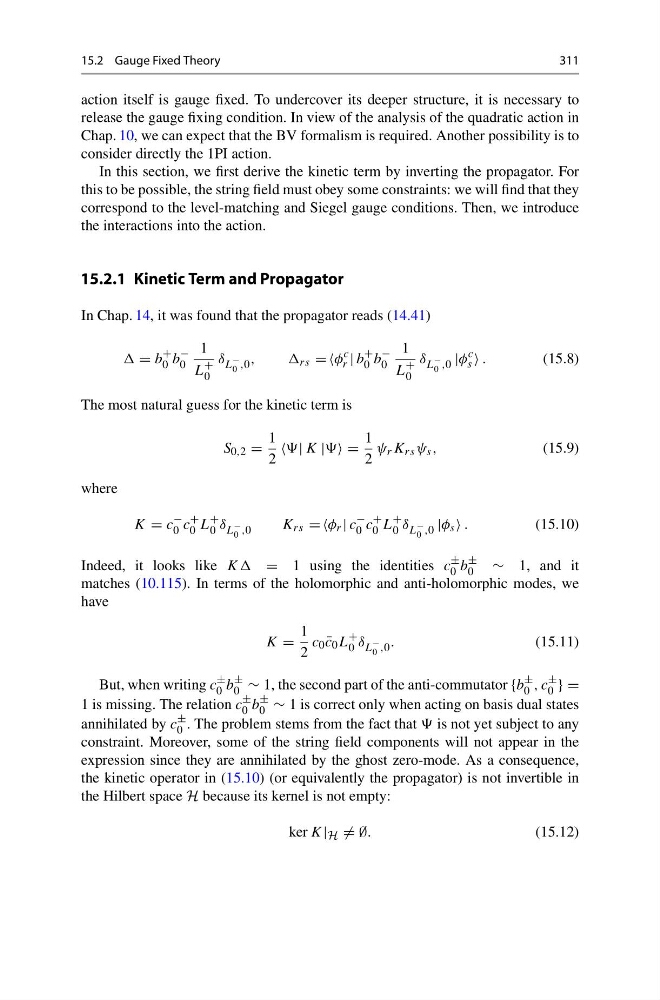
In Chap. 14, it was found that the propagator reads (14.41)
= b
+
0 b
−
0
1
L
+
0
δ L
−
0 ,0 ,
, rs = =φ
c
r | b
+
0 b
−
0
1
L
+
0
δ L
−
0 ,0 |φ
c
s .
(15.8)
The most natural guess for the kinetic term is
S 0,2 =
1
2
| K | =
1
2
ψ r K rs ψ s ,
(15.9)
where
K = c
−
0 c
+
0 L
+
0 δ L
−
0 ,0
K rs = =φ r | c
−
0 c
+
0 L
+
0 δ L
−
0 ,0 |φ s .
(15.10)
Indeed, it looks like KK = 1 using the identities c
±
0 b
±
0
∼ 1, and it
matches (10.115). In terms of the holomorphic and anti-holomorphic modes, we
have
K =
1
2
c 0 ¯
c 0 L
+
0 δ L
−
0 ,0 .
(15.11)
But, when writing c
±
0 b
±
0 ∼ 1, the second part of the anti-commutator {b
±
0 , c
±
0 } =
1 is missing. The relation c
±
0 b
±
0 ∼ 1 is correct only when acting on basis dual states
annihilated by c
±
0 . The problem stems from the fact that is not yet subject to any
constraint. Moreover, some of the string field components will not appear in the
expression since they are annihilated by the ghost zero-mode. As a consequence,
the kinetic operator in (15.10) (or equivalently the propagator) is not invertible in
the Hilbert space H because its kernel is not empty:
ker K| H = ∅.
(15.12)
311
action itself is gauge fixed. To undercover its deeper structure, it is necessary to
release the gauge fixing condition. In view of the analysis of the quadratic action in
Chap. 10, we can expect that the BV formalism is required. Another possibility is to
consider directly the 1PI action.
In this section, we first derive the kinetic term by inverting the propagator. For
this to be possible, the string field must obey some constraints: we will find that they
correspond to the level-matching and Siegel gauge conditions. Then, we introduce
the interactions into the action.
15.2.1 Kinetic Term and Propagator
In Chap. 14, it was found that the propagator reads (14.41)
= b
+
0 b
−
0
1
L
+
0
δ L
−
0 ,0 ,
, rs = =φ
c
r | b
+
0 b
−
0
1
L
+
0
δ L
−
0 ,0 |φ
c
s .
(15.8)
The most natural guess for the kinetic term is
S 0,2 =
1
2
| K | =
1
2
ψ r K rs ψ s ,
(15.9)
where
K = c
−
0 c
+
0 L
+
0 δ L
−
0 ,0
K rs = =φ r | c
−
0 c
+
0 L
+
0 δ L
−
0 ,0 |φ s .
(15.10)
Indeed, it looks like KK = 1 using the identities c
±
0 b
±
0
∼ 1, and it
matches (10.115). In terms of the holomorphic and anti-holomorphic modes, we
have
K =
1
2
c 0 ¯
c 0 L
+
0 δ L
−
0 ,0 .
(15.11)
But, when writing c
±
0 b
±
0 ∼ 1, the second part of the anti-commutator {b
±
0 , c
±
0 } =
1 is missing. The relation c
±
0 b
±
0 ∼ 1 is correct only when acting on basis dual states
annihilated by c
±
0 . The problem stems from the fact that is not yet subject to any
constraint. Moreover, some of the string field components will not appear in the
expression since they are annihilated by the ghost zero-mode. As a consequence,
the kinetic operator in (15.10) (or equivalently the propagator) is not invertible in
the Hilbert space H because its kernel is not empty:
ker K| H = ∅.
(15.12)