

14.3 Properties of Fundamental Vertices
307
Writing z i = f i (0), there is a SL(2, C) transformation g(z) such that
g(z 1 ) = z 2 ,
g(z 2 ) = z 3 ,
g(z 3 ) = z 1
(14.75)
such that
V 0,3 (V 3 , V 1 , V 2 ) = =g ◦ f 1 ◦ V 3 (0)g ◦ f 2 ◦ V 1 (0)g ◦ f 3 ◦ V 2 (0).
(14.76)
While the state V i is correctly inserted at the puncture z i in this expression, this
is not sufficient to guarantee the equality of the amplitudes. Indeed the fibre is
defined by the complete functions f i (w) and not only by their values at w = 0.
For this reason, the amplitudes can be equal only if
g ◦ f 1 = f 2 ,
g◦ f 2 = f 3 ,
g◦ f 3 = f 1 .
(14.77)
This provides constraints on the functions f i , but it is often not possible to solve
them.
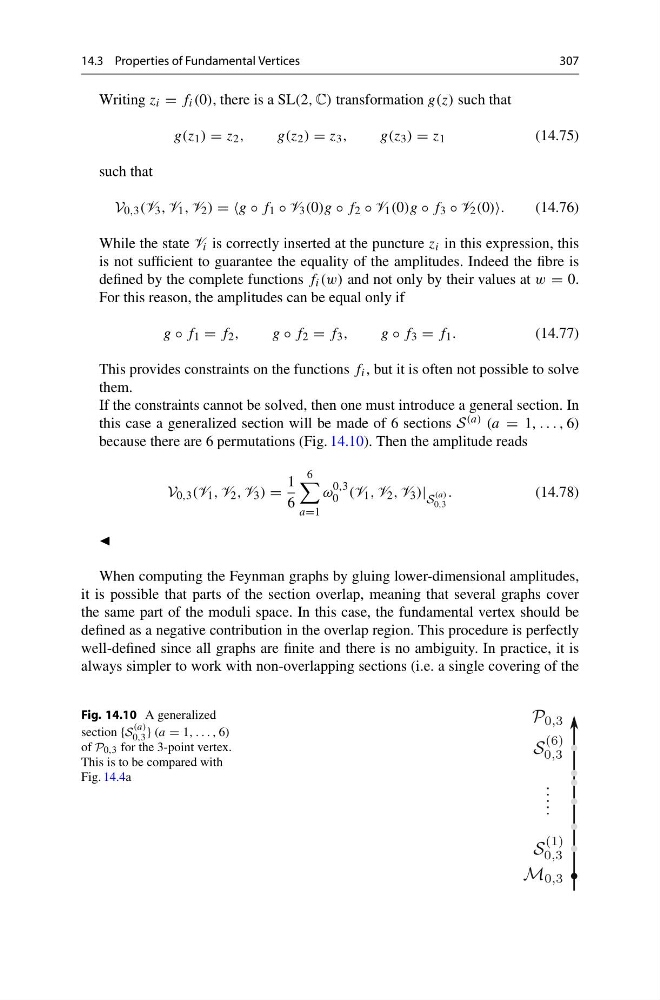
If the constraints cannot be solved, then one must introduce a general section. In
this case a generalized section will be made of 6 sections S (a) (a = 1, . . . , 6)
because there are 6 permutations (Fig. 14.10). Then the amplitude reads
V 0,3 (V 1 , V 2 , V 3 ) =
1
6
6
a=1
ω
0,3
0 (V 1 , V 2 , V 3 )| S
(a)
0,3
.
(14.78)
When computing the Feynman graphs by gluing lower-dimensional amplitudes,
it is possible that parts of the section overlap, meaning that several graphs cover
the same part of the moduli space. In this case, the fundamental vertex should be
defined as a negative contribution in the overlap region. This procedure is perfectly
well-defined since all graphs are finite and there is no ambiguity. In practice, it is
always simpler to work with non-overlapping sections (i.e. a single covering of the
Fig. 14.10 A generalized
section {S
(a)
0,3 } (a = 1, . . . , 6)
of P 0,3 for the 3-point vertex.
This is to be compared with
Fig. 14.4a
307
Writing z i = f i (0), there is a SL(2, C) transformation g(z) such that
g(z 1 ) = z 2 ,
g(z 2 ) = z 3 ,
g(z 3 ) = z 1
(14.75)
such that
V 0,3 (V 3 , V 1 , V 2 ) = =g ◦ f 1 ◦ V 3 (0)g ◦ f 2 ◦ V 1 (0)g ◦ f 3 ◦ V 2 (0).
(14.76)
While the state V i is correctly inserted at the puncture z i in this expression, this
is not sufficient to guarantee the equality of the amplitudes. Indeed the fibre is
defined by the complete functions f i (w) and not only by their values at w = 0.
For this reason, the amplitudes can be equal only if
g ◦ f 1 = f 2 ,
g◦ f 2 = f 3 ,
g◦ f 3 = f 1 .
(14.77)
This provides constraints on the functions f i , but it is often not possible to solve
them.
If the constraints cannot be solved, then one must introduce a general section. In
this case a generalized section will be made of 6 sections S (a) (a = 1, . . . , 6)
because there are 6 permutations (Fig. 14.10). Then the amplitude reads
V 0,3 (V 1 , V 2 , V 3 ) =
1
6
6
a=1
ω
0,3
0 (V 1 , V 2 , V 3 )| S
(a)
0,3
.
(14.78)
When computing the Feynman graphs by gluing lower-dimensional amplitudes,
it is possible that parts of the section overlap, meaning that several graphs cover
the same part of the moduli space. In this case, the fundamental vertex should be
defined as a negative contribution in the overlap region. This procedure is perfectly
well-defined since all graphs are finite and there is no ambiguity. In practice, it is
always simpler to work with non-overlapping sections (i.e. a single covering of the
Fig. 14.10 A generalized
section {S
(a)
0,3 } (a = 1, . . . , 6)
of P 0,3 for the 3-point vertex.
This is to be compared with
Fig. 14.4a