

286
14 Amplitude Factorization and Feynman Diagrams
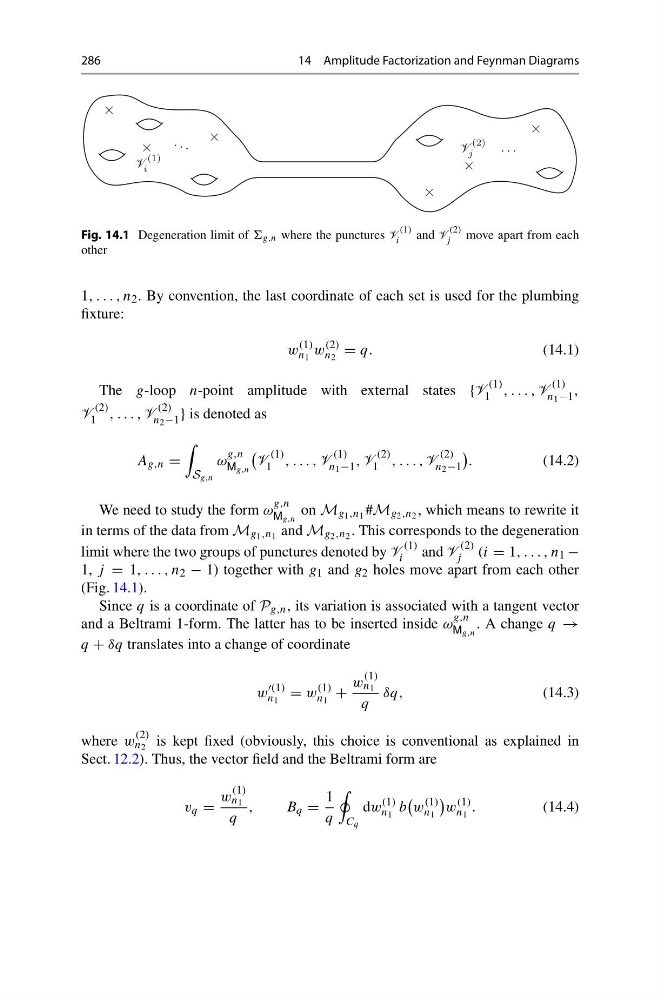
Fig. 14.1 Degeneration limit of g,n where the punctures V
(1)
i
and V
(2)
j
move apart from each
other
1, . . . , n 2 . By convention, the last coordinate of each set is used for the plumbing
fixture:
w
(1)
n 1
w
(2)
n 2
= q.
(14.1)
The g-loop n-point amplitude with external states {V
(1)
1 , . . . , V
(1)
n 1 −1 ,
V
(2)
1 , . . . , V
(2)
n 2 −1 } is denoted as
A g,n =
S g,n
ω
g,n
M g,n
V
(1)
1 , . . . , V
(1)
n 1 −1 , V
(2)
1 , . . . , V
(2)
n 2 −1
.
(14.2)
We need to study the form ω
g,n
M g,n
on M g 1 ,n 1 #M g 2 ,n 2 , which means to rewrite it
in terms of the data from M g 1 ,n 1 and M g 2 ,n 2 . This corresponds to the degeneration
limit where the two groups of punctures denoted by V
(1)
i
and V
(2)
j
(i = 1, . . . , n 1 −
1, j = 1, . . . , n 2 − 1) together with g 1 and g 2 holes move apart from each other
(Fig. 14.1).
Since q is a coordinate of P g,n , its variation is associated with a tangent vector
and a Beltrami 1-form. The latter has to be inserted inside ω
g,n
M g,n
. A change q →
q + δq translates into a change of coordinate
w
(1)
n 1
= w
(1)
n 1
+
w
(1)
n 1
q
δq,
(14.3)
where w
(2)
n 2 is kept fixed (obviously, this choice is conventional as explained in
Sect. 12.2). Thus, the vector field and the Beltrami form are
v q =
w
(1)
n 1
q
,
B q =
1
q
C q
dw
(1)
n 1
b
w
(1)
n 1
w
(1)
n 1
.
(14.4)
14 Amplitude Factorization and Feynman Diagrams
Fig. 14.1 Degeneration limit of g,n where the punctures V
(1)
i
and V
(2)
j
move apart from each
other
1, . . . , n 2 . By convention, the last coordinate of each set is used for the plumbing
fixture:
w
(1)
n 1
w
(2)
n 2
= q.
(14.1)
The g-loop n-point amplitude with external states {V
(1)
1 , . . . , V
(1)
n 1 −1 ,
V
(2)
1 , . . . , V
(2)
n 2 −1 } is denoted as
A g,n =
S g,n
ω
g,n
M g,n
V
(1)
1 , . . . , V
(1)
n 1 −1 , V
(2)
1 , . . . , V
(2)
n 2 −1
.
(14.2)
We need to study the form ω
g,n
M g,n
on M g 1 ,n 1 #M g 2 ,n 2 , which means to rewrite it
in terms of the data from M g 1 ,n 1 and M g 2 ,n 2 . This corresponds to the degeneration
limit where the two groups of punctures denoted by V
(1)
i
and V
(2)
j
(i = 1, . . . , n 1 −
1, j = 1, . . . , n 2 − 1) together with g 1 and g 2 holes move apart from each other
(Fig. 14.1).
Since q is a coordinate of P g,n , its variation is associated with a tangent vector
and a Beltrami 1-form. The latter has to be inserted inside ω
g,n
M g,n
. A change q →
q + δq translates into a change of coordinate
w
(1)
n 1
= w
(1)
n 1
+
w
(1)
n 1
q
δq,
(14.3)
where w
(2)
n 2 is kept fixed (obviously, this choice is conventional as explained in
Sect. 12.2). Thus, the vector field and the Beltrami form are
v q =
w
(1)
n 1
q
,
B q =
1
q
C q
dw
(1)
n 1
b
w
(1)
n 1
w
(1)
n 1
.
(14.4)