

282
13 Off-Shell Amplitudes
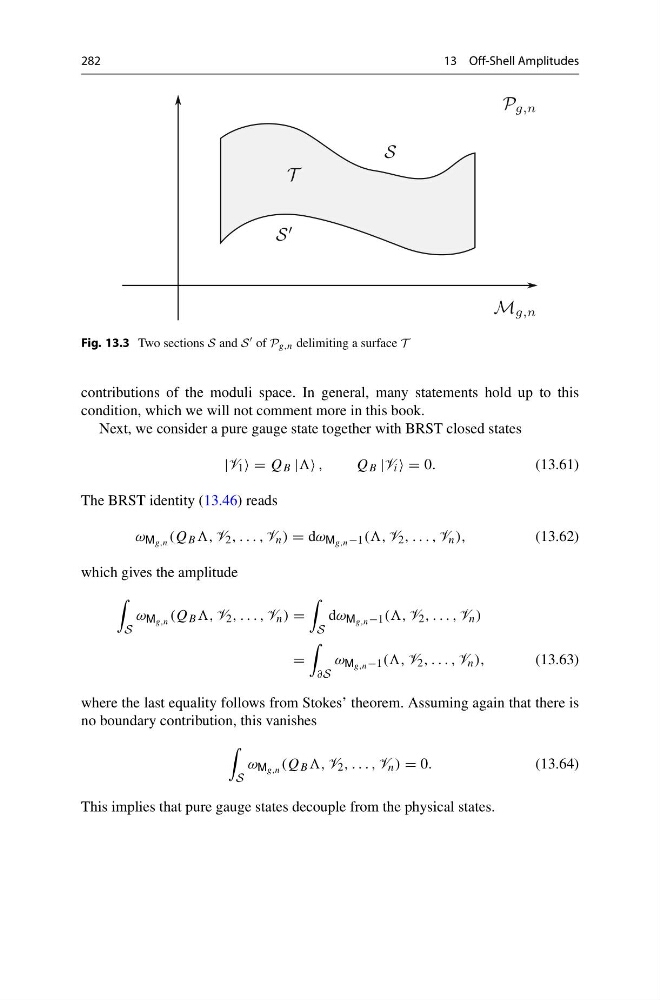
Fig. 13.3 Two sections S and S of P g,n delimiting a surface T
contributions of the moduli space. In general, many statements hold up to this
condition, which we will not comment more in this book.
Next, we consider a pure gauge state together with BRST closed states
|V 1 = Q B | ,
Q B |V i = 0.
(13.61)
The BRST identity (13.46) reads
ω M g,n (Q B , V 2 , . . . , V n ) = dω M g,n −1 ((, V 2 , . . . , V n ),
(13.62)
which gives the amplitude
S
ω M g,n (Q B , V 2 , . . . , V n ) =
S
dω M g,n −1 ((, V 2 , . . . , V n )
=
∂S
ω M g,n −1 ((, V 2 , . . . , V n ),
(13.63)
where the last equality follows from Stokes’ theorem. Assuming again that there is
no boundary contribution, this vanishes
S
ω M g,n (Q B , V 2 , . . . , V n ) = 0.
(13.64)
This implies that pure gauge states decouple from the physical states.
13 Off-Shell Amplitudes
Fig. 13.3 Two sections S and S of P g,n delimiting a surface T
contributions of the moduli space. In general, many statements hold up to this
condition, which we will not comment more in this book.
Next, we consider a pure gauge state together with BRST closed states
|V 1 = Q B | ,
Q B |V i = 0.
(13.61)
The BRST identity (13.46) reads
ω M g,n (Q B , V 2 , . . . , V n ) = dω M g,n −1 ((, V 2 , . . . , V n ),
(13.62)
which gives the amplitude
S
ω M g,n (Q B , V 2 , . . . , V n ) =
S
dω M g,n −1 ((, V 2 , . . . , V n )
=
∂S
ω M g,n −1 ((, V 2 , . . . , V n ),
(13.63)
where the last equality follows from Stokes’ theorem. Assuming again that there is
no boundary contribution, this vanishes
S
ω M g,n (Q B , V 2 , . . . , V n ) = 0.
(13.64)
This implies that pure gauge states decouple from the physical states.