

280
13 Off-Shell Amplitudes
(a)
(b)
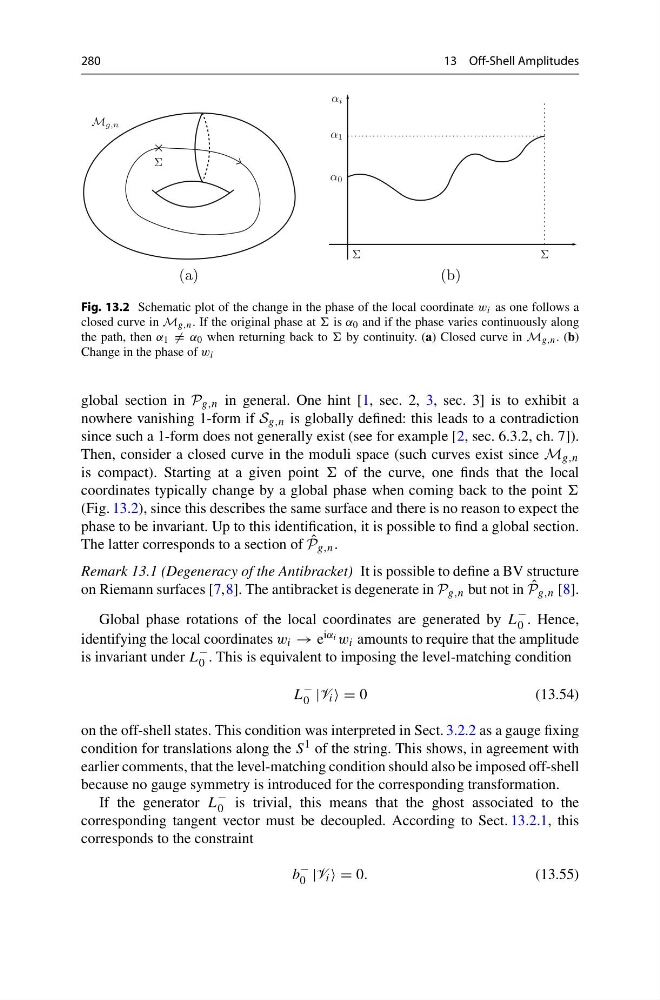
Fig. 13.2 Schematic plot of the change in the phase of the local coordinate w i as one follows a
closed curve in M g,n . If the original phase at is α 0 and if the phase varies continuously along
the path, then α 1 = α 0 when returning back to by continuity. (a) Closed curve in M g,n . (b)
Change in the phase of w i
global section in P g,n in general. One hint [1, sec. 2, 3, sec. 3] is to exhibit a
nowhere vanishing 1-form if S g,n is globally defined: this leads to a contradiction
since such a 1-form does not generally exist (see for example [2, sec. 6.3.2, ch. 7]).
Then, consider a closed curve in the moduli space (such curves exist since M g,n
is compact). Starting at a given point of the curve, one finds that the local
coordinates typically change by a global phase when coming back to the point
(Fig. 13.2), since this describes the same surface and there is no reason to expect the
phase to be invariant. Up to this identification, it is possible to find a global section.
The latter corresponds to a section of ˆ
P g,n .
Remark 13.1 (Degeneracy of the Antibracket) It is possible to define a BV structure
on Riemann surfaces [7,8]. The antibracket is degenerate in P g,n but not in ˆ
P g,n [8].
Global phase rotations of the local coordinates are generated by L
−
0 . Hence,
identifying the local coordinates w i → e iα i w i amounts to require that the amplitude
is invariant under L
−
0 . This is equivalent to imposing the level-matching condition
L
−
0 |V i = 0
(13.54)
on the off-shell states. This condition was interpreted in Sect. 3.2.2 as a gauge fixing
condition for translations along the S 1 of the string. This shows, in agreement with
earlier comments, that the level-matching condition should also be imposed off-shell
because no gauge symmetry is introduced for the corresponding transformation.
If the generator L
−
0 is trivial, this means that the ghost associated to the
corresponding tangent vector must be decoupled. According to Sect. 13.2.1, this
corresponds to the constraint
b
−
0 |V i = 0.
(13.55)
13 Off-Shell Amplitudes
(a)
(b)
Fig. 13.2 Schematic plot of the change in the phase of the local coordinate w i as one follows a
closed curve in M g,n . If the original phase at is α 0 and if the phase varies continuously along
the path, then α 1 = α 0 when returning back to by continuity. (a) Closed curve in M g,n . (b)
Change in the phase of w i
global section in P g,n in general. One hint [1, sec. 2, 3, sec. 3] is to exhibit a
nowhere vanishing 1-form if S g,n is globally defined: this leads to a contradiction
since such a 1-form does not generally exist (see for example [2, sec. 6.3.2, ch. 7]).
Then, consider a closed curve in the moduli space (such curves exist since M g,n
is compact). Starting at a given point of the curve, one finds that the local
coordinates typically change by a global phase when coming back to the point
(Fig. 13.2), since this describes the same surface and there is no reason to expect the
phase to be invariant. Up to this identification, it is possible to find a global section.
The latter corresponds to a section of ˆ
P g,n .
Remark 13.1 (Degeneracy of the Antibracket) It is possible to define a BV structure
on Riemann surfaces [7,8]. The antibracket is degenerate in P g,n but not in ˆ
P g,n [8].
Global phase rotations of the local coordinates are generated by L
−
0 . Hence,
identifying the local coordinates w i → e iα i w i amounts to require that the amplitude
is invariant under L
−
0 . This is equivalent to imposing the level-matching condition
L
−
0 |V i = 0
(13.54)
on the off-shell states. This condition was interpreted in Sect. 3.2.2 as a gauge fixing
condition for translations along the S 1 of the string. This shows, in agreement with
earlier comments, that the level-matching condition should also be imposed off-shell
because no gauge symmetry is introduced for the corresponding transformation.
If the generator L
−
0 is trivial, this means that the ghost associated to the
corresponding tangent vector must be decoupled. According to Sect. 13.2.1, this
corresponds to the constraint
b
−
0 |V i = 0.
(13.55)