

278
13 Off-Shell Amplitudes
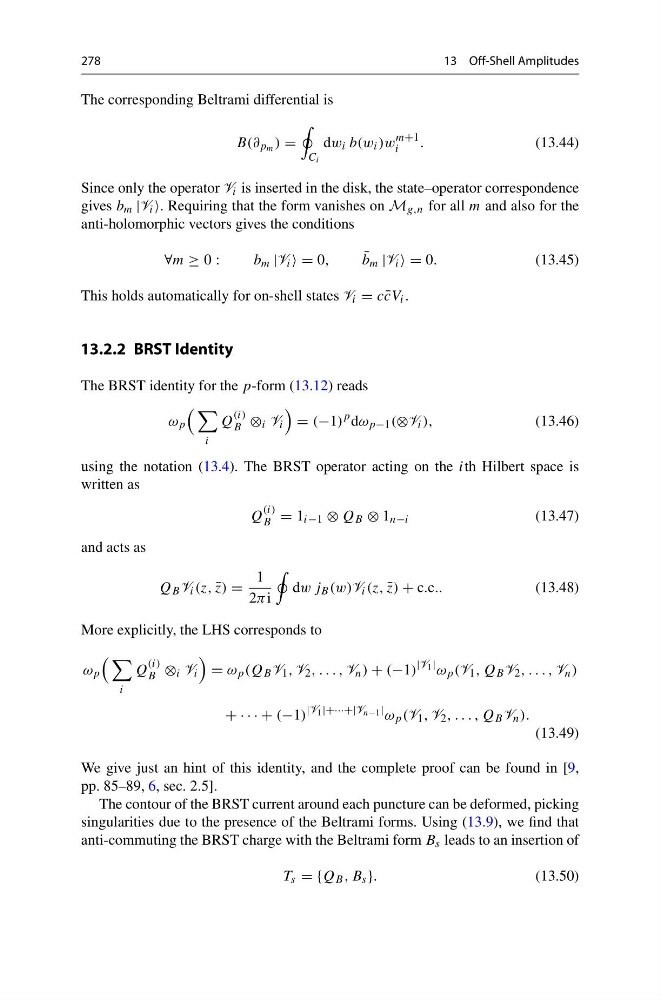
The corresponding Beltrami differential is
B(∂ p m ) =
C i
dw i b(w i )w
m+1
i
.
(13.44)
Since only the operator V i is inserted in the disk, the state–operator correspondence
gives b m |V i . Requiring that the form vanishes on M g,n for all m and also for the
anti-holomorphic vectors gives the conditions
∀m ≥ 0 :
b m |V i = 0,
¯
b m |V i = 0.
(13.45)
This holds automatically for on-shell states V i = c ¯
cV i .
13.2.2 BRST Identity
The BRST identity for the p-form (13.12) reads
ω p
i
Q
(i)
B ⊗ i V i
= (−1)
p dω p−1 (⊗V i ),
(13.46)
using the notation (13.4). The BRST operator acting on the ith Hilbert space is
written as
Q
(i)
B = 1 i−1 ⊗ Q B ⊗ 1 n−i
(13.47)
and acts as
Q B V i (z, ¯
z) =
1
2π i
dw j B (w)V i (z, ¯
z) + c.c..
(13.48)
More explicitly, the LHS corresponds to
ω p
i
Q
(i)
B ⊗ i V i
= ω p (Q B V 1 , V 2 , . . . , V n ) + (−1)
|V 1 | ω p (V 1 , Q B V 2 , . . . , V n )
+ · · · + (−1)
|V 1 |+···+|V n−1 | ω p (V 1 , V 2 , . . . , Q B V n ).
(13.49)
We give just an hint of this identity, and the complete proof can be found in [9,
pp. 85–89, 6, sec. 2.5].
The contour of the BRST current around each puncture can be deformed, picking
singularities due to the presence of the Beltrami forms. Using (13.9), we find that
anti-commuting the BRST charge with the Beltrami form B s leads to an insertion of
T s = {Q B , B s }.
(13.50)
13 Off-Shell Amplitudes
The corresponding Beltrami differential is
B(∂ p m ) =
C i
dw i b(w i )w
m+1
i
.
(13.44)
Since only the operator V i is inserted in the disk, the state–operator correspondence
gives b m |V i . Requiring that the form vanishes on M g,n for all m and also for the
anti-holomorphic vectors gives the conditions
∀m ≥ 0 :
b m |V i = 0,
¯
b m |V i = 0.
(13.45)
This holds automatically for on-shell states V i = c ¯
cV i .
13.2.2 BRST Identity
The BRST identity for the p-form (13.12) reads
ω p
i
Q
(i)
B ⊗ i V i
= (−1)
p dω p−1 (⊗V i ),
(13.46)
using the notation (13.4). The BRST operator acting on the ith Hilbert space is
written as
Q
(i)
B = 1 i−1 ⊗ Q B ⊗ 1 n−i
(13.47)
and acts as
Q B V i (z, ¯
z) =
1
2π i
dw j B (w)V i (z, ¯
z) + c.c..
(13.48)
More explicitly, the LHS corresponds to
ω p
i
Q
(i)
B ⊗ i V i
= ω p (Q B V 1 , V 2 , . . . , V n ) + (−1)
|V 1 | ω p (V 1 , Q B V 2 , . . . , V n )
+ · · · + (−1)
|V 1 |+···+|V n−1 | ω p (V 1 , V 2 , . . . , Q B V n ).
(13.49)
We give just an hint of this identity, and the complete proof can be found in [9,
pp. 85–89, 6, sec. 2.5].
The contour of the BRST current around each puncture can be deformed, picking
singularities due to the presence of the Beltrami forms. Using (13.9), we find that
anti-commuting the BRST charge with the Beltrami form B s leads to an insertion of
T s = {Q B , B s }.
(13.50)