

260
12 Geometry of Moduli Spaces and Riemann Surfaces
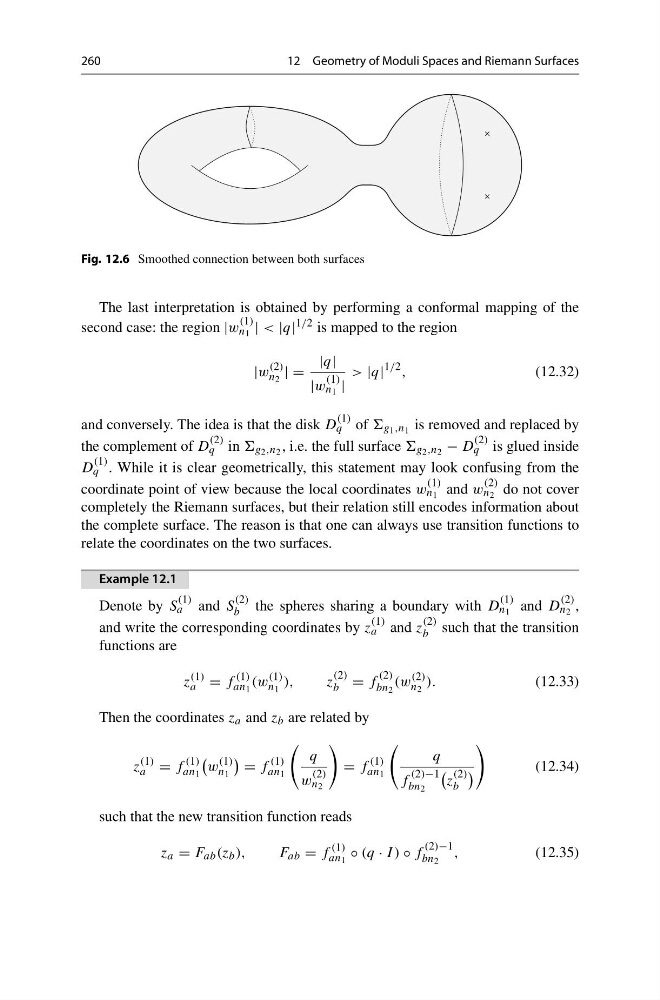
Fig. 12.6 Smoothed connection between both surfaces
The last interpretation is obtained by performing a conformal mapping of the
second case: the region |w
(1)
n 1 | < |q| 1/2 is mapped to the region
|w
(2)
n 2
| =
|q|
|w
(1)
n 1 |
> |q|
1/2 ,
(12.32)
and conversely. The idea is that the disk D
(1)
q of g 1 ,n 1 is removed and replaced by
the complement of D
(2)
q in g 2 ,n 2 , i.e. the full surface g 2 ,n 2 − D
(2)
q is glued inside
D
(1)
q . While it is clear geometrically, this statement may look confusing from the
coordinate point of view because the local coordinates w
(1)
n 1 and w
(2)
n 2 do not cover
completely the Riemann surfaces, but their relation still encodes information about
the complete surface. The reason is that one can always use transition functions to
relate the coordinates on the two surfaces.
Example 12.1
Denote by S
(1)
a and S
(2)
b the spheres sharing a boundary with D
(1)
n 1 and D
(2)
n 2 ,
and write the corresponding coordinates by z
(1)
a and z
(2)
b such that the transition
functions are
z
(1)
a = f
(1)
an 1
(w
(1)
n 1
),
z
(2)
b = f
(2)
bn 2
(w
(2)
n 2
).
(12.33)
Then the coordinates z a and z b are related by
z
(1)
a = f
(1)
an 1
w
(1)
n 1
= f
(1)
an 1
q
w
(2)
n 2
= f
(1)
an 1
q
f
(2)−1
bn 2
z
(2)
b
(12.34)
such that the new transition function reads
z a = F ab (z b ),
F ab = f
(1)
an 1
◦ (q · I ) ◦ f
(2)−1
bn 2
,
(12.35)
12 Geometry of Moduli Spaces and Riemann Surfaces
Fig. 12.6 Smoothed connection between both surfaces
The last interpretation is obtained by performing a conformal mapping of the
second case: the region |w
(1)
n 1 | < |q| 1/2 is mapped to the region
|w
(2)
n 2
| =
|q|
|w
(1)
n 1 |
> |q|
1/2 ,
(12.32)
and conversely. The idea is that the disk D
(1)
q of g 1 ,n 1 is removed and replaced by
the complement of D
(2)
q in g 2 ,n 2 , i.e. the full surface g 2 ,n 2 − D
(2)
q is glued inside
D
(1)
q . While it is clear geometrically, this statement may look confusing from the
coordinate point of view because the local coordinates w
(1)
n 1 and w
(2)
n 2 do not cover
completely the Riemann surfaces, but their relation still encodes information about
the complete surface. The reason is that one can always use transition functions to
relate the coordinates on the two surfaces.
Example 12.1
Denote by S
(1)
a and S
(2)
b the spheres sharing a boundary with D
(1)
n 1 and D
(2)
n 2 ,
and write the corresponding coordinates by z
(1)
a and z
(2)
b such that the transition
functions are
z
(1)
a = f
(1)
an 1
(w
(1)
n 1
),
z
(2)
b = f
(2)
bn 2
(w
(2)
n 2
).
(12.33)
Then the coordinates z a and z b are related by
z
(1)
a = f
(1)
an 1
w
(1)
n 1
= f
(1)
an 1
q
w
(2)
n 2
= f
(1)
an 1
q
f
(2)−1
bn 2
z
(2)
b
(12.34)
such that the new transition function reads
z a = F ab (z b ),
F ab = f
(1)
an 1
◦ (q · I ) ◦ f
(2)−1
bn 2
,
(12.35)