

216
10 Free BRST String Field Theory
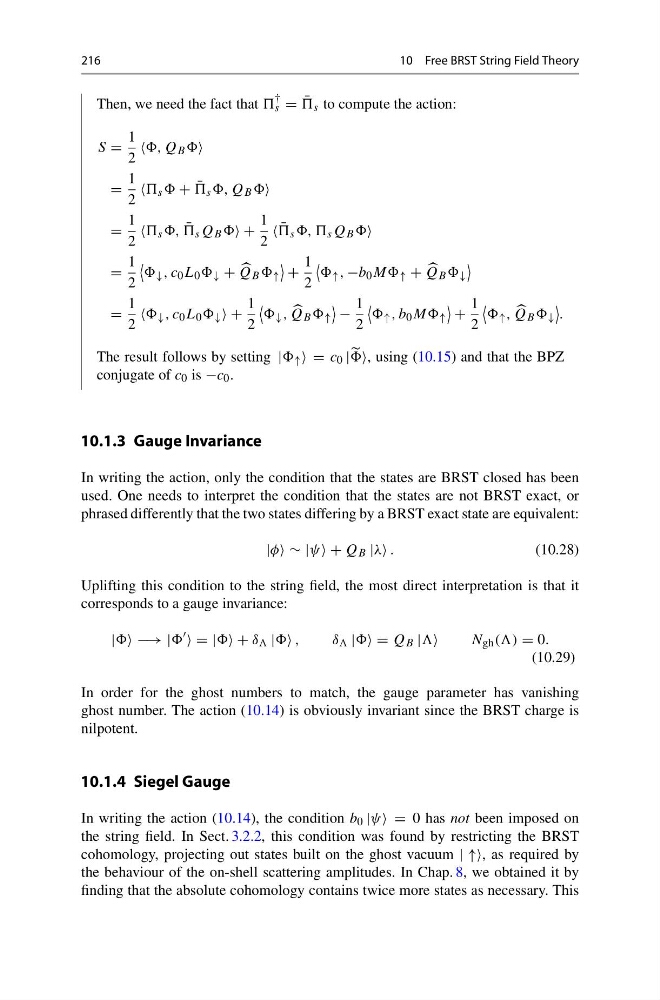
Then, we need the fact that
†
s = ¯
s to compute the action:
S =
1
2
Q B
=
1
2
s + ¯
s Q B
=
1
2
s , ¯
s Q B +
1
2
¯
s , s Q B
=
1
2
↓ , c 0 L 0 ↓ +
Q B ↑
+
1
2
↑ , −b 0 MM ↑ +
Q B ↓
=
1
2
↓ , c 0 L 0 ↓ +
1
2
↓ ,
Q B ↑
−
1
2
↑ , b 0 MM ↑
+
1
2
↑ ,
Q B ↓
.
The result follows by setting | ↑ = c 0 |
, using (10.15) and that the BPZ
conjugate of c 0 is −c 0 .
10.1.3 Gauge Invariance
In writing the action, only the condition that the states are BRST closed has been
used. One needs to interpret the condition that the states are not BRST exact, or
phrased differently that the two states differing by a BRST exact state are equivalent:
|φ ∼ |ψ + Q B |λ .
(10.28)
Uplifting this condition to the string field, the most direct interpretation is that it
corresponds to a gauge invariance:
| −→ |
= | + δ | ,
δ | = Q B |
N gh (() = 0.
(10.29)
In order for the ghost numbers to match, the gauge parameter has vanishing
ghost number. The action (10.14) is obviously invariant since the BRST charge is
nilpotent.
10.1.4 Siegel Gauge
In writing the action (10.14), the condition b 0 |ψ = 0 has not been imposed on
the string field. In Sect. 3.2.2, this condition was found by restricting the BRST
cohomology, projecting out states built on the ghost vacuum | ↑↑, as required by
the behaviour of the on-shell scattering amplitudes. In Chap. 8, we obtained it by
finding that the absolute cohomology contains twice more states as necessary. This
10 Free BRST String Field Theory
Then, we need the fact that
†
s = ¯
s to compute the action:
S =
1
2
Q B
=
1
2
s + ¯
s Q B
=
1
2
s , ¯
s Q B +
1
2
¯
s , s Q B
=
1
2
↓ , c 0 L 0 ↓ +
Q B ↑
+
1
2
↑ , −b 0 MM ↑ +
Q B ↓
=
1
2
↓ , c 0 L 0 ↓ +
1
2
↓ ,
Q B ↑
−
1
2
↑ , b 0 MM ↑
+
1
2
↑ ,
Q B ↓
.
The result follows by setting | ↑ = c 0 |
, using (10.15) and that the BPZ
conjugate of c 0 is −c 0 .
10.1.3 Gauge Invariance
In writing the action, only the condition that the states are BRST closed has been
used. One needs to interpret the condition that the states are not BRST exact, or
phrased differently that the two states differing by a BRST exact state are equivalent:
|φ ∼ |ψ + Q B |λ .
(10.28)
Uplifting this condition to the string field, the most direct interpretation is that it
corresponds to a gauge invariance:
| −→ |
= | + δ | ,
δ | = Q B |
N gh (() = 0.
(10.29)
In order for the ghost numbers to match, the gauge parameter has vanishing
ghost number. The action (10.14) is obviously invariant since the BRST charge is
nilpotent.
10.1.4 Siegel Gauge
In writing the action (10.14), the condition b 0 |ψ = 0 has not been imposed on
the string field. In Sect. 3.2.2, this condition was found by restricting the BRST
cohomology, projecting out states built on the ghost vacuum | ↑↑, as required by
the behaviour of the on-shell scattering amplitudes. In Chap. 8, we obtained it by
finding that the absolute cohomology contains twice more states as necessary. This