

212
10 Free BRST String Field Theory
showing how these can be found from the worldsheet formalism, we will study the
case of the point-particle to fix ideas and notations.
10.1.1 Warm-Up: Point-Particle
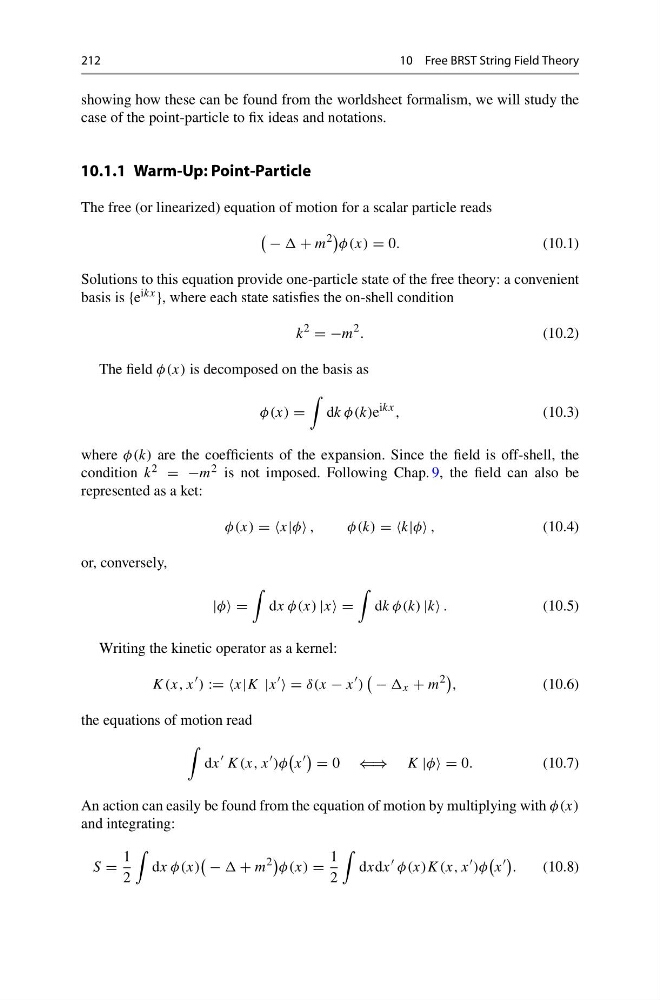
The free (or linearized) equation of motion for a scalar particle reads
− + m
2
φ(x) = 0.
(10.1)
Solutions to this equation provide one-particle state of the free theory: a convenient
basis is {e ikx }, where each state satisfies the on-shell condition
k
2
= −m
2 .
(10.2)
The field φ(x) is decomposed on the basis as
φ(x) =
dk φ(k)e
ikx ,
(10.3)
where φ(k) are the coefficients of the expansion. Since the field is off-shell, the
condition k 2 = −m 2 is not imposed. Following Chap. 9, the field can also be
represented as a ket:
φ(x) = =x|φ ,
φ(k)= =k|φ ,
(10.4)
or, conversely,
|φ =
dx φ(x) |x =
dk φ(k) |k .
(10.5)
Writing the kinetic operator as a kernel:
K(x, x
) := =x|K |x
= δ(x − x
)
− x + m
2
,
(10.6)
the equations of motion read
dx
K(x, x
)φ
x
= 0 ⇐⇒ K |φ = 0.
(10.7)
An action can easily be found from the equation of motion by multiplying with φ(x)
and integrating:
S =
1
2
dx φ(x)
− + m
2
φ(x) =
1
2
dxdx
φ(x)K(x, x
)φ
x
.
(10.8)
10 Free BRST String Field Theory
showing how these can be found from the worldsheet formalism, we will study the
case of the point-particle to fix ideas and notations.
10.1.1 Warm-Up: Point-Particle
The free (or linearized) equation of motion for a scalar particle reads
− + m
2
φ(x) = 0.
(10.1)
Solutions to this equation provide one-particle state of the free theory: a convenient
basis is {e ikx }, where each state satisfies the on-shell condition
k
2
= −m
2 .
(10.2)
The field φ(x) is decomposed on the basis as
φ(x) =
dk φ(k)e
ikx ,
(10.3)
where φ(k) are the coefficients of the expansion. Since the field is off-shell, the
condition k 2 = −m 2 is not imposed. Following Chap. 9, the field can also be
represented as a ket:
φ(x) = =x|φ ,
φ(k)= =k|φ ,
(10.4)
or, conversely,
|φ =
dx φ(x) |x =
dk φ(k) |k .
(10.5)
Writing the kinetic operator as a kernel:
K(x, x
) := =x|K |x
= δ(x − x
)
− x + m
2
,
(10.6)
the equations of motion read
dx
K(x, x
)φ
x
= 0 ⇐⇒ K |φ = 0.
(10.7)
An action can easily be found from the equation of motion by multiplying with φ(x)
and integrating:
S =
1
2
dx φ(x)
− + m
2
φ(x) =
1
2
dxdx
φ(x)K(x, x
)φ
x
.
(10.8)