

198
8 BRST Quantization
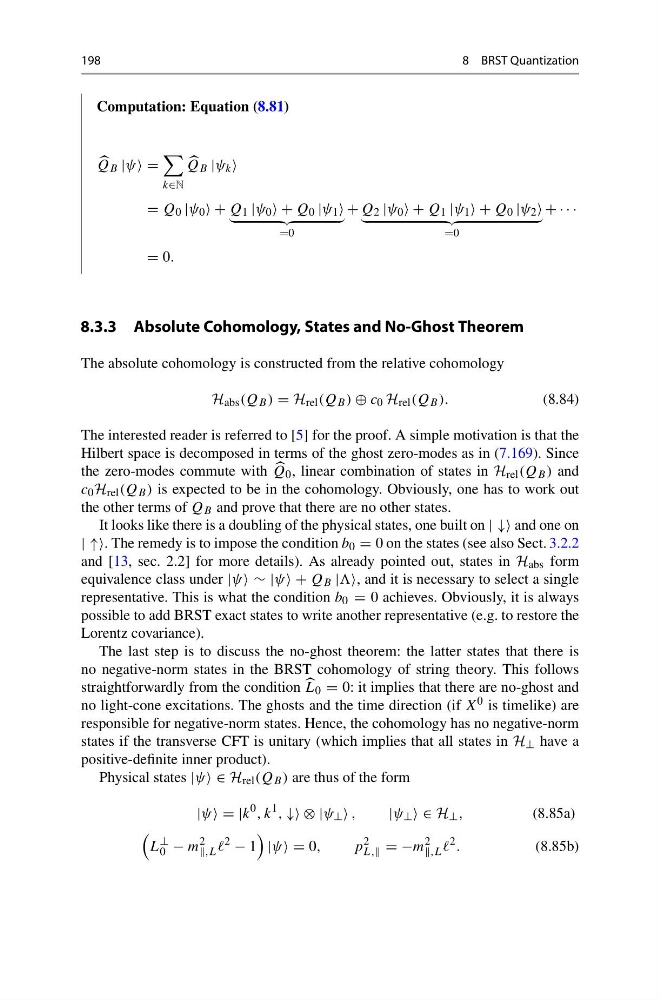
Computation: Equation (8.81)
Q B |ψ =
k∈N
Q B |ψ k
= Q 0 |ψ 0 + Q 1 |ψ 0 + Q 0 |ψ 1
=0
+ Q 2 |ψ 0 + Q 1 |ψ 1 + Q 0 |ψ 2
=0
+ · · ·
= 0.
8.3.3 Absolute Cohomology, States and No-Ghost Theorem
The absolute cohomology is constructed from the relative cohomology
H abs (Q B ) = H rel (Q B ) ⊕ c 0 H rel (Q B ).
(8.84)
The interested reader is referred to [5] for the proof. A simple motivation is that the
Hilbert space is decomposed in terms of the ghost zero-modes as in (7.169). Since
the zero-modes commute with
Q 0 , linear combination of states in H rel (Q B ) and
c 0 H rel (Q B ) is expected to be in the cohomology. Obviously, one has to work out
the other terms of Q B and prove that there are no other states.
It looks like there is a doubling of the physical states, one built on | ↓↓ and one on
| ↑↑. The remedy is to impose the condition b 0 = 0 on the states (see also Sect. 3.2.2
and [13, sec. 2.2] for more details). As already pointed out, states in H abs form
equivalence class under |ψ ∼ |ψ + Q B |, and it is necessary to select a single
representative. This is what the condition b 0 = 0 achieves. Obviously, it is always
possible to add BRST exact states to write another representative (e.g. to restore the
Lorentz covariance).
The last step is to discuss the no-ghost theorem: the latter states that there is
no negative-norm states in the BRST cohomology of string theory. This follows
straightforwardly from the condition
L 0 = 0: it implies that there are no-ghost and
no light-cone excitations. The ghosts and the time direction (if X 0 is timelike) are
responsible for negative-norm states. Hence, the cohomology has no negative-norm
states if the transverse CFT is unitary (which implies that all states in H ⊥ have a
positive-definite inner product).
Physical states |ψ ∈ H rel (Q B ) are thus of the form
|ψ = |k
0 , k
1 , ↓↓ ⊗ |ψ ⊥ ,
|ψ ⊥ ∈ H ⊥ ,
(8.85a)
L
⊥
0 − m
2
,L
2
− 1
|ψ = 0,
p
2
L, = −m
2
,L
2 .
(8.85b)
8 BRST Quantization
Computation: Equation (8.81)
Q B |ψ =
k∈N
Q B |ψ k
= Q 0 |ψ 0 + Q 1 |ψ 0 + Q 0 |ψ 1
=0
+ Q 2 |ψ 0 + Q 1 |ψ 1 + Q 0 |ψ 2
=0
+ · · ·
= 0.
8.3.3 Absolute Cohomology, States and No-Ghost Theorem
The absolute cohomology is constructed from the relative cohomology
H abs (Q B ) = H rel (Q B ) ⊕ c 0 H rel (Q B ).
(8.84)
The interested reader is referred to [5] for the proof. A simple motivation is that the
Hilbert space is decomposed in terms of the ghost zero-modes as in (7.169). Since
the zero-modes commute with
Q 0 , linear combination of states in H rel (Q B ) and
c 0 H rel (Q B ) is expected to be in the cohomology. Obviously, one has to work out
the other terms of Q B and prove that there are no other states.
It looks like there is a doubling of the physical states, one built on | ↓↓ and one on
| ↑↑. The remedy is to impose the condition b 0 = 0 on the states (see also Sect. 3.2.2
and [13, sec. 2.2] for more details). As already pointed out, states in H abs form
equivalence class under |ψ ∼ |ψ + Q B |, and it is necessary to select a single
representative. This is what the condition b 0 = 0 achieves. Obviously, it is always
possible to add BRST exact states to write another representative (e.g. to restore the
Lorentz covariance).
The last step is to discuss the no-ghost theorem: the latter states that there is
no negative-norm states in the BRST cohomology of string theory. This follows
straightforwardly from the condition
L 0 = 0: it implies that there are no-ghost and
no light-cone excitations. The ghosts and the time direction (if X 0 is timelike) are
responsible for negative-norm states. Hence, the cohomology has no negative-norm
states if the transverse CFT is unitary (which implies that all states in H ⊥ have a
positive-definite inner product).
Physical states |ψ ∈ H rel (Q B ) are thus of the form
|ψ = |k
0 , k
1 , ↓↓ ⊗ |ψ ⊥ ,
|ψ ⊥ ∈ H ⊥ ,
(8.85a)
L
⊥
0 − m
2
,L
2
− 1
|ψ = 0,
p
2
L, = −m
2
,L
2 .
(8.85b)