

8.3 BRST Cohomology: Two Flat Directions
189
8.3.1 Conditions on the States
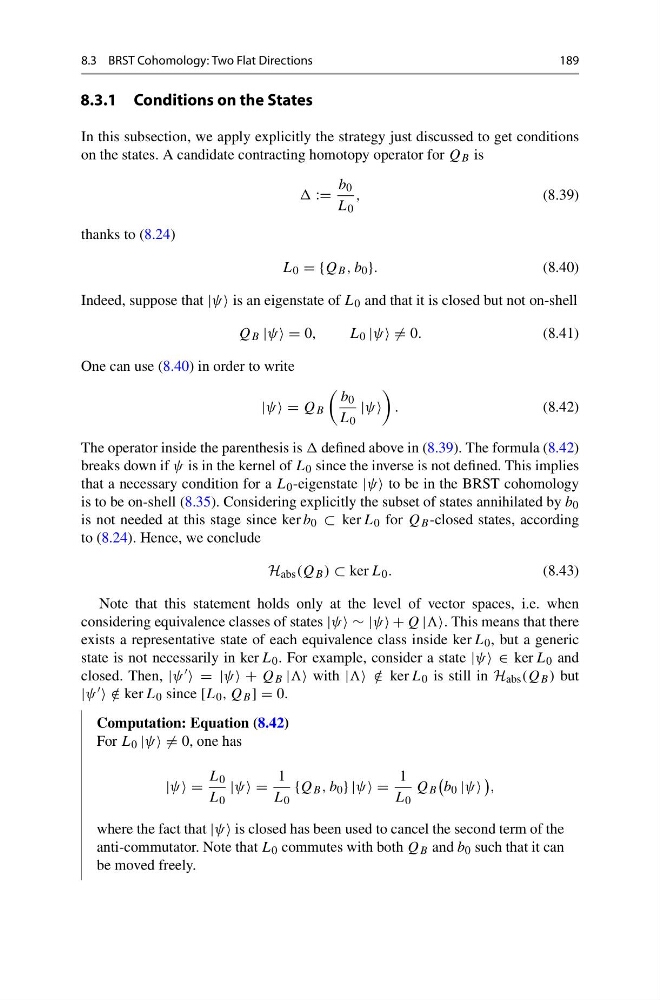
In this subsection, we apply explicitly the strategy just discussed to get conditions
on the states. A candidate contracting homotopy operator for Q B is
:=
b 0
L 0
,
(8.39)
thanks to (8.24)
L 0 = {Q B , b 0 }.
(8.40)
Indeed, suppose that |ψ is an eigenstate of L 0 and that it is closed but not on-shell
Q B |ψ = 0,
L 0 |ψ = 0.
(8.41)
One can use (8.40) in order to write
|ψ = Q B
b 0
L 0
|ψ
.
(8.42)
The operator inside the parenthesis is defined above in (8.39). The formula (8.42)
breaks down if ψ is in the kernel of L 0 since the inverse is not defined. This implies
that a necessary condition for a L 0 -eigenstate |ψ to be in the BRST cohomology
is to be on-shell (8.35). Considering explicitly the subset of states annihilated by b 0
is not needed at this stage since ker b 0 ⊂ ker L 0 for Q B -closed states, according
to (8.24). Hence, we conclude
H abs (Q B ) ⊂ ker L 0 .
(8.43)
Note that this statement holds only at the level of vector spaces, i.e. when
considering equivalence classes of states |ψ ∼ |ψ + Q |. This means that there
exists a representative state of each equivalence class inside ker L 0 , but a generic
state is not necessarily in ker L 0 . For example, consider a state |ψ ∈ ker L 0 and
closed. Then, |ψ = |ψ + Q B | with | /
∈ ker L 0 is still in H abs (Q B ) but
|ψ /
∈ ker L 0 since [L 0 , Q B ] = 0.
Computation: Equation (8.42)
For L 0 |ψ = 0, one has
|ψ =
L 0
L 0
|ψ =
1
L 0
{Q B , b 0 } |ψ =
1
L 0
Q B
b 0 |ψ
,
where the fact that |ψ is closed has been used to cancel the second term of the
anti-commutator. Note that L 0 commutes with both Q B and b 0 such that it can
be moved freely.
189
8.3.1 Conditions on the States
In this subsection, we apply explicitly the strategy just discussed to get conditions
on the states. A candidate contracting homotopy operator for Q B is
:=
b 0
L 0
,
(8.39)
thanks to (8.24)
L 0 = {Q B , b 0 }.
(8.40)
Indeed, suppose that |ψ is an eigenstate of L 0 and that it is closed but not on-shell
Q B |ψ = 0,
L 0 |ψ = 0.
(8.41)
One can use (8.40) in order to write
|ψ = Q B
b 0
L 0
|ψ
.
(8.42)
The operator inside the parenthesis is defined above in (8.39). The formula (8.42)
breaks down if ψ is in the kernel of L 0 since the inverse is not defined. This implies
that a necessary condition for a L 0 -eigenstate |ψ to be in the BRST cohomology
is to be on-shell (8.35). Considering explicitly the subset of states annihilated by b 0
is not needed at this stage since ker b 0 ⊂ ker L 0 for Q B -closed states, according
to (8.24). Hence, we conclude
H abs (Q B ) ⊂ ker L 0 .
(8.43)
Note that this statement holds only at the level of vector spaces, i.e. when
considering equivalence classes of states |ψ ∼ |ψ + Q |. This means that there
exists a representative state of each equivalence class inside ker L 0 , but a generic
state is not necessarily in ker L 0 . For example, consider a state |ψ ∈ ker L 0 and
closed. Then, |ψ = |ψ + Q B | with | /
∈ ker L 0 is still in H abs (Q B ) but
|ψ /
∈ ker L 0 since [L 0 , Q B ] = 0.
Computation: Equation (8.42)
For L 0 |ψ = 0, one has
|ψ =
L 0
L 0
|ψ =
1
L 0
{Q B , b 0 } |ψ =
1
L 0
Q B
b 0 |ψ
,
where the fact that |ψ is closed has been used to cancel the second term of the
anti-commutator. Note that L 0 commutes with both Q B and b 0 such that it can
be moved freely.