

184
8 BRST Quantization
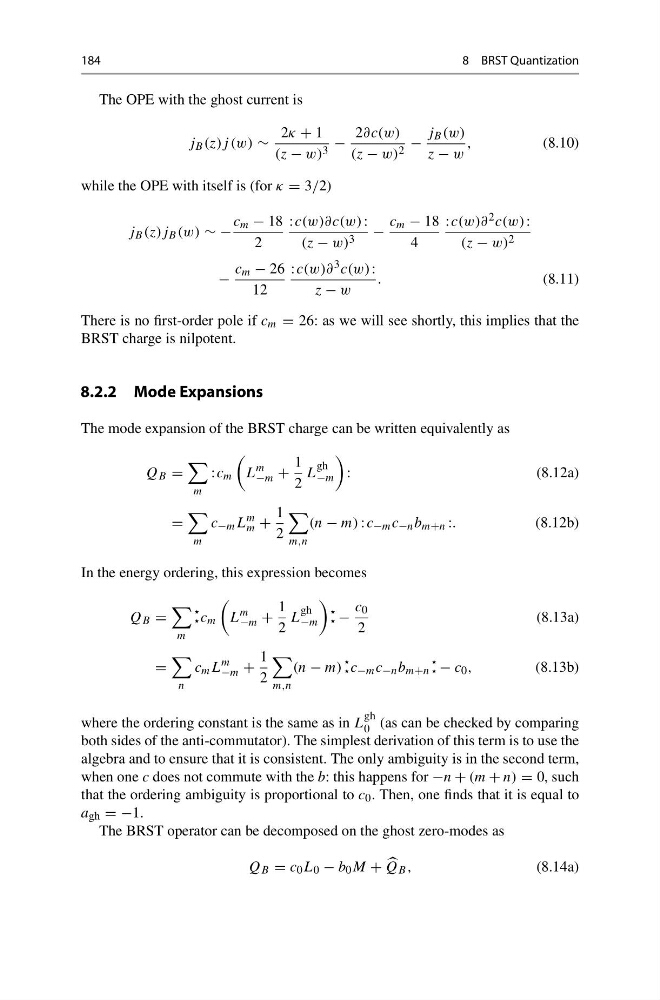
The OPE with the ghost current is
j B (z)j (w) ∼
2κ + 1
(z − w) 3 −
2∂c(w)
(z − w) 2 −
j B (w)
z − w
,
(8.10)
while the OPE with itself is (for κ = 3/2)
j B (z)j B (w) ∼ −
c m − 18
2
: c(w)∂c(w) :
(z − w) 3 −
c m − 18
4
: c(w)∂ 2 c(w) :
(z − w) 2
−
c m − 26
12
: c(w)∂ 3 c(w) :
z − w
.
(8.11)
There is no first-order pole if c m = 26: as we will see shortly, this implies that the
BRST charge is nilpotent.
8.2.2 Mode Expansions
The mode expansion of the BRST charge can be written equivalently as
Q B =
m
: c m
L
m
−m +
1
2
L
gh
−m
:
(8.12a)
=
m
c −m L
m
m +
1
2
m,n
(n − m) : c −m c −n b m+n :.
(8.12b)
In the energy ordering, this expression becomes
Q B =
m
c m
L
m
−m +
1
2
L
gh
−m
−
c 0
2
(8.13a)
=
n
c m L
m
−m +
1
2
m,n
(n − m)
c −m c −n b m+n
− c 0 ,
(8.13b)
where the ordering constant is the same as in L
gh
0 (as can be checked by comparing
both sides of the anti-commutator). The simplest derivation of this term is to use the
algebra and to ensure that it is consistent. The only ambiguity is in the second term,
when one c does not commute with the b: this happens for −n + (m + n) = 0, such
that the ordering ambiguity is proportional to c 0 . Then, one finds that it is equal to
a gh = −1.
The BRST operator can be decomposed on the ghost zero-modes as
Q B = c 0 L 0 − b 0 M +
Q B ,
(8.14a)
8 BRST Quantization
The OPE with the ghost current is
j B (z)j (w) ∼
2κ + 1
(z − w) 3 −
2∂c(w)
(z − w) 2 −
j B (w)
z − w
,
(8.10)
while the OPE with itself is (for κ = 3/2)
j B (z)j B (w) ∼ −
c m − 18
2
: c(w)∂c(w) :
(z − w) 3 −
c m − 18
4
: c(w)∂ 2 c(w) :
(z − w) 2
−
c m − 26
12
: c(w)∂ 3 c(w) :
z − w
.
(8.11)
There is no first-order pole if c m = 26: as we will see shortly, this implies that the
BRST charge is nilpotent.
8.2.2 Mode Expansions
The mode expansion of the BRST charge can be written equivalently as
Q B =
m
: c m
L
m
−m +
1
2
L
gh
−m
:
(8.12a)
=
m
c −m L
m
m +
1
2
m,n
(n − m) : c −m c −n b m+n :.
(8.12b)
In the energy ordering, this expression becomes
Q B =
m
c m
L
m
−m +
1
2
L
gh
−m
−
c 0
2
(8.13a)
=
n
c m L
m
−m +
1
2
m,n
(n − m)
c −m c −n b m+n
− c 0 ,
(8.13b)
where the ordering constant is the same as in L
gh
0 (as can be checked by comparing
both sides of the anti-commutator). The simplest derivation of this term is to use the
algebra and to ensure that it is consistent. The only ambiguity is in the second term,
when one c does not commute with the b: this happens for −n + (m + n) = 0, such
that the ordering ambiguity is proportional to c 0 . Then, one finds that it is equal to
a gh = −1.
The BRST operator can be decomposed on the ghost zero-modes as
Q B = c 0 L 0 − b 0 M +
Q B ,
(8.14a)