

7.2 First-Order bc Ghost System
179
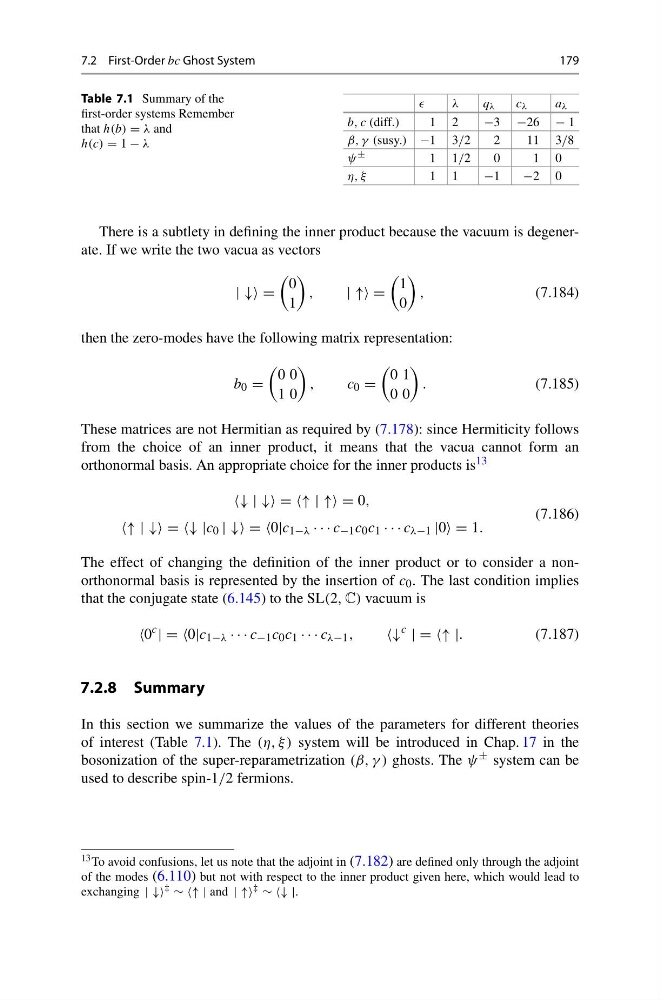
Table 7.1 Summary of the
first-order systems Remember
that h(b) = λ and
h(c) = 1 − λ
λ
q λ
c λ
a λ
b, c (diff.)
1 2
−3 −26 − 1
β, γ (susy.) −1 3/2
2
11 3/8
ψ ±
1 1/2
0
1 0
η, ξ
1 1
−1
−2 0
There is a subtlety in defining the inner product because the vacuum is degenerate. If we write the two vacua as vectors
| ↓↓ =
0
1
,
| ↑↑ =
1
0
,
(7.184)
then the zero-modes have the following matrix representation:
b 0 =
0 0
1 0
,
c 0 =
0 1
0 0
.
(7.185)
These matrices are not Hermitian as required by (7.178): since Hermiticity follows
from the choice of an inner product, it means that the vacua cannot form an
orthonormal basis. An appropriate choice for the inner products is 13
↓ | ↓↓ = =↑ | ↑↑ = 0,
| ↓↓ = =↓ |c 0 | ↓↓ = =0|c 1−λ · · · c −1 c 0 c 1 · · · c λ−1 |0 = 1.
(7.186)
The effect of changing the definition of the inner product or to consider a nonorthonormal basis is represented by the insertion of c 0 . The last condition implies
that the conjugate state (6.145) to the SL(2, C) vacuum is
0
c
| = =0|c 1−λ · · · c −1 c 0 c 1 · · · c λ−1 ,
↓
c
| = =↑ |.
(7.187)
7.2.8 Summary
In this section we summarize the values of the parameters for different theories
of interest (Table 7.1). The (η, ξ ) system will be introduced in Chap. 17 in the
bosonization of the super-reparametrization (β, γ ) ghosts. The ψ ± system can be
used to describe spin-1/2 fermions.
13 To avoid confusions, let us note that the adjoint in (7.182) are defined only through the adjoint
of the modes (6.110) but not with respect to the inner product given here, which would lead to
exchanging | ↓↓ ‡ ∼ ∼↑ | and | ↑↑ ‡ ∼ ∼↓ |.
179
Table 7.1 Summary of the
first-order systems Remember
that h(b) = λ and
h(c) = 1 − λ
λ
q λ
c λ
a λ
b, c (diff.)
1 2
−3 −26 − 1
β, γ (susy.) −1 3/2
2
11 3/8
ψ ±
1 1/2
0
1 0
η, ξ
1 1
−1
−2 0
There is a subtlety in defining the inner product because the vacuum is degenerate. If we write the two vacua as vectors
| ↓↓ =
0
1
,
| ↑↑ =
1
0
,
(7.184)
then the zero-modes have the following matrix representation:
b 0 =
0 0
1 0
,
c 0 =
0 1
0 0
.
(7.185)
These matrices are not Hermitian as required by (7.178): since Hermiticity follows
from the choice of an inner product, it means that the vacua cannot form an
orthonormal basis. An appropriate choice for the inner products is 13
↓ | ↓↓ = =↑ | ↑↑ = 0,
| ↓↓ = =↓ |c 0 | ↓↓ = =0|c 1−λ · · · c −1 c 0 c 1 · · · c λ−1 |0 = 1.
(7.186)
The effect of changing the definition of the inner product or to consider a nonorthonormal basis is represented by the insertion of c 0 . The last condition implies
that the conjugate state (6.145) to the SL(2, C) vacuum is
0
c
| = =0|c 1−λ · · · c −1 c 0 c 1 · · · c λ−1 ,
↓
c
| = =↑ |.
(7.187)
7.2.8 Summary
In this section we summarize the values of the parameters for different theories
of interest (Table 7.1). The (η, ξ ) system will be introduced in Chap. 17 in the
bosonization of the super-reparametrization (β, γ ) ghosts. The ψ ± system can be
used to describe spin-1/2 fermions.
13 To avoid confusions, let us note that the adjoint in (7.182) are defined only through the adjoint
of the modes (6.110) but not with respect to the inner product given here, which would lead to
exchanging | ↓↓ ‡ ∼ ∼↑ | and | ↑↑ ‡ ∼ ∼↓ |.