

7.2 First-Order bc Ghost System
177
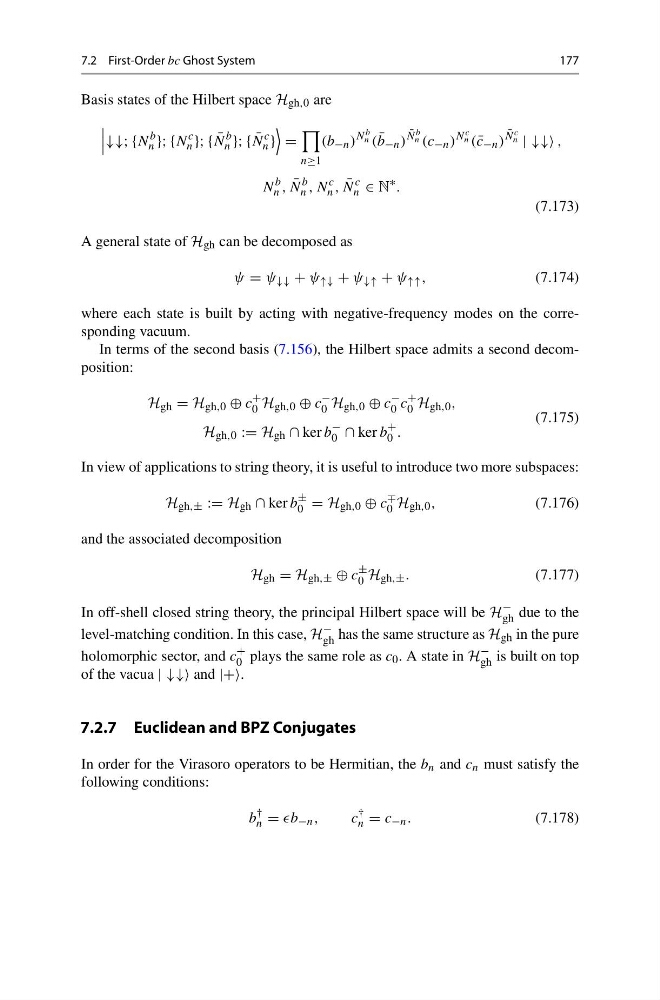
Basis states of the Hilbert space H gh,0 are
↓↓; {N
b
n }; {N
c
n }; { ¯
N
b
n }; { ¯
N
c
n }
=
n≥1
(b −n )
N b
n ( ¯
b −n )
¯
N b
n (c −n )
N c
n ( ¯
c −n )
¯
N c
n | ↓↓↓ ,
N
b
n , ¯
N
b
n , N
c
n , ¯
N
c
n ∈ N
∗ .
(7.173)
A general state of H gh can be decomposed as
ψ = ψ ↓↓ + ψ ↑↓ + ψ ↓↑ + ψ ↑↑ ,
(7.174)
where each state is built by acting with negative-frequency modes on the corresponding vacuum.
In terms of the second basis (7.156), the Hilbert space admits a second decomposition:
H gh = H gh,0 ⊕ c
+
0 H gh,0 ⊕ c
−
0 H gh,0 ⊕ c
−
0 c
+
0 H gh,0 ,
H gh,0 := H gh ∩ ker b
−
0 ∩ ker b
+
0 .
(7.175)
In view of applications to string theory, it is useful to introduce two more subspaces:
H gh,± := H gh ∩ ker b
±
0 = H gh,0 ⊕ c
∓
0 H gh,0 ,
(7.176)
and the associated decomposition
H gh = H gh,± ⊕ c
±
0 H gh,± .
(7.177)
In off-shell closed string theory, the principal Hilbert space will be H
−
gh due to the
level-matching condition. In this case, H
−
gh has the same structure as H gh in the pure
holomorphic sector, and c
+
0 plays the same role as c 0 . A state in H
−
gh is built on top
of the vacua | ↓↓↓ and |++.
7.2.7 Euclidean and BPZ Conjugates
In order for the Virasoro operators to be Hermitian, the b n and c n must satisfy the
following conditions:
b
†
n = b −n ,
c
†
n = c −n .
(7.178)
177
Basis states of the Hilbert space H gh,0 are
↓↓; {N
b
n }; {N
c
n }; { ¯
N
b
n }; { ¯
N
c
n }
=
n≥1
(b −n )
N b
n ( ¯
b −n )
¯
N b
n (c −n )
N c
n ( ¯
c −n )
¯
N c
n | ↓↓↓ ,
N
b
n , ¯
N
b
n , N
c
n , ¯
N
c
n ∈ N
∗ .
(7.173)
A general state of H gh can be decomposed as
ψ = ψ ↓↓ + ψ ↑↓ + ψ ↓↑ + ψ ↑↑ ,
(7.174)
where each state is built by acting with negative-frequency modes on the corresponding vacuum.
In terms of the second basis (7.156), the Hilbert space admits a second decomposition:
H gh = H gh,0 ⊕ c
+
0 H gh,0 ⊕ c
−
0 H gh,0 ⊕ c
−
0 c
+
0 H gh,0 ,
H gh,0 := H gh ∩ ker b
−
0 ∩ ker b
+
0 .
(7.175)
In view of applications to string theory, it is useful to introduce two more subspaces:
H gh,± := H gh ∩ ker b
±
0 = H gh,0 ⊕ c
∓
0 H gh,0 ,
(7.176)
and the associated decomposition
H gh = H gh,± ⊕ c
±
0 H gh,± .
(7.177)
In off-shell closed string theory, the principal Hilbert space will be H
−
gh due to the
level-matching condition. In this case, H
−
gh has the same structure as H gh in the pure
holomorphic sector, and c
+
0 plays the same role as c 0 . A state in H
−
gh is built on top
of the vacua | ↓↓↓ and |++.
7.2.7 Euclidean and BPZ Conjugates
In order for the Virasoro operators to be Hermitian, the b n and c n must satisfy the
following conditions:
b
†
n = b −n ,
c
†
n = c −n .
(7.178)