

166
7 CFT Systems
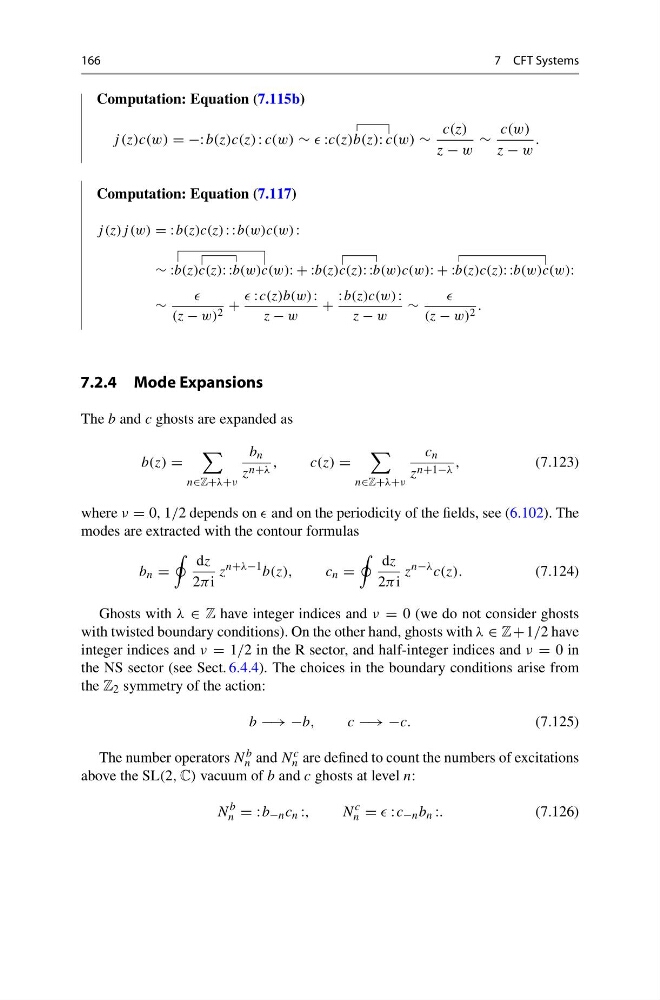
Computation: Equation (7.115b)
j (z)c(w) = −:b(z)c(z) : c(w) ∼ :c(z)b(z): c(w) ∼
c(z)
z − w
∼
c(w)
z − w
.
Computation: Equation (7.117)
j (z)j (w) = :b(z)c(z) : :b(w)c(w) :
∼ :b(z)c(z): :b(w)c(w): + :b(z)c(z): :b(w)c(w): + :b(z)c(z): :b(w)c(w):
∼
(z − w) 2 +
: c(z)b(w) :
z − w
+
: b(z)c(w) :
z − w
∼
(z − w) 2 .
7.2.4 Mode Expansions
The b and c ghosts are expanded as
b(z) =
n∈Z+λ+ν
b n
z n+λ ,
c(z)=
n∈Z+λ+ν
c n
z n+1−λ ,
(7.123)
where ν = 0, 1/2 depends on and on the periodicity of the fields, see (6.102). The
modes are extracted with the contour formulas
b n =
dz
2π i
z
n+λ−1 b(z),
c n =
dz
2π i
z
n−λ c(z).
(7.124)
Ghosts with λ ∈ Z have integer indices and ν = 0 (we do not consider ghosts
with twisted boundary conditions). On the other hand, ghosts with λ ∈ Z+1/2 have
integer indices and ν = 1/2 in the R sector, and half-integer indices and ν = 0 in
the NS sector (see Sect. 6.4.4). The choices in the boundary conditions arise from
the Z 2 symmetry of the action:
b −→ −b,
c −→ −c.
(7.125)
The number operators N b
n and N c
n are defined to count the numbers of excitations
above the SL(2, C) vacuum of b and c ghosts at level n:
N
b
n = :b −n c n :,
N
c
n = : c −n b n :.
(7.126)
7 CFT Systems
Computation: Equation (7.115b)
j (z)c(w) = −:b(z)c(z) : c(w) ∼ :c(z)b(z): c(w) ∼
c(z)
z − w
∼
c(w)
z − w
.
Computation: Equation (7.117)
j (z)j (w) = :b(z)c(z) : :b(w)c(w) :
∼ :b(z)c(z): :b(w)c(w): + :b(z)c(z): :b(w)c(w): + :b(z)c(z): :b(w)c(w):
∼
(z − w) 2 +
: c(z)b(w) :
z − w
+
: b(z)c(w) :
z − w
∼
(z − w) 2 .
7.2.4 Mode Expansions
The b and c ghosts are expanded as
b(z) =
n∈Z+λ+ν
b n
z n+λ ,
c(z)=
n∈Z+λ+ν
c n
z n+1−λ ,
(7.123)
where ν = 0, 1/2 depends on and on the periodicity of the fields, see (6.102). The
modes are extracted with the contour formulas
b n =
dz
2π i
z
n+λ−1 b(z),
c n =
dz
2π i
z
n−λ c(z).
(7.124)
Ghosts with λ ∈ Z have integer indices and ν = 0 (we do not consider ghosts
with twisted boundary conditions). On the other hand, ghosts with λ ∈ Z+1/2 have
integer indices and ν = 1/2 in the R sector, and half-integer indices and ν = 0 in
the NS sector (see Sect. 6.4.4). The choices in the boundary conditions arise from
the Z 2 symmetry of the action:
b −→ −b,
c −→ −c.
(7.125)
The number operators N b
n and N c
n are defined to count the numbers of excitations
above the SL(2, C) vacuum of b and c ghosts at level n:
N
b
n = :b −n c n :,
N
c
n = : c −n b n :.
(7.126)