

7.2 First-Order bc Ghost System
161
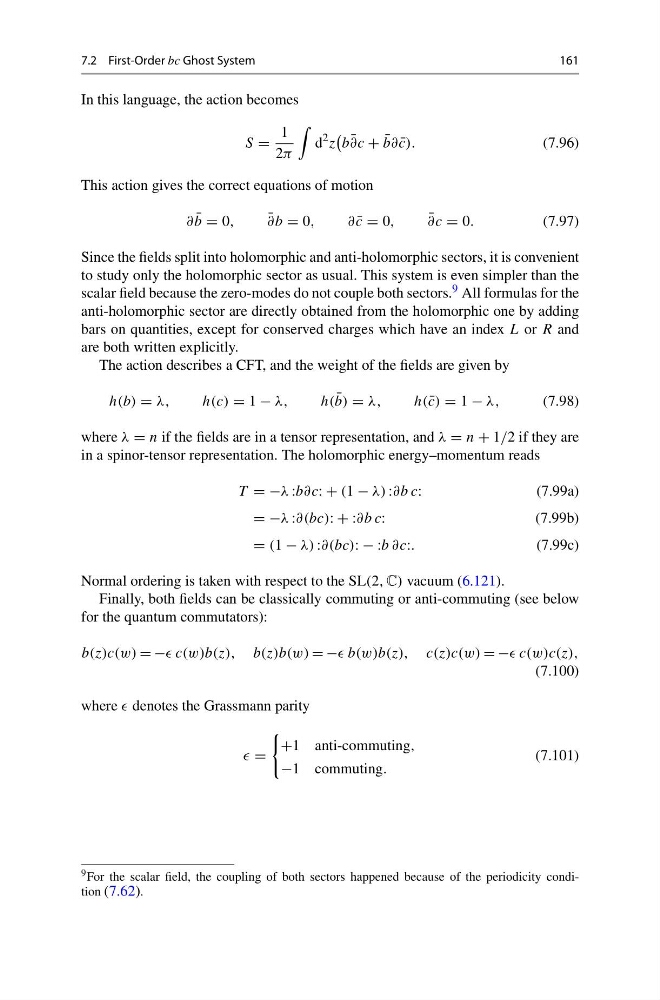
In this language, the action becomes
S =
1
2π
d
2 z
b ¯
∂c + ¯
b∂ ¯
c).
(7.96)
This action gives the correct equations of motion
∂ ¯
b = 0,
¯
∂b = 0,
∂¯ c = 0,
¯
∂c = 0.
(7.97)
Since the fields split into holomorphic and anti-holomorphic sectors, it is convenient
to study only the holomorphic sector as usual. This system is even simpler than the
scalar field because the zero-modes do not couple both sectors. 9 All formulas for the
anti-holomorphic sector are directly obtained from the holomorphic one by adding
bars on quantities, except for conserved charges which have an index L or R and
are both written explicitly.
The action describes a CFT, and the weight of the fields are given by
h(b) = λ,
h(c) = 1 − λ,
h( ¯
b) = λ,
h( ¯
c) = 1 − λ,
(7.98)
where λ = n if the fields are in a tensor representation, and λ = n + 1/2 if they are
in a spinor-tensor representation. The holomorphic energy–momentum reads
T = −λ :b∂c: + (1 − λ) :∂b c:
(7.99a)
= −λ :∂(bc): + :∂b c:
(7.99b)
= (1 − λ) :∂(bc): − :b ∂c:.
(7.99c)
Normal ordering is taken with respect to the SL(2, C) vacuum (6.121).
Finally, both fields can be classically commuting or anti-commuting (see below
for the quantum commutators):
b(z)c(w) = − c(w)b(z), b(z)b(w) = − b(w)b(z), c(z)c(w) = − c(w)c(z),
(7.100)
where denotes the Grassmann parity
=
+1 anti-commuting,
−1 commuting.
(7.101)
9 For the scalar field, the coupling of both sectors happened because of the periodicity condition (7.62).
161
In this language, the action becomes
S =
1
2π
d
2 z
b ¯
∂c + ¯
b∂ ¯
c).
(7.96)
This action gives the correct equations of motion
∂ ¯
b = 0,
¯
∂b = 0,
∂¯ c = 0,
¯
∂c = 0.
(7.97)
Since the fields split into holomorphic and anti-holomorphic sectors, it is convenient
to study only the holomorphic sector as usual. This system is even simpler than the
scalar field because the zero-modes do not couple both sectors. 9 All formulas for the
anti-holomorphic sector are directly obtained from the holomorphic one by adding
bars on quantities, except for conserved charges which have an index L or R and
are both written explicitly.
The action describes a CFT, and the weight of the fields are given by
h(b) = λ,
h(c) = 1 − λ,
h( ¯
b) = λ,
h( ¯
c) = 1 − λ,
(7.98)
where λ = n if the fields are in a tensor representation, and λ = n + 1/2 if they are
in a spinor-tensor representation. The holomorphic energy–momentum reads
T = −λ :b∂c: + (1 − λ) :∂b c:
(7.99a)
= −λ :∂(bc): + :∂b c:
(7.99b)
= (1 − λ) :∂(bc): − :b ∂c:.
(7.99c)
Normal ordering is taken with respect to the SL(2, C) vacuum (6.121).
Finally, both fields can be classically commuting or anti-commuting (see below
for the quantum commutators):
b(z)c(w) = − c(w)b(z), b(z)b(w) = − b(w)b(z), c(z)c(w) = − c(w)c(z),
(7.100)
where denotes the Grassmann parity
=
+1 anti-commuting,
−1 commuting.
(7.101)
9 For the scalar field, the coupling of both sectors happened because of the periodicity condition (7.62).